





Establishing a personal rapport with clients is a primary concern for many organizations, but the issue remains: how? Including a case study is a proven approach for demonstrating how your product or service functions, allowing potential buyers to envision themselves using it through real-life instances.
However, what exactly is a case study in a professional context, and how does one write it? This tutorial provides information on what they are, when they can be helpful, and how to create one independently. We also offer a couple of professional case studies as examples that you may use as a reference.
What is a formally case study?
A case study is a marketing tool that presents a real-life example of how a product or service has helped a consumer. Marketers utilize these longer articles to enhance the appeal of their product or service. They do this by explaining their function and supplying evidence demonstrating their effectiveness. A formal case study can have varying lengths and formats as long as it focuses on the central theme: a genuine account of a customer's successful use of your product or service.
The phrase professional case study is derived from a research case study, a technique of experimentation that focuses on one unique instance instead of several cases with more significant sample sizes.
Advantages of a case study
Are you in need of a case study? It varies based on your business and branding objectives. If you need help with any of the topics mentioned below, incorporating a case study into your website, social media, or other public outreach efforts could be beneficial.
Social evidence
Case studies effectively provide social evidence, particularly if you have a well-known client or consumer. Social evidence demonstrates to customers that their peers already appreciate your products or services, helping to alleviate any concerns or hesitations. There is much to be said regarding the psychology of social proof, but in essence, individuals are more inclined to purchase a product or service that they view as famous.
Responding to client inquiries
Every customer has issues or concerns, and it's difficult to predict them in marketing copywriting. An example can provide solutions or insights to some problems by describing how the product or service functions.
Building expertise
Usually, case studies positively showcase your organization by adequately resolving a problem for the specific consumer highlighted. This assists the customer in perceiving you as an expert, further demonstrating why your product or service may benefit them.
Showing the procedure
When a customer clearly understands what they might anticipate from a purchase, they are more inclined to make a purchase. A case study provides an overview of your firm, demonstrating the procedures involved in a service or the correct way to use a product. In both situations, the case study presents a distinct sequence of actions or experiences for the consumer to envision what it might be like to conduct business together.
Comparison between case study and white paper
A case study is frequently confused with a white paper, another commonly used marketing document. While they have commonalities, they are two separate forms of copywriting.
A case study is a factual account of a specific client. In contrast, a white paper is a comprehensive document providing information and guidance on a relevant company sector. White papers are utilized in lead generation to attract new clients and increase brand visibility. Usually, users must provide their email address to access a white paper.
7 steps to write an effective case study
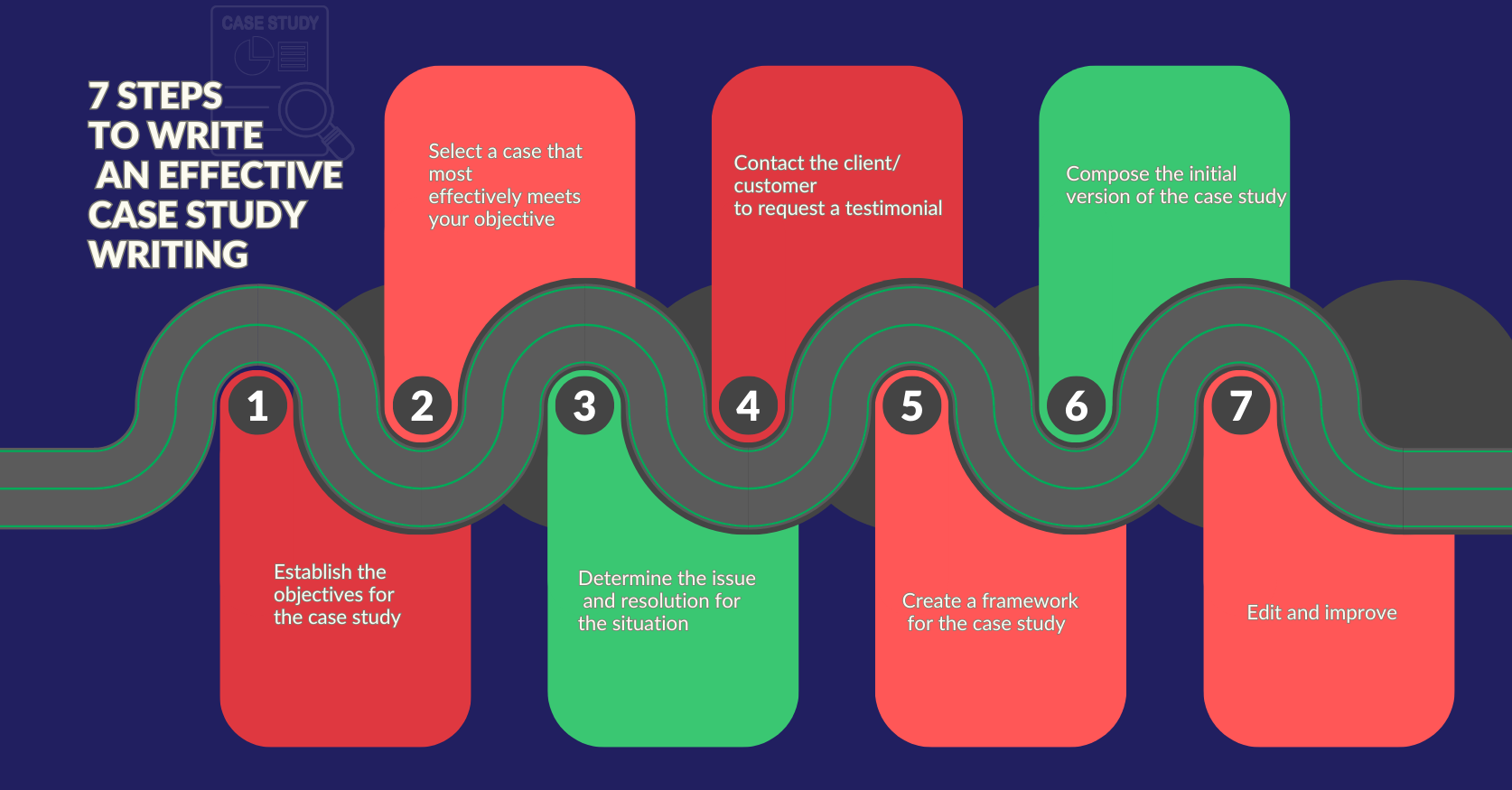
1. Establish the objectives for the case study
You may create a formal case study from any perspective to showcase any facet of your organization, making them versatile. That is why it is essential to establish the objectives of the case study as your initial step to have a clear direction to follow.
A case study can serve as a call to action, an additional advertisement, or even guidance on how to do something. It can also emphasize your company's advantages, impact how your brand is seen, or address typical issues and worries. Before beginning your writing, thoroughly consider the objectives you wish to achieve with your case study.
2. Select a case that most effectively meets your objective
Once you understand the primary objective of your professional case study, you may identify the "case" that is most suitable. Of course, select a success story that positively presents your firm—but the specific success story you choose depends on the topic you want to discuss.
Look through previous clients or consumers to see if their cases inspire you. Consider the facts and your connection with that customer; you will have to seek their consent to disclose the narrative.
3. Determine the issue and resolution for the situation
The two critical components of a case study are the issue and resolution. You should select a narrative addressing a typical problem that numerous readers can identify with, along with a resolution tailored to your company's product or service.
Creating a problem statement is beneficial since it effectively and succinctly conveys the problem. Take into account your market research and the kind of issues that the majority of your target audience has in common.
The solution should align with your value proposition, a brief statement about the advantages of your products or services. Including your value proposition somewhere in the case study is very advised.
4. Contact the client/customer to request a testimonial
Adding a testimonial is consistently a wise choice for professional case studies. Firstly, witnessing a quote in the authentic words of a consumer improves the social evidence. Furthermore, it confirms the authenticity of the story.
Contacting the customer in the early stages is beneficial, as they will probably require some time to reply. Furthermore, kindly get their consent to share the tale and ask for a brief endorsement that showcases your company. Assure them it doesn't have to be lengthy—just a short paragraph of two or three sentences will be enough.
5. Create a framework for the case study
Case studies use a structure similar to other texts to create an overview, but they are adjusted to suit your business objectives. Organize which sections to include and which precise facts to discuss, such as where to put your problem statement, value proposition, customer testimonial, and numbers and data.
Divisions are essential in professional case studies to divide lengthy lines of text into manageable portions (we apply the same concepts for professional blog writing). Usually, you can have a category for each procedure step, such as "meeting with the client" or "conducting market research." Alternatively, you can utilize elementary divisions to address the problem and solution.
To begin, it is beneficial to start with a section that introduces the consumer (their identity and occupation) and the issue that your products or services ultimately resolve.
6. Compose the initial version of the case study
Creating the initial version requires adhering to the structure and incorporating all the specific characteristics and components you prearranged. Like most initial versions, don't stress clear word selection or wording too much. You can improve that later when you edit.
Gather a sufficient amount of numbers and information to both promote sales and substantiate your assertions. If you're having difficulty, you can also receive help from AI copywriting. Although AI technology still needs to be mature enough to copy and paste AI-generated case studies directly without any modifications, it can assist by offering suggestions for structure and wording when facing difficulties.
7. Edit and improve
Now that the initial version is complete, it's time to review and modify it. Now that most of the writing is finished, you can concentrate on the specifics, such as selecting the right words and expressions and making any necessary structural modifications (such as relocating, adding, or removing sections). Once you have completed the changes and are content with your draft, the last step is proofreading to address any spelling and grammar mistakes.
Grammarly is quite helpful at this stage. Firstly, the free version can effortlessly detect spelling and grammatical mistakes, making proofreading effortless. You can utilize our complimentary online grammar checker to observe its functionality. By subscribing to Grammarly Premium, you may benefit from features like whole-sentence revisions, tone suggestions, and word choice advice that enhance the professionalism of your writing.
Conclusion
In conclusion, mastering the art of writing a practical case study is crucial for anyone looking to showcase success stories, highlight expertise, and engage their audience. By following the guidelines outlined in this guide, from defining your objectives and selecting a compelling subject to crafting a structured narrative and emphasizing results, you can create a case study that captivates readers and serves as a powerful tool for marketing and communication. Remember to balance detail and clarity, employ a conversational tone, and incorporate relevant keywords to enhance your case study's discoverability. Regularly updating and optimizing your case studies with fresh content will contribute to their long-term effectiveness in attracting and retaining your target audience. As you refine your case study writing skills, you'll discover the immense impact it can have on building credibility, fostering trust, and ultimately driving success for your clients and your business.
Learn more: AI Journey
