




The secret to hitting your sales targets is utilizing the power of a well-written call to action. You can write for as long as you like on a subject, but if you don't include a call to action (CTA), customers might never take advantage of the chance you present.
A call to action (CTA) is a strategic marketing tactic that is intended to get an immediate response from viewers and turn them from observers into participants. It's the process of getting your audience to support the objectives of your company or campaign.
Think of this as your manual for negotiating the complex world of CTAs. After going over the fundamentals of CTAs, we'll provide a detailed guide on how to write effective prompts. Finally, we'll present some CTA examples.
1. What is a call to action?
A call to action is a brief statement intended to elicit a prompt response from the audience and direct them toward a particular course of action. A call to action is a strategic marketing tactic that can encourage an audience to buy something, sign up for a service, or interact with content.
A call to action (CTA) is primarily used to transform people from passive bystanders into active participants whose activities align with the company's or campaign's objectives. CTAs are essential for increasing conversions and engagement because they generate a sense of urgency, clarify the desired action, and highlight its benefits.
2. When to utilize a call to action (CTA)?
A call to action, sometimes abbreviated as CTA, can be expressed in a number of ways, such as compelling language or clickable buttons. They are used in marketing collateral such as emails, social media posts, websites, and ads.
CTAs work well in the majority of marketing channels. Because of their widespread usage, call to action (CTA) language and placement should be customized to the particular context and intended user action. A thoughtfully designed and well-positioned call to action (CTA) can significantly increase user engagement and assist you in reaching your objectives.
Here's where CTAs are frequently used by marketers:
| Website landing pages |
| Blog posts and articles |
| Email marketing |
| Social media posts |
| Product pages |
| Pop-up forms |
| Videos |
| Printed materials |
| Online advertisements |
| Exit intent pop-ups |
Where marketers commonly use CTAs: Button text, headers, subject lines, body copy, and practically anything text-based can all have a call to action (CTA).
3. CTA Types
According to a company's or marketing campaign's objectives, each kind fulfills a specific function in attracting people and encouraging targeted behavior.
CTAs with a direct action
Take direct action CTAs formally ask visitors to perform a particular, quick action. This kind of call to action is frequently used in email marketing, sales pages, ads, and the conclusion of cover letters. "Buy Now," "Subscribe Today," and "Make an Appointment" are a few examples.
CTAs with information
CTAs that provide information encourage consumers to learn more about a campaign, concept, service, or product. These could lead to a sales page or blog. "Learn More," "Read the Guide," and "Explore the Features" are a few examples.
CTAs for social media sharing
A social media exchange Users are urged by CTA to share content on social media. This call to action is frequently seen in blogs, podcasts, and newsletters. "Share With Your Network," "Repost This TikTok," and "Pin It" are a few examples.
CTAs for feedback
Feedback CTAs prompt users to share their thoughts and reviews or participate in surveys. When a recipient of a business email unsubscribes, terminates a free trial, purchases a product, or listens to a podcast, these are frequently used to request feedback. "Leave a Review," "Take a Survey," and "Tell Us What You Think" are a few examples.
Customized Calls to Action
Personalized CTAs adapt dynamically to the user's choices, actions, and demographics. They frequently have the user's initial name on them. "Your Exclusive Offer Awaits," "Recommended for You," and "Tailored Just for You" are a few examples.
4. Write a CTA: A Guide with 9 Tips
Carefully evaluating language, placement, and audience relevance is necessary when crafting a solid call to action. This is a step-by-step method to help you write compelling calls to action.
1. Recognize your audience
Determine the needs, preferences, and pain areas of your target audience. Next, consider why they desire to carry out your requested activity. What advantages would it offer them?
2. Specify your objective
Give a clear description of the precise action you want your audience to perform. A single, unambiguous aim, whether sharing information, completing a purchase, or joining up, is essential.
3. Use language that can be put into action.
Use verbs that compel action. Use an action verb, such as "Shop," "Subscribe," "Explore," or "Join," at the beginning of your call to action to encourage quick action.
4. Establish a sense of urgency
Create a sense of urgency to motivate quick decision-making. Countdowns, limited-quantity offers, and limited-time offers are examples of urgency strategies.
5. Emphasize advantages
Think about conveying the advantages of performing the intended action before you create your call to action. Describe how it will benefit the user or address a concern. Use these advantages to inform your CTA writing or briefly mention them in the CTA.
6. Be brief and straightforward
Keep your call to action brief and uncomplicated. To help customers quickly understand what is expected, omit superfluous details or filler words.
7. Place firmly
Put your CTA in a prominent location for easy viewing. It works well after an article, as a large button on a website, or as two or three buttons inside an email.
8. Evaluate and repeat
A/B test several iterations of your call to action (CTA) to see which best connects with your target audience. The most effective CTAs are created by examining performance indicators and iteratively improving strategies to achieve the best outcomes.
9. Be constant
Content to call to action should flow naturally and logically from one another. Ensure that the language and brand voice used in both are consistent by starting with your content.
5. 50 CTA illustrations
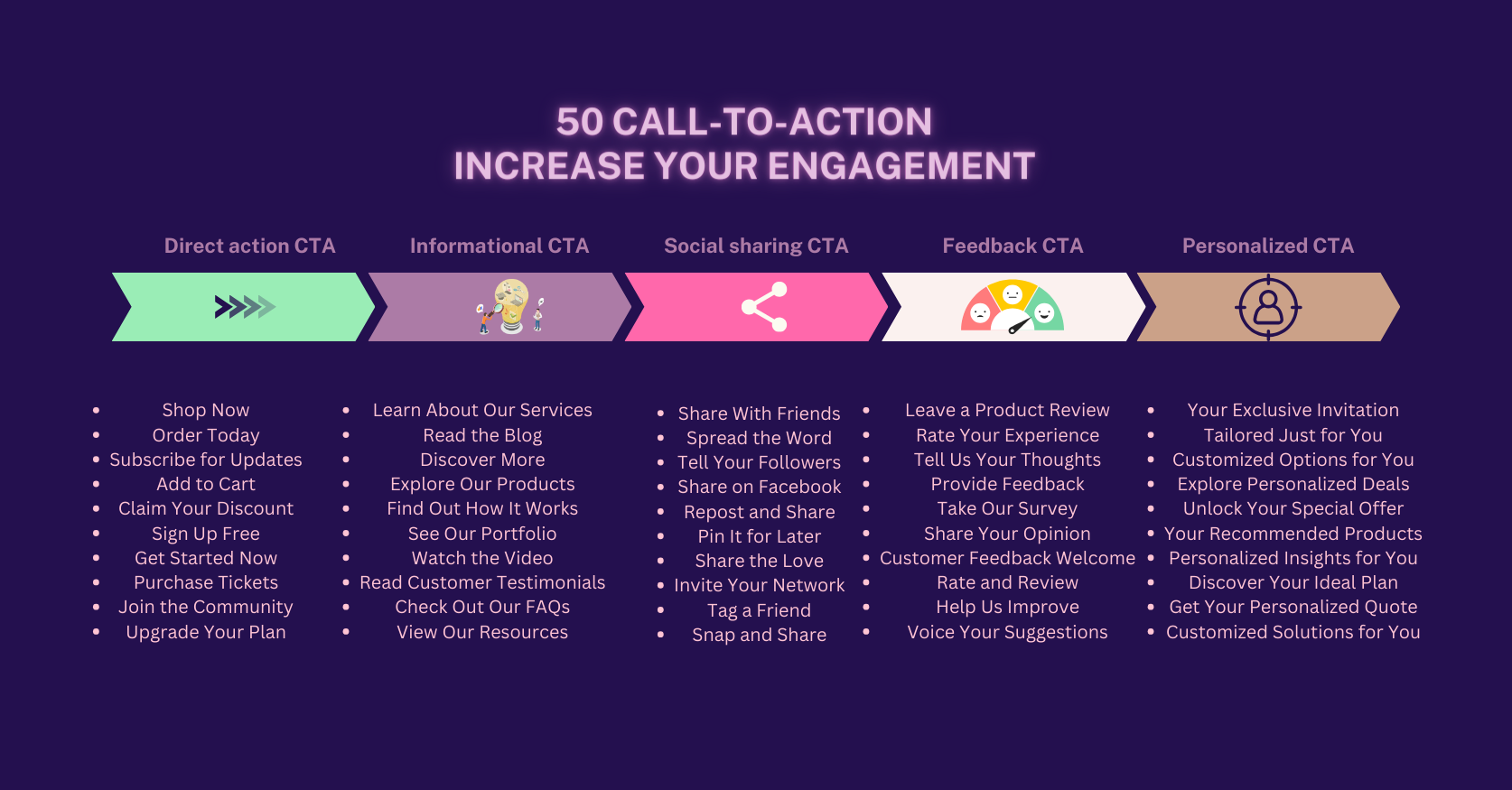
Direct action CTA examples
| 1. Shop Now | 6. Sign Up Free |
| 2. Order Today | 7. Get Started Now |
| 3. Subscribe for Updates | 8. Purchase Tickets |
| 4. Add to Cart | 9. Join the Community |
| 5. Claim Your Discount | 10. Upgrade Your Plan |
Informational CTA examples
| 1. Learn About Our Services | 6. See Our Portfolio |
| 2. Read the Blog | 7. Watch the Video |
| 3. Discover More | 8. Read Customer Testimonials |
| 4. Explore Our Products | 9. Check Out Our FAQs |
| 5. Explore Our Products | 10. View Our Resources |
Social sharing CTA examples
| 1. Share With Friends | 6. Pin It for Later |
| 2. Spread the Word | 7. Share the Love |
| 3. Tell Your Followers | 8. Invite Your Network |
| 4. Share on Facebook | 9. Tag a Friend |
| 5. Repost and Share | 10. Snap and Share |
Feedback CTA examples
| 1. Leave a Product Review | 6. Share Your Opinion |
| 2. Rate Your Experience | 7. Customer Feedback Welcome |
| 3. Tell Us Your Thoughts | 8. Rate and Review |
| 4. Provide Feedback | 9. Help Us Improve |
| 5. Take Our Survey | 10. Voice Your Suggestions |
Personalized CTA examples
| 1. Your Exclusive Invitation | 6. Your Recommended Products |
| 2. Tailored Just for You | 7. Personalized Insights for You |
| 3. Customized Options for You | 8. Discover Your Ideal Plan |
| 4. Explore Personalized Deals | 9. Get Your Personalized Quote |
| 5. Unlock Your Special Offer | 10. Customized Solutions for You |
Conclusion
In conclusion, anyone looking to increase engagement, conversions, and overall success in the digital space must master the art of creating powerful calls to action. You now have a solid arsenal for writing CTAs that connect with your audience, motivate action, and improve your online presence, thanks to these 50 suggestions and examples. Always remember that the secret is knowing your audience, being concise but convincing, and testing and refining your ideas until you find what works best for your objectives. So go ahead and put these methods into practice, try out some new tactics, and see how your calls to action become effective drivers of meaningful interactions and conversions. Cheers to creating call-to-actions (CTAs) that enthrall, convert, and elevate your online business!
Learn more : AI Journey
