




Have you ever considered contacting the writer or potential employer you admire without making it uncomfortable? The solution is to compose a considerate, formal, cold email.
However, cold does not imply rigidity. These are emails you send to individuals you have yet to meet personally who may assist you in your job search, offer a freelance opportunity, or facilitate an engaging partnership. Think of it as the online equivalent of creating a first impression at a networking event.
Here, we will discuss how to compose a powerful cold email, and we will include suggestions for enhancing your emails and examples that can serve as templates for your cold emails.
What does the term "cold email" mean?
An unsolicited email is a method to establish contact with individuals or companies whom you have yet to meet personally. These emails serve as initial introductions and are referred to as cold emails since they are distinct from warm or hot leads, which involve some level of prior connection or existing relationship. Cold emails are usually sent to people or groups you have not contacted.
Individuals send unsolicited emails to market items, investigate employment possibilities, establish professional relationships, or advertise events. The challenging aspect is capturing the other individual's attention and eliciting a good response. Effective cold emails are typically brief and customized, offering something of worth to the receiver.
When is the ideal moment to send a cold email?
Cold emails are an effective strategy to initiate a professional or academic connection. Here are seven methods to utilize a cold email:
1. Seeking employment/opportunity for work experience
2. Potential clients
3. Connect with professionals in the industry
4. Promotion of events
5. Seek information or expertise
6. Independent work possibilities
7. Working together with other companies
5 simple steps to sending a cold email
Cold emails should be engaging, customized, and actionable. Here are the five ways to make a good impression in a cold email.
Step 1: Make it personal
Ensure that your email is sent from a familiar and appropriate address. Avoid utilizing alternative names or usernames that are too intricate. Personalize your message for the particular recipient. Please include a specific detail about them or their work to demonstrate that you have conducted research.
Step 2: Create an engaging opening
Compose a subject line that generates interest, acknowledges a problem, or briefly explains the purpose of your email. Make it brief and captivating. For instance, "Freelance Writer available on LinkedIn" or "Would you like to be a guest on my podcast?" Next, start your email with a brief and captivating opening sentence. You can add a nice comment, a shared hobby, or a short self-introduction. Be polite and concise.
Step 3: Offer precise details and worth
In the content of your email, express the worth you offer. Regardless of talents, insights, or a product/service, demonstrate how it can immediately benefit the recipient.
Utilize specific instances or stories of achievement while maintaining brevity and a clear focus in your message. Individuals frequently skim over emails. Therefore, it is advisable to be concise. Avoid using superfluous technical terms, and be direct in your speech.
Step 4: Request what you desire
Conclude your email with a plain CTA ( CALL-TO-ACTION) This may say something like "I would be happy to meet with you if you have the time; here is the link to my scheduling tool," or "Would you like to collaborate?" Please respond to this email to begin," or "Are you planning to attend? Please respond at this link''.
Step 5: End your message in a formal manner
Use a pleasant closing to end your email. Attempt to retain a formal yet friendly tone throughout the communication. In that manner, you will prevent coming out as either formal or excessively casual. Find a middle ground that matches the style of your email and the person you are sending it to.
Seven tips for sending a cold email
Are you prepared to send your initial unsolicited email? Remember these suggestions for optimal outcomes.
1. Time for sending
Based on research conducted by Siege Media, the optimal time to send a cold email is between 9 a.m. and noon in the recipient's local time zone. The optimal day of the week to send a cold email is Monday or Tuesday. Nowadays, many email applications, such as Gmail and Outlook, allow you to set a specific time for sending your email. If your email client does not include the option to schedule sending, you can utilize a third-party application.
2. Review for errors
Nothing is more unpleasant than finding you made a mistake in a pitch email after sending it. Utilize Grammarly's browser extension to check the grammar of your emails within your email client! Remember that if you have any uncertainties about how to begin, you can utilize Grammarly's generative AI to assist you in composing your email.
3. Add typical interests
The most effective cold emails are customized—not only with the recipient's name, job title, and organization but also with their hobbies or preferences. Typically, you can discover personal or corporate interests by visiting your receivers' websites, reviewing their work, or examining their public social media accounts, such as LinkedIn.
4. Share your availability
Ensure that obtaining what you're requesting is as simple as possible. If you propose a meeting as your request, or if you inform them that you are willing to work, you may mention your future availability in the email or include the link to a scheduling service. Platforms like Google Calendar and Cal.com offer free alternatives for finding suitable meeting schedules.
5. Follow the guidelines
Regulations in some areas of the globe regulate unwanted emails and mandate specific disclosures and choices for recipients to unsubscribe. For instance, there is the GDPR in Europe, while in the United States, there is the CAN-SPAM Act. These primarily pertain to large quantities of cold emails but are nonetheless crucial email guidelines to adhere to. Familiarize yourself with these laws to ensure that you act within legality and ethics.
6. Include a postscript
Many receivers try to read the postscript in an email—some even read it before anything else. Include a personal element in the PS to enhance your email's visual appeal and persuasiveness. Additionally, please remember that the length of your email directly affects the visibility of your postscript (PS).
7 Plan to follow up
You are more likely to receive a reply from the subsequent communication following your initial email than from the original email. Over 50% of the responses to cold email marketing are received through the following email. Feel free if you receive a response from your initial follow-up! Aiming for three follow-ups is a very typical goal.
Cold email illustration
Looking for some inspiration? Here are three instances of cold emails.
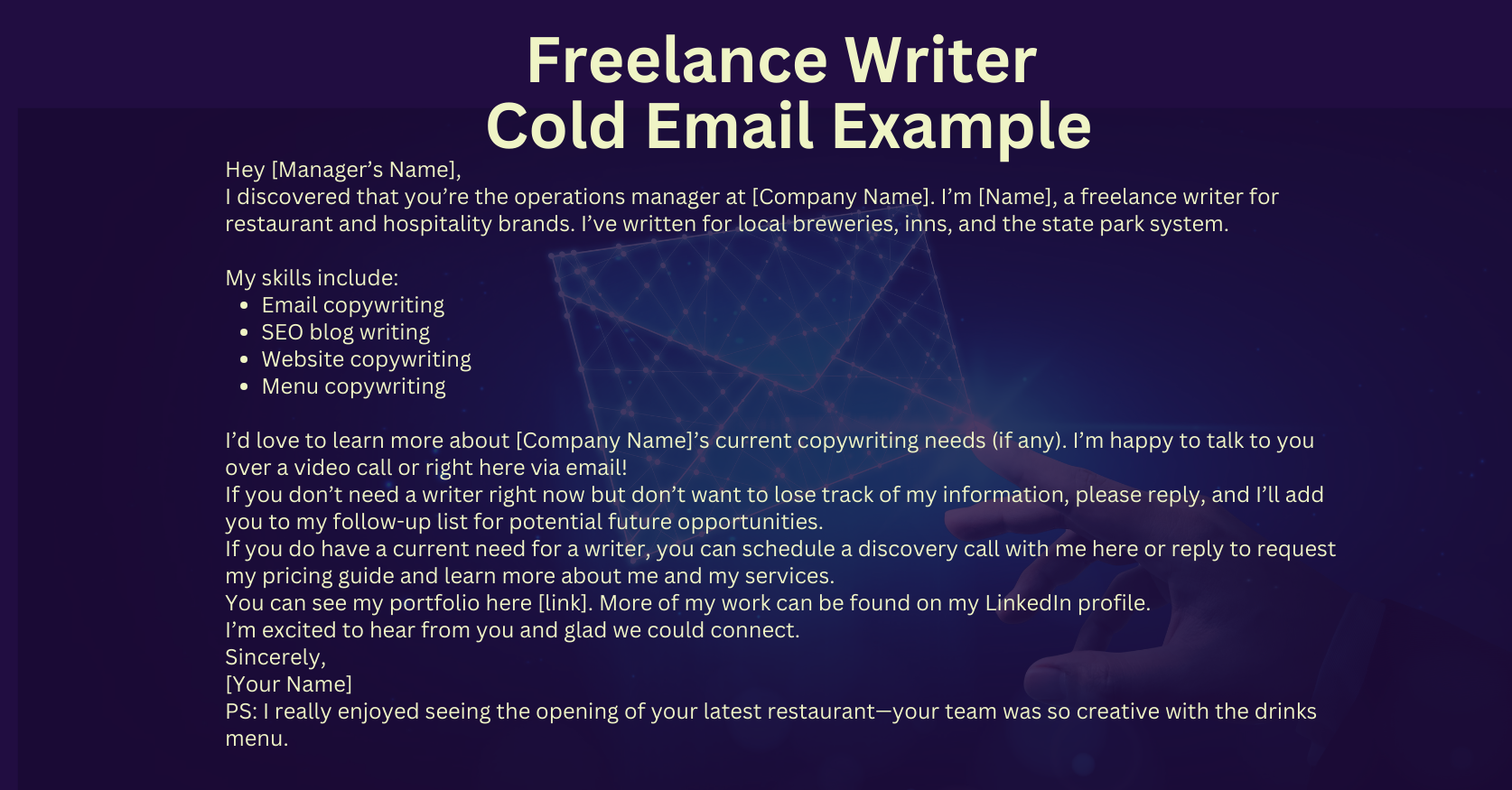
Freelance Writer Cold Email Example
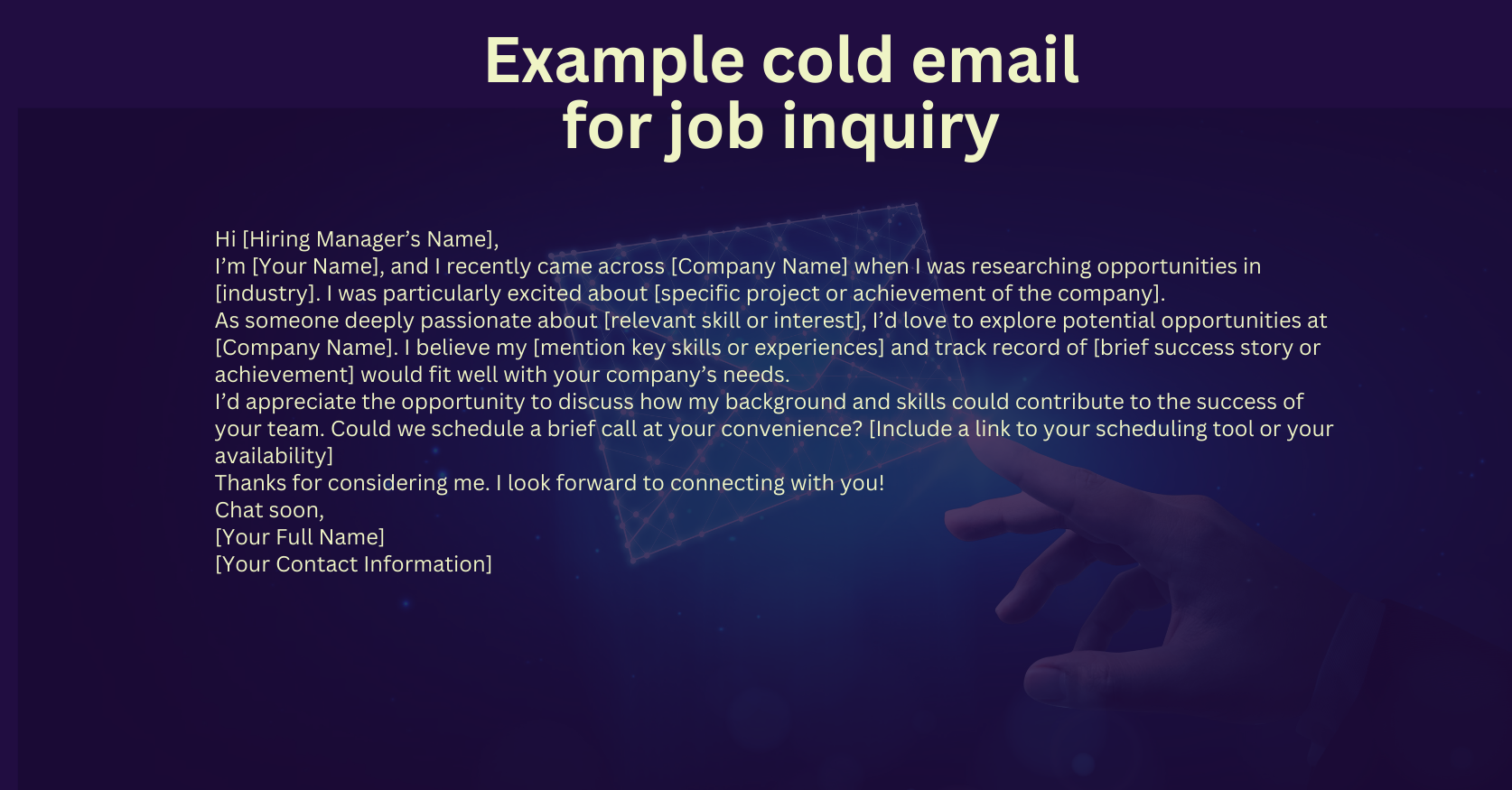
Example cold email for job inquiry
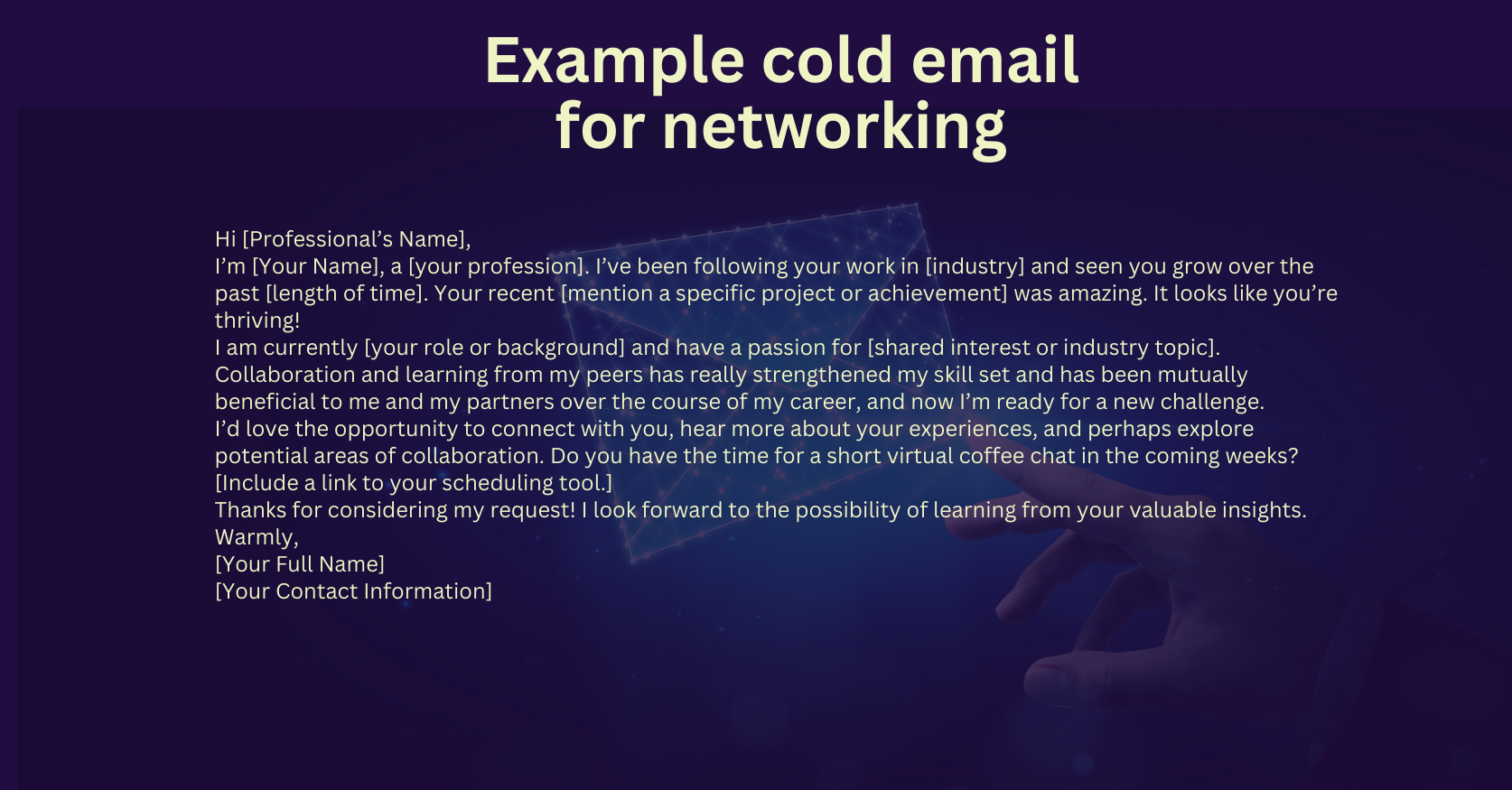
Example cold email for networking
Conclusion
In conclusion, mastering the art of writing effective cold emails is a valuable skill that can open doors to new opportunities and connections. By following the five simple steps outlined in this guide,
Learn more: AI JOURNEY
