


We'll walk you through creating your ClickBank Affiliate Account, selecting your topic and promoting products, and three distinct techniques for generating traffic and achieving your first sale.
Creating a ClickBank Affiliate Account
Before we discuss the technical aspects of earning your first ClickBank commission, please ensure that your account is properly set up.
Visit the ClickBank signup page and provide your name, email address, nationality, and phone number.
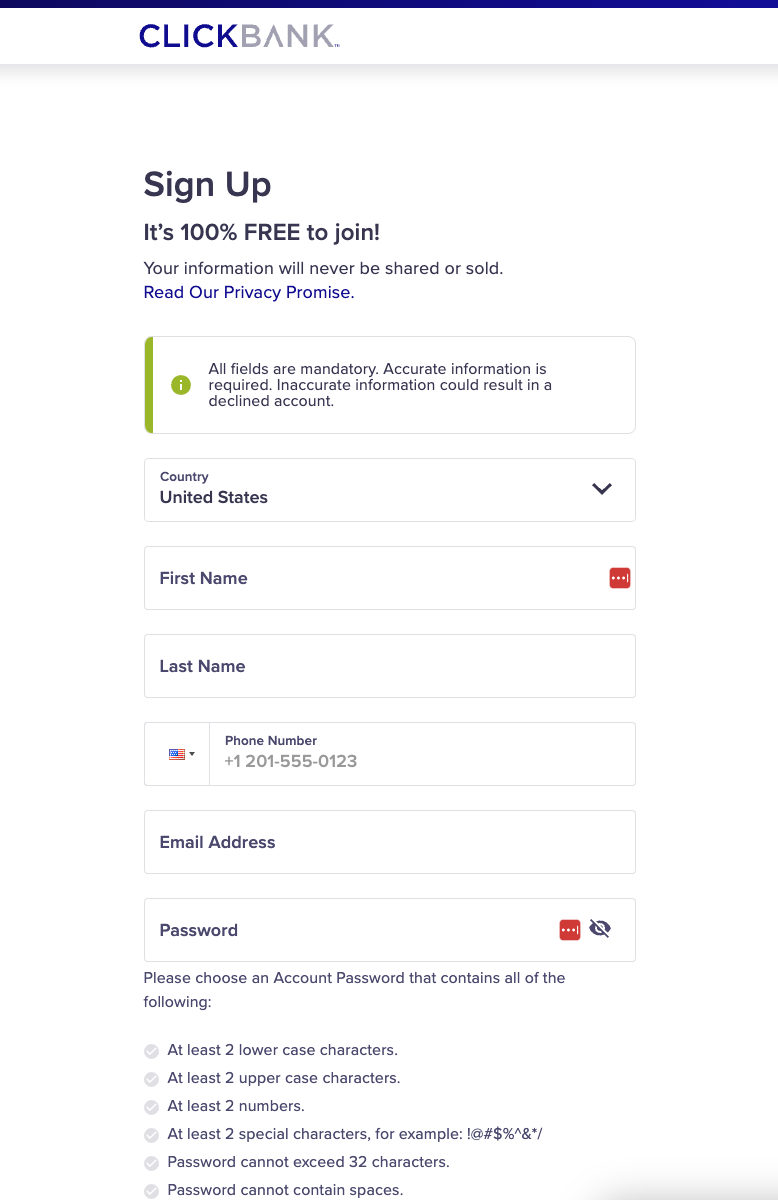 < 1>
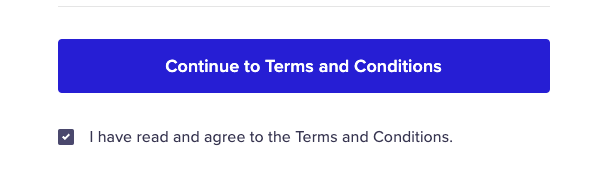
Next, scroll down and click the continue button to read the terms and conditions.
 <2>
Once you understand the conditions, scroll down and click the "Accept Terms and Conditions" button.
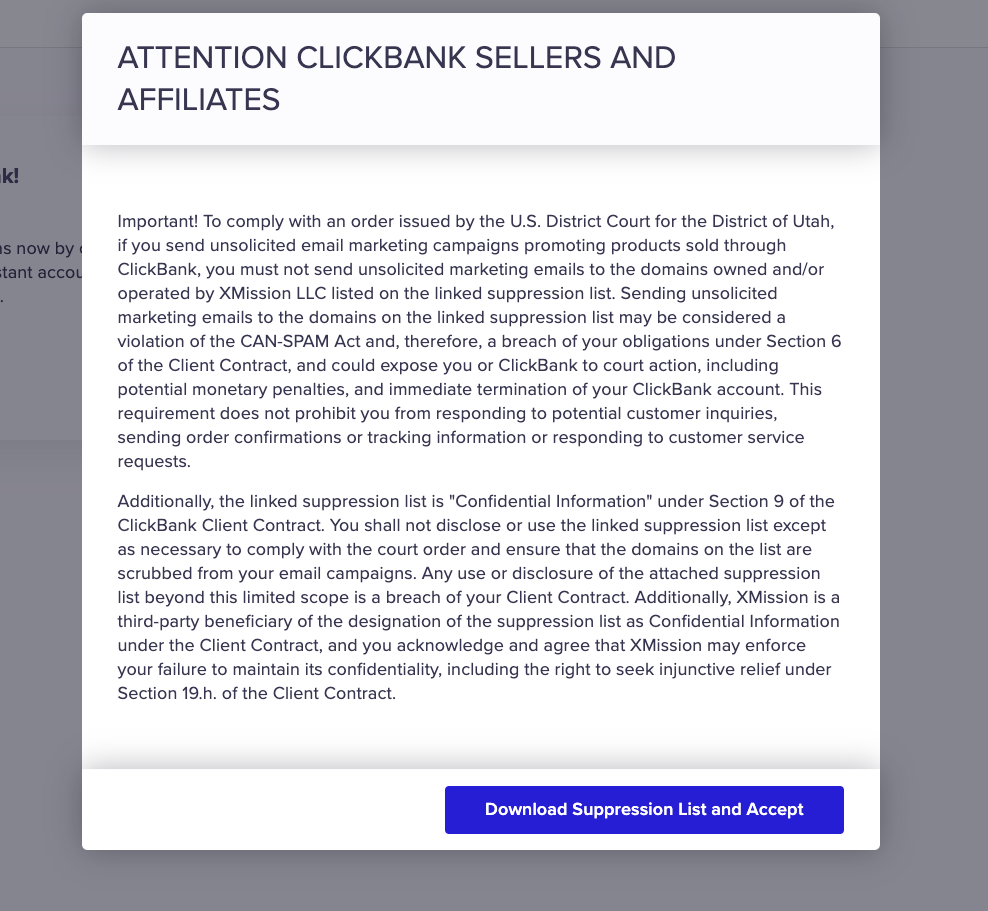
Then, click the "Join ClickBank!" button, and you'll be an official member. After downloading and accepting the suppression list, you will be taken to your account's homepage.
 <3>
From here, you may finish your profile. Fill out your personal and tax information, and ClickBank's fast account verification check will verify your identity and location for approval.
If you do not have a company tax ID, use your personal identity number instead. (Note that ClickBank only requires this information for accounts based in the United States.)
Then, define your aim as "promote products as an affiliate," select your company's revenue, and save.
You have now completed your profile and can begin marketing offers.
Every January, ClickBank will deliver 1099 tax forms to US accounts that have earned more than $600 in commissions so that they can file their taxes. However, no other information is required at this time.
ClickBank's step-by-step tutorial is an excellent resource if you need further help setting up your account.
Done, Now you can access your ClickBank affiliate dashboard, simply navigate to the ClickBank affiliate login page and enter your credentials.
Establishing Your ClickBank Affiliate Sub-Account
The overall ClickBank account manages all sub-accounts, including vendor accounts, allowing you to sell your products via ClickBank affiliates.
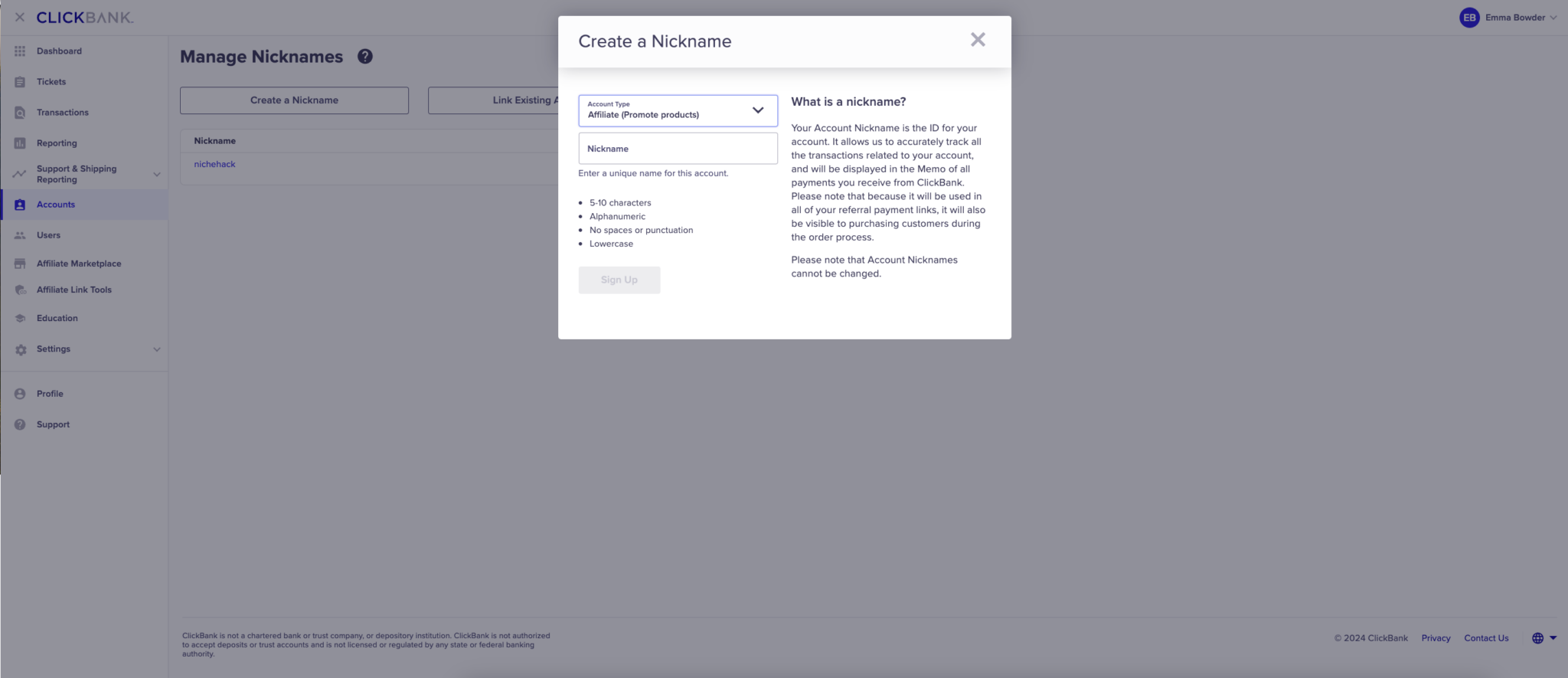
So, the next step is to create your affiliate sub-account. Navigate to the Accounts menu and select the "Accounts" button. Set the account type to affiliate and give the sub-account a moniker.
After all, when setting up your ClickBank affiliate links, don't forget to include your unique ClickBank tracking ID to monitor your performance accurately.
Selecting a Niche and Products to Kickstart Your ClickBank Affiliate Journey on Your Niche Site
Now that you've signed up, it's time to identify the ideal niche for your new ClickBank business.
If you need clarification on what a niche is or why you need one, let's start there.
What Exactly Is a Niche? And Why Is It Essential for Your Online Endeavors?
A niche is a specific segment within a broader business, such as the Keto Diet or weight reduction for new mothers, rather than general weight loss.
If you want to maximize the effectiveness of your marketing efforts, you must focus on a specific speciality.
With a niche, you can build a brand and entice people to return to your site or sign up. After all, who wants to subscribe to a newsletter that covers a variety of themes at random? Would you subscribe to a weekly email about anything and everything?
Without a niche, establishing yourself as an expert in your field will be challenging. Use the E-A-T (Expertise, Authority, and Trustworthiness) standards to get Google ranks.
It is much easier to begin ranking for specialized keywords in Google and being featured in smaller specialist magazines and blogs
The Four Essential Elements of a Profitable ClickBank Niche
When selecting a new specialization, make sure that you align these four elements for the best results.
Your Interests and Expertise: Sharing your passion makes it easier to write about what you know and establish relationships with potential consumers.
High-quality, sellable ClickBank Products: You need something to sell.
Consumer Demand: A firm cannot exist without interested customers.
Manageable Competition: You don't want to be a mere affiliate among hundreds of established websites and blogs.
You may wonder why having expertise or interest in a topic is necessary.
It's simple. It would help if you generated a large volume of engaging content for your speciality website and social media channels. And the chances are significantly better if you're passionate about your niche.
Begin with a list of your interests and areas of expertise
The simplest way to begin is to list your areas of interest and competence in an Excel spreadsheet, arranging them in order of interest or experience.
Include pastimes that you might otherwise abandon due to a lack of funds. Knitting, meditation, and gardening are all major sectors that attract many full-time affiliate marketers, bloggers, and influencers.
Once you've compiled the list, provide additional fields to reflect consumer desire, competition, and available ClickBank items.
This simple spreadsheet can help you determine the income potential of your various interests, hobbies, and skill areas.
Find ClickBank products
If you want to create passive income from ClickBank items, you should target a topic that contains high-quality, sellable ClickBank products.
Fortunately, none of the significant niches have this issue due to ClickBank's vast product library.
Begin with your favourite interest or area of expertise. Navigate to the ClickBank marketplace and look for the most suitable search keyword. In this situation, "woodworking" is the primary keyword for the speciality.
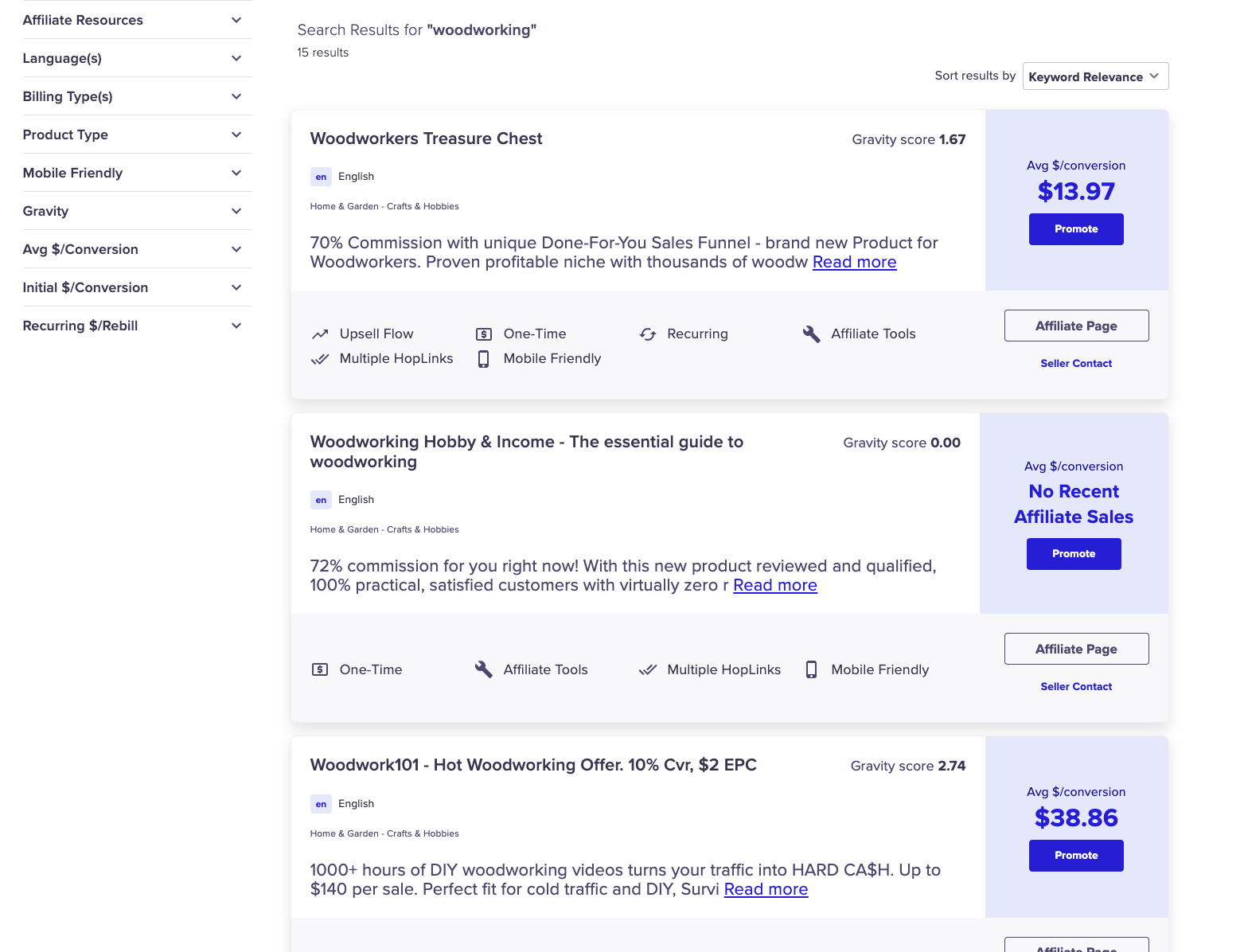
As you can see, even for this somewhat unusual topic, we obtained many relevant results.
There are two significant numbers to consider: the gravity score and the average value per conversion.
The gravity score represents the average number of affiliates who have made at least one sale in a month.
You can order by gravity if you like; however, when searching for keywords, this may yield some irrelevant results.
Scroll through the relevant products and select a few with high gravity scores and average sale conversion rates.
You should not choose a product solely because the numbers appear correct.
You must conduct thorough evaluations of each product.
Evaluate the landing page: will it successfully convert the traffic you send its way?
Check the consumer reputation: will promoting your new site hurt its brand?
First, check the product's landing page. Some ClickBank product landing pages are over a decade old and will convert at a terrible rate.
Next, assess the public impression of the product. Please ensure the product is of high quality by endorsing it to avoid harming your brand.
Assessing Consumer Demand
Once solid items sell and pay out big commissions to affiliate marketers, we must assess overall customer demand.
While gravity scores can be helpful, they only sometimes indicate a substantial market. For example, 60 affiliates can generate an average of 90 monthly sales while maintaining a gravity score of 60.
A single affiliate can sell hundreds of products monthly without adding more than one point to the gravity score.
So, it's critical to check additional sources.
The first thing you should do is assess the general search demand. You can check search demand for free with Google Ads Keyword Planner or a tool like KeySearch Starter.
However, we recommend investing in professional keyword research and SEO (search engine optimization) tools, such as Ahrefs or SEMrush.
We use Ahrefs, so we'll use it here, but any tool will suffice. They are comparable enough that you can follow our directions anyway.
Begin using the keyword explorer tool (keyword researcher in SEMrush). Look for the most significant keyword that describes your interest.
In this situation, the term would be "woodworking."
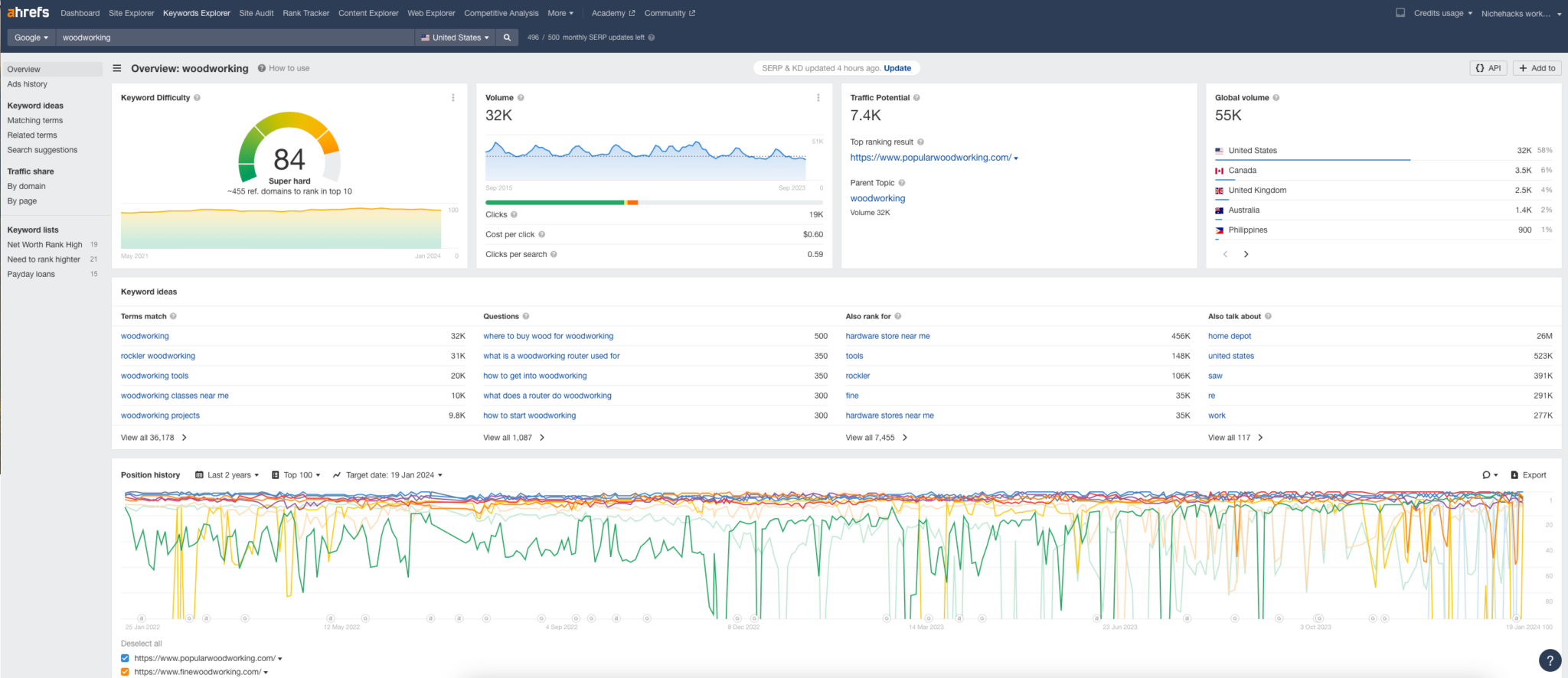
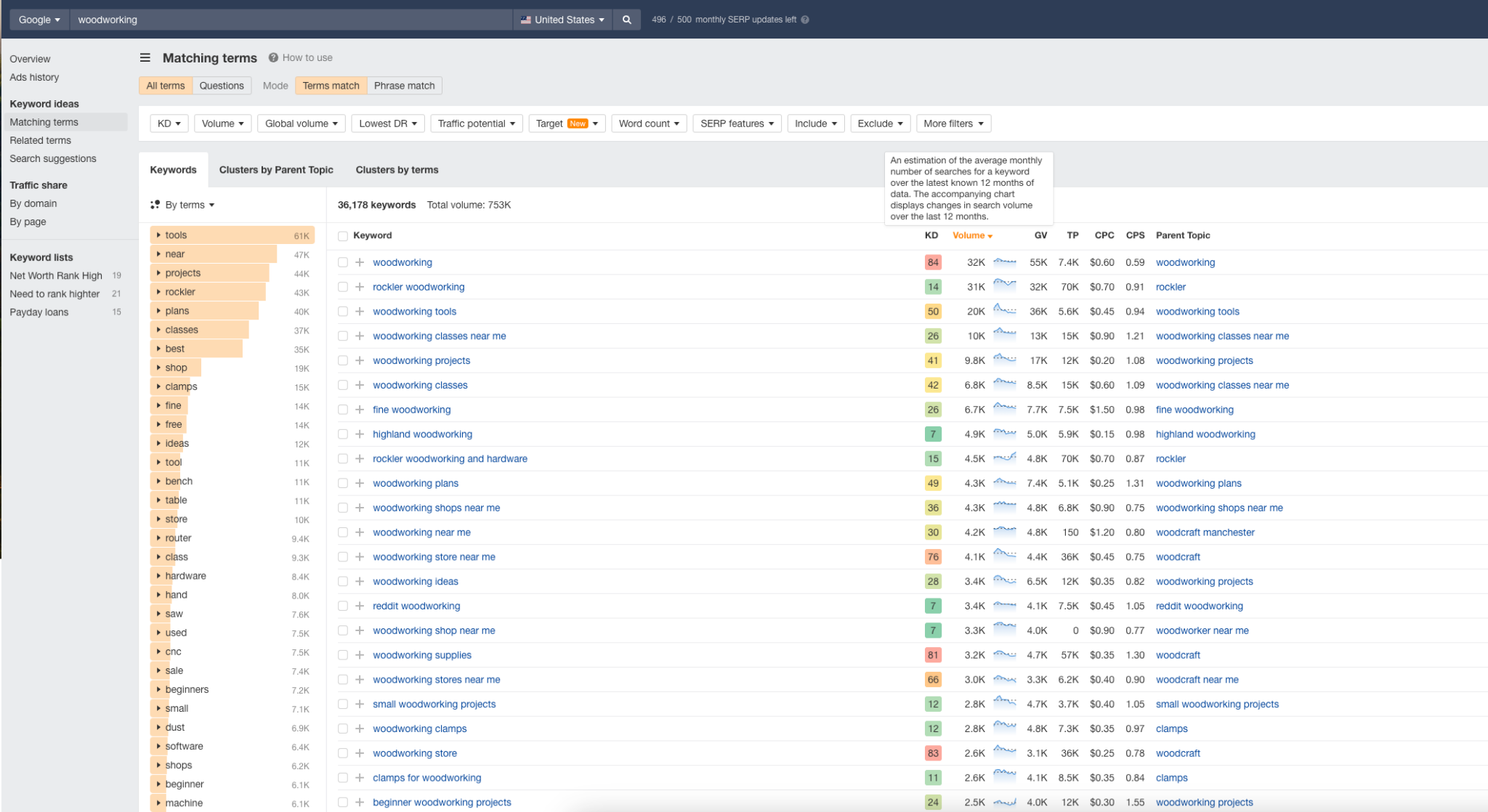
With 32,000 global searches for the general keyword "woodworking," it may not appear to be a considerable speciality. But that's encouraging. The only issue is that the keyword difficulty is 84/100 (more in the following section).
If you look into the keywords further, you'll notice hundreds of thousands of searches per month, including some with no competition. You should see a long list of words when you click the "Keyword ideas" area. The next step is to determine whether it is something that people are willing to pay for. You can see that "woodworking tools" receive nearly as many monthly searches as the general keyword.
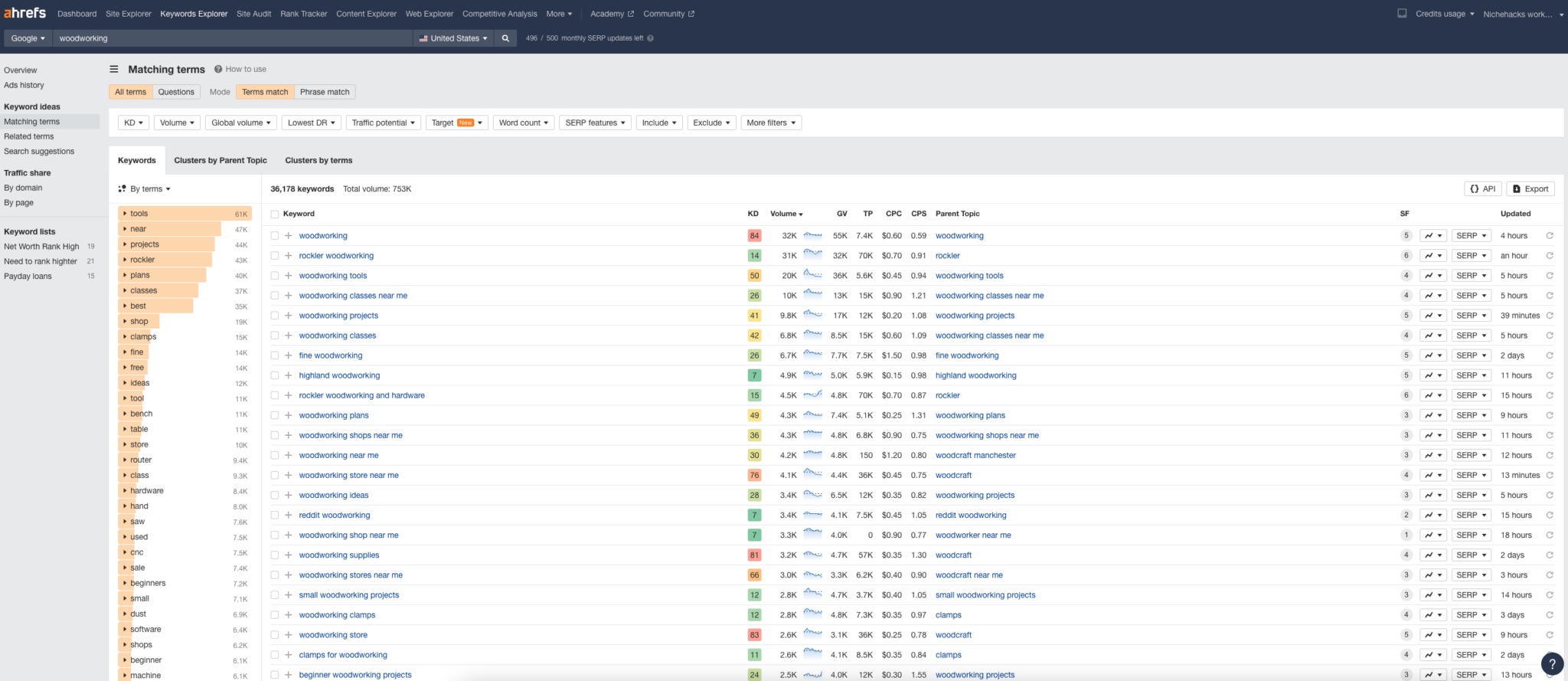
Shopping advertising includes popular tools, indicating consumers are eager to spend money on this activity.
Looking for subreddits, Facebook groups, forums, and other online communities can also help you understand how enthusiastic people are about the subject.
These indicators point to high consumer interest in the niche and product.
In this instance, you might say customer demand for the speciality is high.
Assessing Market Competition
Finally, evaluate the competition. If you do not invest in a professional SEO tool, it will take up a lot of time. One, such as Ahrefs or SEMRush, displays competitive organic data for each keyword you search for.
The main keyword for woodworking is highly competitive and beyond our reach. Keywords with scores of 50 or higher often require 100 or more unique backlinks from relevant sites before ranking in the top ten. However, the good news is that we want to target something other than generic top-of-funnel terms. We want to investigate the keywords more closely related to the ClickBank items we discovered. Examine the volume and competitiveness for keywords connected to your ClickBank items, and select those with low-medium competition and low volume. If you quickly identify 10+ keyword opportunities like this, you can conclude that the competition is low-medium for that sub-niche.
Rinse and Repeat for Each Interest
It may take some time to complete the above mentioned procedures, but you should still settle for the first speciality you discover. Repeat the procedures for each of your main hobbies and areas of competence, and list keywords you might employ.
Once you've compiled a comprehensive list, you may decide based on consumer demand, competition, items, value per sale, and your level of interest in the issue. Evaluating your paper options will help you make the best decision.
Create Your Niche Site the Right Way
After deciding on a niche, the following step is correctly building your specialised site. With a solid basis, you can begin drawing organic visitors. However, if you select the incorrect host and domain name, you will stab yourself in the foot. A poor decision will reduce the impact of your entire marketing campaign.
Choose a Reliable and Fast Hosting Provider
Page loading speed is a significant Google ranking criterion. It directly affects whether or not people can find your new website. Furthermore, page speed influences the user experience, whether visitors stay on your page, and whether they convert. Seventy per cent of people believe page speed influences their shopping decisions.
Even a few extra seconds of loading delay can result in them bouncing (not interacting with your page).
Wix and Siteground are among the poorest-performing desktop hosts. WP Engine is the finest host for WordPress sites, and Weebly is the fastest website builder. Before you choose a host, make sure you conduct your homework and select a reputable alternative.
Choose a memorable, 100% available domain name
Your domain name is one of the first things a potential visitor or customer will see.
Register a generic domain name only to test a few niches at a time. People want authoritative material from someone who knows what they are talking about.
Something like "all-products-reviewed.com" is a terrible domain name. It will lower your CTR in search and make it more difficult for you to create a brand and newsletter.
Also, avoid domain names with primary top-level domains (TLDs) such as .com and .net that are already taken. (You can use a domain registrar like Namecheap to search.)
Simply because you can register a domain name such as woodworkingforbeginners.ai does not imply you should.
Instead, you can mix a relevant speciality term, such as a shop, with your name, as in johnnieswoodshop.com.
You're ready to go as long as the domain name is relevant to the niche and easy to remember. It does not have to be a creative masterpiece.
However, only create a business where someone else owns the.com domain or if it is clear what your site is about (unless you use your name).
Invest in a relevant template or theme
Envato Market (previously known as ThemeForest) offers many professional themes that fit most niches. You can either leave them as is or use the stock photos to inspire you to take shots in a similar style.
A little genuineness may go a long way. If you can get the confidence to appear in your images and videos, you will save money and be more likely to connect with your target audience.
A quick-loading, visually appealing website with a memorable domain name is the ideal starting point for an affiliate marketing career.
Create content with relevant keywords
Once your speciality website or blog is up and running, the worst thing you can do is begin blogging about irrelevant topics. Do not try to produce material based on what is currently on your mind. That is a waste of time. Instead, you should intentionally target terms relevant to most of your potential (affiliate) clients.
Identify low-hanging fruit: keywords with little competition and decent volume
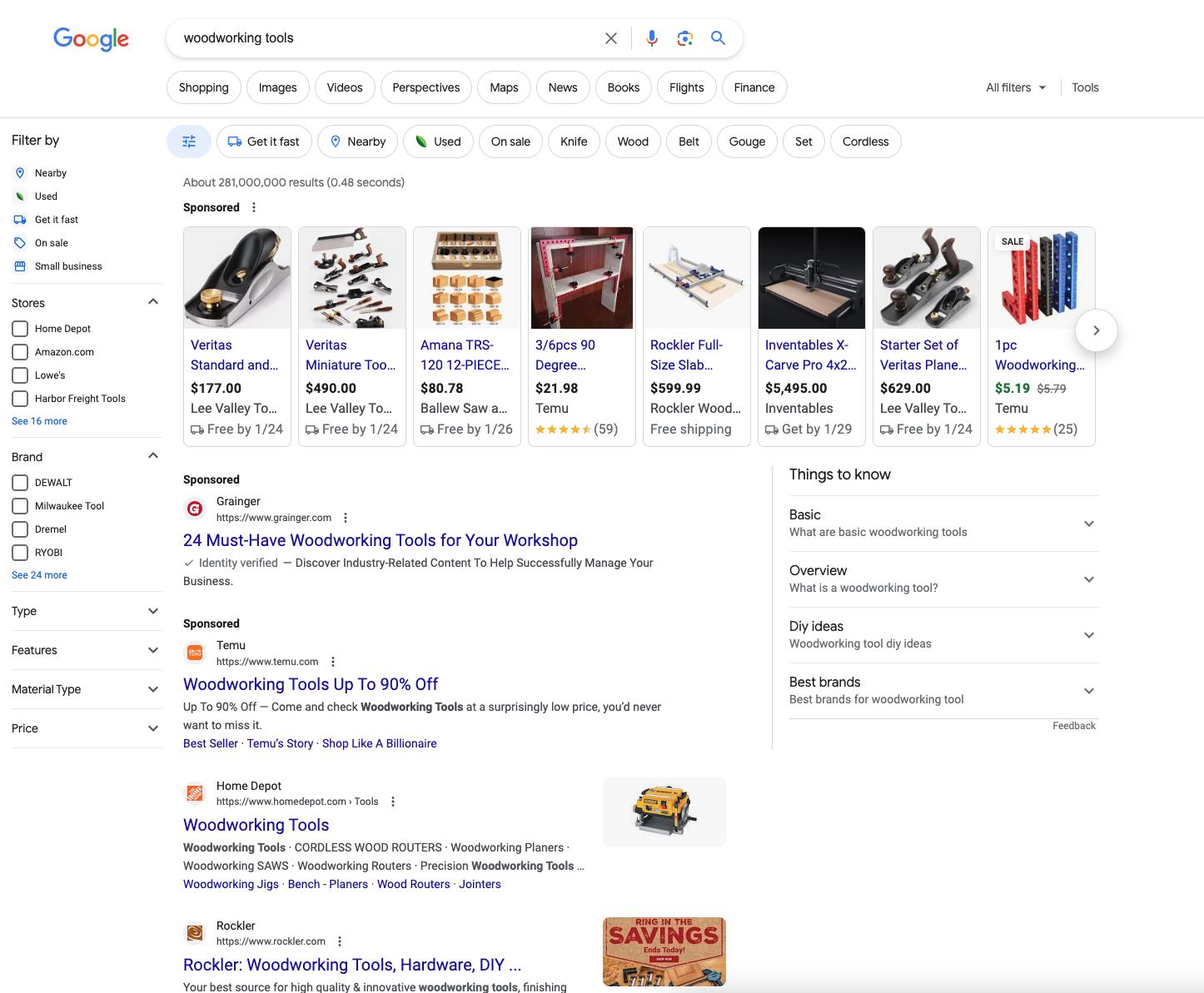
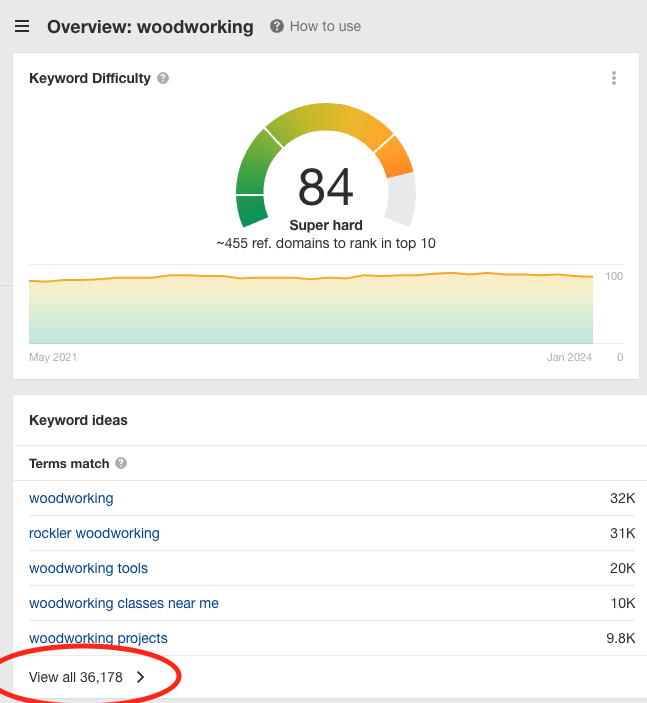
To identify low-hanging fruit, start with a more extensive niche keyword, such as returning to woodworking in the keyword explorer. Select "view all" under Keyword Ideas with Matching Terms.
Then, sort the keyword ideas by search volume. It will display a list of all keyword suggestions with the search term "woodworking" in them, sorted from most searched to least searched.
Next, you can configure a global volume filter with a minimum of 500. You can also specify a limit of 20,000 to filter out prominent brand searches. Next, create a keyword difficulty filter of 35 to exclude keywords that are too tough to target in the short term. (In Ahrefs, KD stands for keyword difficulty, the most crucial measure after search volume.) Now, all you have to do is evaluate the keywords for relevance and add the most relevant ones to your keyword list.
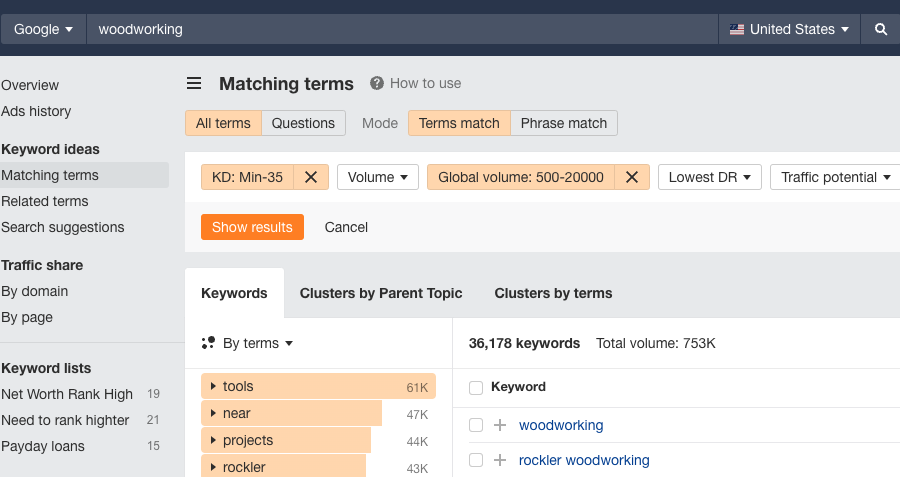
You may either click the + symbol to add it to a keyword list in Ahrefs or copy and paste it into a separate spreadsheet. Go through the pages (and tweak your filters) until you identify at least 20-30 (preferably 50+) low-hanging fruit keywords with a volume of 500 or more internationally. If you're having trouble coming up with new ideas on the "terms matching" tab, check out the "also rank for" and "questions" themes. Once you've compiled your initial list of keywords, it's time to move on to other sources.
Steal keywords from competitors
Another excellent method for identifying content ideas to write about is researching which keywords deliver revenue traffic to your competition. Since you're just getting started, you may need to learn who your competition is. A straightforward approach to finding smaller niche competitors to imitate is to search for "top [NICHE] blogs" on Google. That frequently results in several "roundup posts" that spotlight several lesser competitors in that field. For example, when you search for "top woodworking blogs," the first two results are lists of 70 and 10 sites.
You may also identify competitors by researching which domains rank for your target keywords. Note possible competitors' domains (other than Pinterest or social networks).
Answer the Most Frequently Asked Questions
People also use the inquiry box in Google results to get keyword ideas and SEO pointers. Google any keyword and scroll down to find it. You may need to include "what is" in the search for broad phrases. When searching for "how to make a coffee table," Google provides the following related questions.
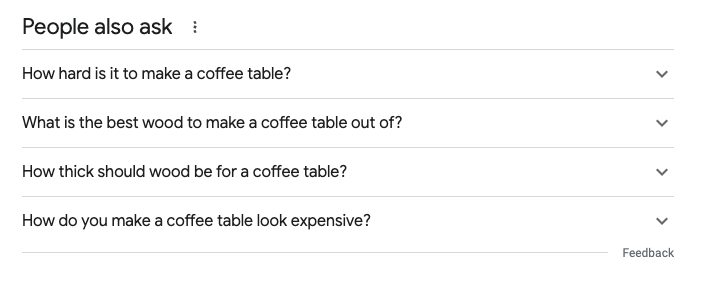
Add any questions with potential to a list and assess their search traffic and competitiveness.
Even if the volume is insufficient to target these keywords with a complete blog post, you can still target these queries by including them as short H2 or H3 subheading sections in a blog post focused on a related topic.
In your how-to guide, for example, you may answer the question, "What is the best wood to build a coffee table?"
If you need more help finding more keyword ideas, check out our approach to speciality keyword research.
Use keywords in the title, subheaders, and other on-page SEO basics
You might be wondering what to do with your keyword list now that you've compiled it.
The quick answer is to compose an SEO-optimized blog post or article addressing each one.
If you're new to SEO, try these SEO basics:
Include the exact match (100% the same) keyword in your meta title and description.
Always include your keyword in the opening paragraph of your introduction.
Use the keyword in an H1 tag (which happens automatically in WordPress and other CMS)
Include the primary or related keywords in the image alt tags and titles.
Use relevant keywords and questions in the H2 and H3 subheadings.
Cover relevant topics thoroughly and vary your use of semantically related keywords.
Use YouTube, Pinterest, and Other Social Media
You can only have a successful digital marketing campaign if you pay attention to social media. As a ClickBank affiliate, YouTube and Pinterest are ideal venues to target.
Create YouTube videos to accompany your how-to guides.
YouTube is the world's second-largest search engine for how-to content, trailing only Google. 86% of consumers say they frequently use YouTube to learn something new. Furthermore, for these how-to topics, YouTube videos often have the top results highlighted in video snippets by Google. Make video guides for YouTube to supplement your written material and increase organic traffic.
Here are some general YouTube rules:
- Speak faster and more enthusiastically than you would in a regular chat. It would help if you had a strong enough presence to engage strangers.
- The initial 10 seconds are the most essential. Showcase the finished product, begin with a joke, or do something else to capture viewers' attention and encourage them to keep watching.
- Plan your topic and edit the final video to remove rambling and unnecessary side notes.
- The thumbnail is nearly as crucial as the movie itself. It must be eye-catching and persuade viewers to click and begin viewing the video.
- Watch and study videos that rank first for relevant search phrases to learn what it takes for Google to boost you. Learn and emulate, but do not copy.
Create Pinterest-shareable visuals for your guide and comparison posts.
Pinterest receives around 600 million visual searches per month. Many of these searches are for projects based on ClickBank's digital items.
To make matters even better, Pinterest users spend 50% more than users of other social channels.
That makes it one of the most successful web outlets, period.
Before investing significant time in the platform, you should determine whether your desired speciality has an active community.
With woodworking, we've already seen Pinterest pages appear in search results for some of our terms.
A quick search for the term on Pinterest yields many popular posts and even a few accounts.
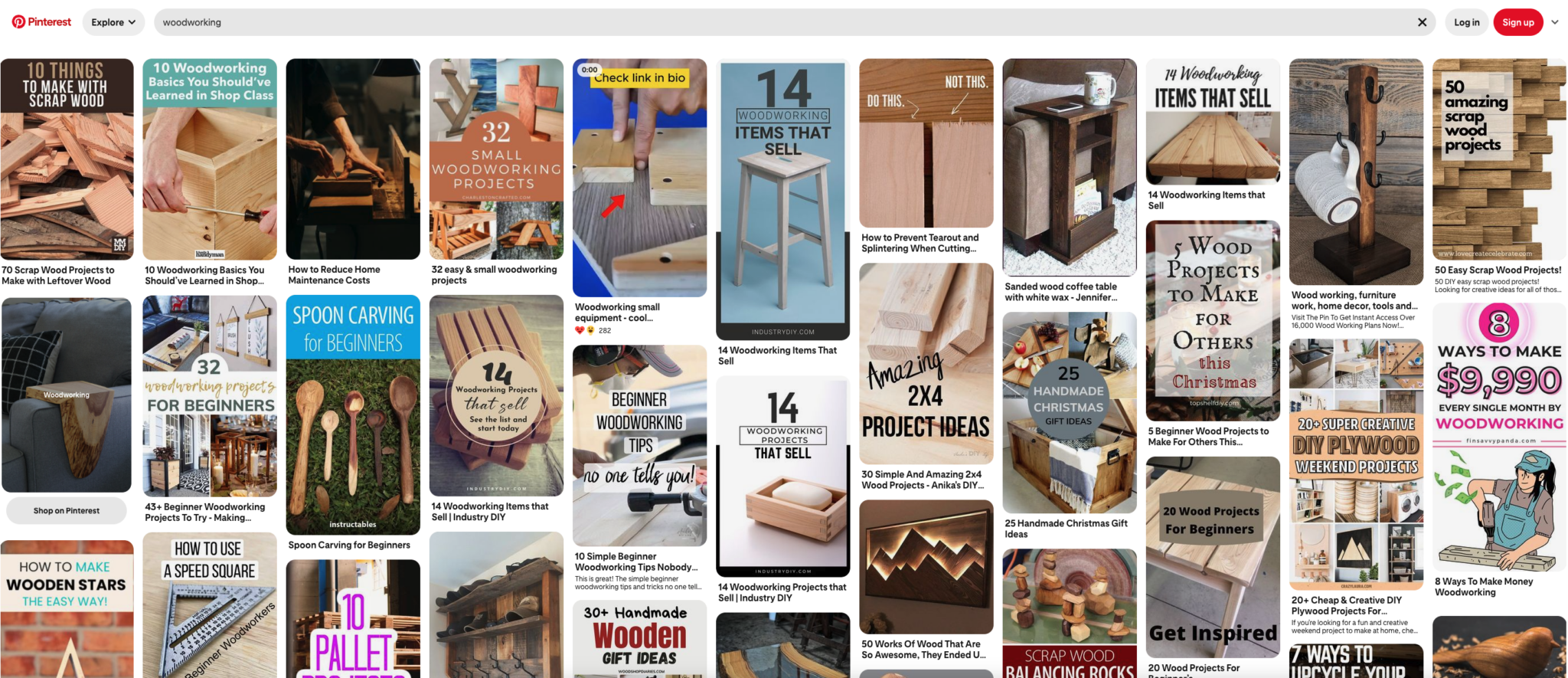
In our example, we may design a shareable image or graphic to promote specific woodworking plans from our affiliate products.
A high-resolution professional photo of a completed DIY product you created using skills learnt from a ClickBank product.
A before and after photo of a finished room renovation (which included various designs and DIY things).
You won't get far if you try to share the official banners or pictures for the ClickBank affiliate product. To succeed, you must be more imaginative and work harder.
Nurture visitors using an email campaign.
Most people leave your website without clicking an affiliate link or purchasing anything. Create an email course or newsletter to make the most of the excellent targeted visitors you receive. Email marketing generates an average ROI of $42 for every dollar spent, so it is a channel you must pay attention to. This section will teach you exactly how to get started.
Choose an affordable email marketing platform.
There is no need to spend much money on an email marketing platform when you are just starting.
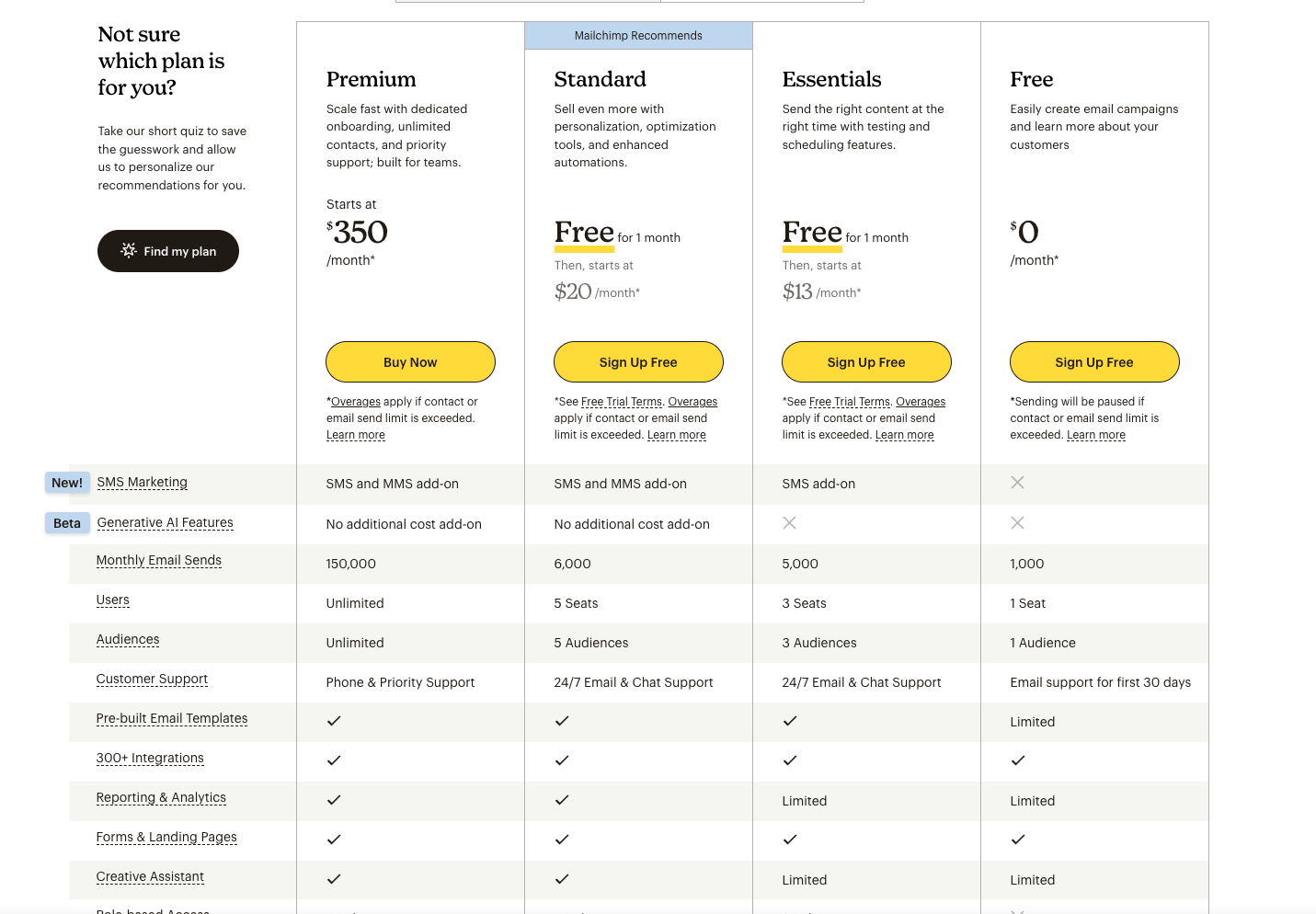
It's simple to export and transfer leads to another platform or upgrade your subscription if you require more complex capabilities later. Mailchimp is free to use (up to 1,000 monthly email sends) and an excellent starting point. The free plan allows you to design personalized landing pages.
Offer a relevant and compelling lead magnet
Create a lead magnet that provides real value to your site's visitors (using a combination of SEO and social media marketing). Jen Woodhouse, our putative competition in the woodworking/DIY market, provides free building designs to entice readers to sign up for her newsletter.
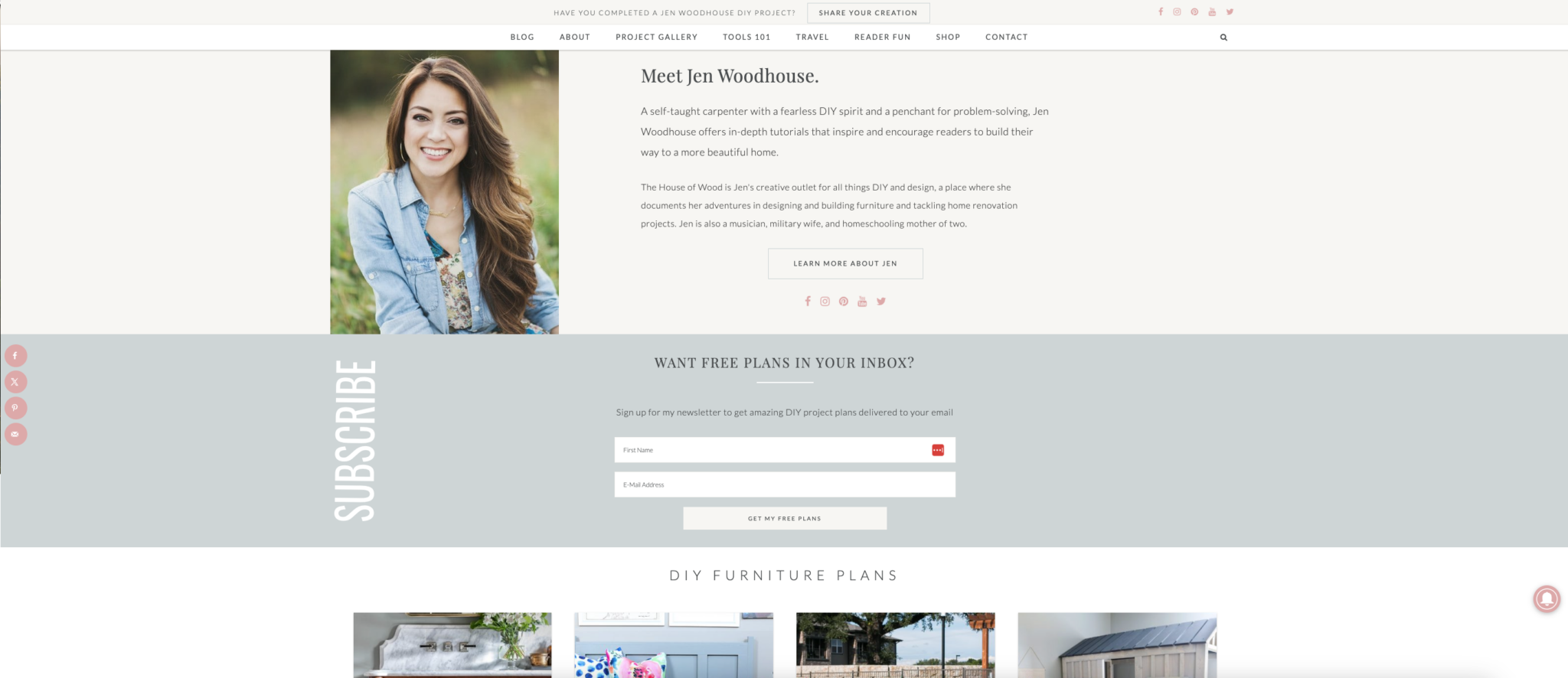
That corresponds well with what the majority of her guests expect. Remember, most are derived from keywords linked to how-to, DIY, and building plans. This alignment is critical since a lead magnet is only effective if relevant to your visitors. If you target various keywords with distinct overall themes, you can create many lead magnets and deploy them on different sites.
Set up an automated drip campaign to nurture subscribers into customers.
Okay, you've set up a lead magnet, and some visitors are signing up. What happens now? How can you convert them into customers? The most effective approach is to use a "drip campaign." It's an automated email campaign with many emails that aims to convert subscribers into clients.
Begin with a welcome email, followed by at least two emails with more tips and value, before attempting to recommend the ClickBank affiliate product in email #4. With a Mailchimp plan, you may send automatic emails based on when a subscriber signs up. A drip campaign, an opt-in funnel, is every experienced affiliate marketer's hidden weapon.
Track results and optimize how you spend time and money
The most common beginner's error is to try things unthinkingly. They employ no tracking and rely on guesswork to determine what works and what does not.
Install and use Google Analytics.
To be a super affiliate, you should become familiar with tracking and analytics programs like Google Analytics. It provides an analysis of traffic and affiliate link hits for each channel. (If your merchant installs your code via ClickBank, you can track sales and other eCommerce statistics.)
If you wish to access this type of data, create a Google Analytics account, add a new property, and copy the code.
After signing up, you can find your ID in the admin area. Copy the UA code from the property or get it via the "tracking code" section. You only need the ID if you use WordPress or another platform like Squarespace. First, use WordPress to search for and install a Google Analytics plugin.
Use ClickBank Tracking IDs to track the source of sales
If you wish to track clicks and sales to ClickBank from various sources, include ClickBank tracking IDs in your links. You can use a channel name like Facebook or a specific campaign.
Once you've promoted the various links and received traffic, you may analyze your sales and "hops" (page views) by source. Go to ClickBank reports and select "By Tracking ID" to sort your statistics by tracking ID.
That way, you'll know which platforms are bringing in the most traffic and generating the most affiliate revenue. Once you've generated a lot of sales, you may contact merchants and ask them to place your tracking tags directly to access more data.
Next Steps
It's easy to get into tunnel vision when you've discovered your topic, built your website, selected low-hanging fruit keywords, and begun posting content. However, if you stop trying to increase your knowledge or skill set after reading this article, you will likely fail in the long run.
Instead, join a flourishing community of niche marketers who share your goals and learn from their triumphs and disappointments. Our Facebook mastermind group is free, and you can get the assistance you need to succeed!
Frequently Asked Questions (FAQ)
What is ClickBank?
ClickBank is an online platform that functions as a marketplace for digital products, primarily in affiliate marketing. It connects product manufacturers (vendors) with affiliate marketers who promote and sell their products.
Is ClickBank legitimate?
Yes, ClickBank is a reputable and well-established internet marketplace. It has existed for many years and has established itself as a reputable marketplace for digital products and affiliate marketing.
Is ClickBank free?
Yes, registering for a ClickBank account is free. ClickBank allows sellers (product makers) and affiliates to set up accounts with no upfront costs.
How can I set up a ClickBank affiliate account?
To create a ClickBank Affiliate Account, go to the ClickBank signup website and provide your name, email, nationality, and phone number. Accept the terms and conditions, create your profile with personal and tax information, and set your goal to "promote products as an affiliate."
