




 In summary
Are you a novice entrepreneur seeking to launch your ideas? or expanding and developing a current business? No matter what stage your company is in, creating a comprehensive business plan is essential to its success.
Your business plan will assist you in identifying your goals and outlining the critical steps necessary to reach them. However, it will also be crucial to distribute this document to stakeholders and investors who have the power to influence the company's future. It must convince them that your vision is sound and, more crucially, that you can execute it for such reasons.
Such a plan may seem intimidating to write. But assistance is available thanks to the development of artificial intelligence (AI) capabilities. Writing helpers, such as Wordtune, provide assistance in a variety of methods that we will discuss in this post. They expedite and simplify the process, giving you more time to develop your company idea into a profitable venture.
This post will show you how to write a business plan step-by-step and discuss how artificial intelligence can have a significant impact.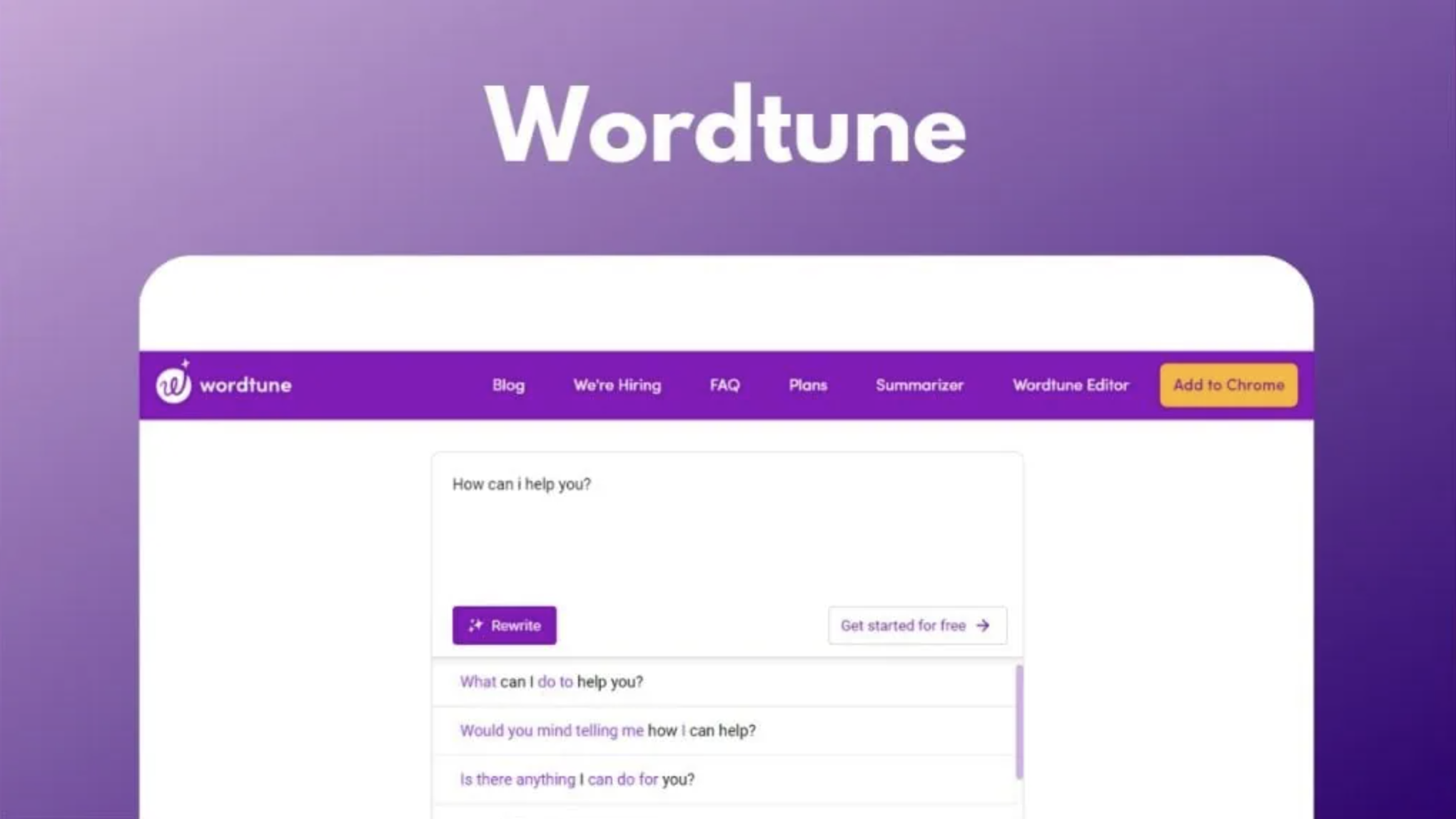
Create a business plan: a detailed guide
Let's examine the process of creating a business strategy by segmenting it into digestible parts. A standard business plan should include information on your company's finances, organizational structure, market potential, and projected future growth in addition to the specifics of your product.
Make sure you take into account the perspective of an outside audience as you cover each step. Every segment need to present a convincing argument for funding, collaborating with, or establishing a connection with your business.
The sections listed below are suggestions for your plan; however, you may need to modify them to fit your own business model.
1. Compose a synopsis for the executive
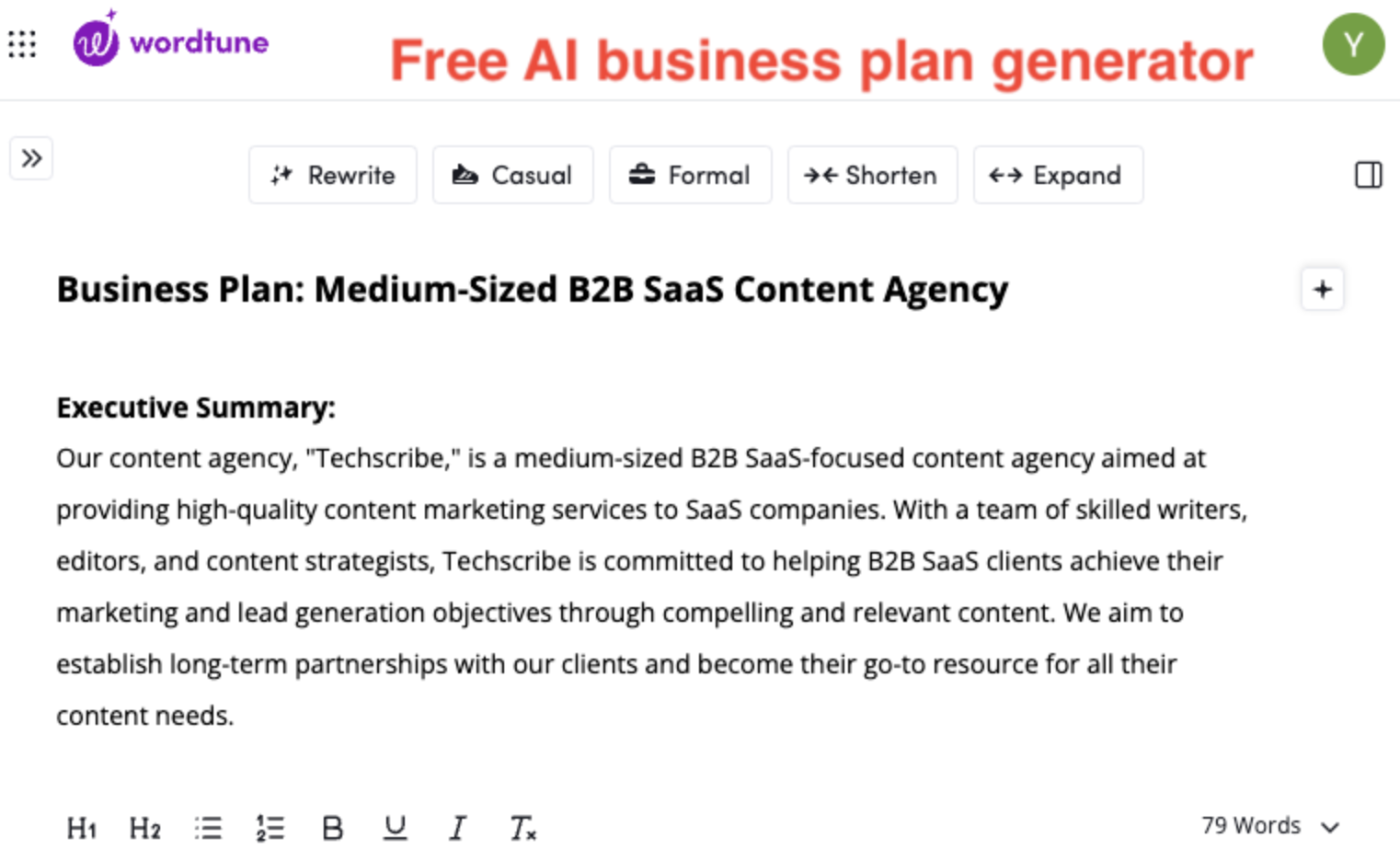
Putting the executive summary at the top of this list is a little bit of cheating. It should be the last sentence you write in a business strategy, even though it frequently comes first. This is because it draws the reader in by summarizing the main ideas and drawing attention to them. It should address the following topics, among others, and be as brief as possible:
- Your overarching business idea, which is typically the issue you're attempting to resolve
- Your vision (the difference you hope to make in your field or with your target audience)
- A succinct explanation of the product
- Market prospects, encompassing potential clients
- Present and anticipated financial situations
- What investors should know about you
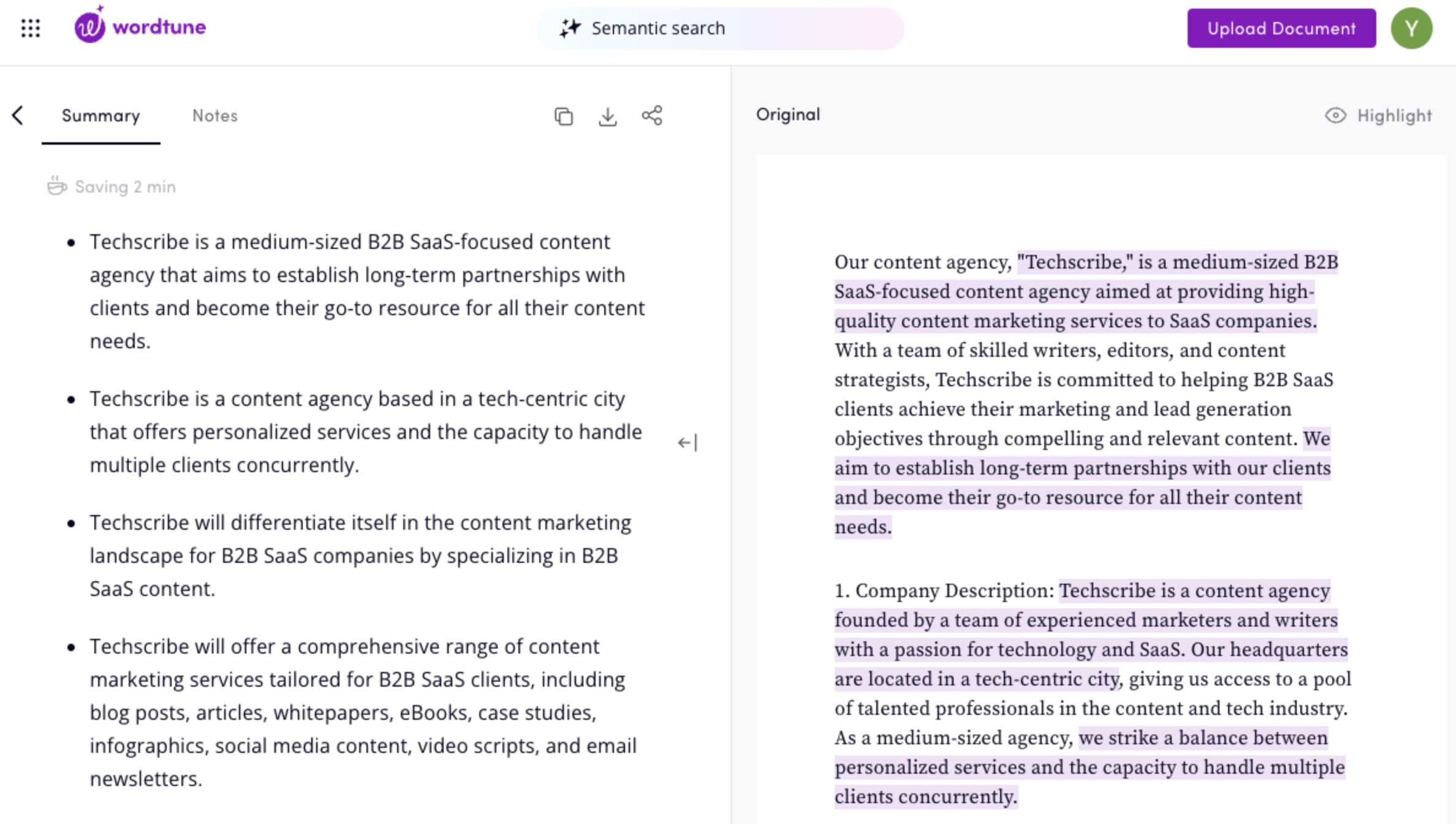
Wordtune's Read feature is ideal for creating executive summaries because it can swiftly summarize any material. Simply provide your business description that addresses the aforementioned bullet points, then request Wordune to condense it! It is a quick and easy procedure. The AI technology can generate a highly intelligible summary since it comprehends what it is reading.
2. Explain your business
The purpose/mission, guiding principles, and general organizational structure of your company should all be made clear to readers in the company description. Your ability to connect with and engage your readers will be greatly aided by this part. Therefore, aim to convey a strong sense of your company's individuality while keeping it brief.
This can involve going over the company's background and founding, goal statement, executive summary, key goods, and strategy for catering to your target market. It can be helpful to briefly outline the advantages you have over possible rivals in this situation as well. You might give a quick synopsis of your legal framework and organizational hierarchy, if applicable.
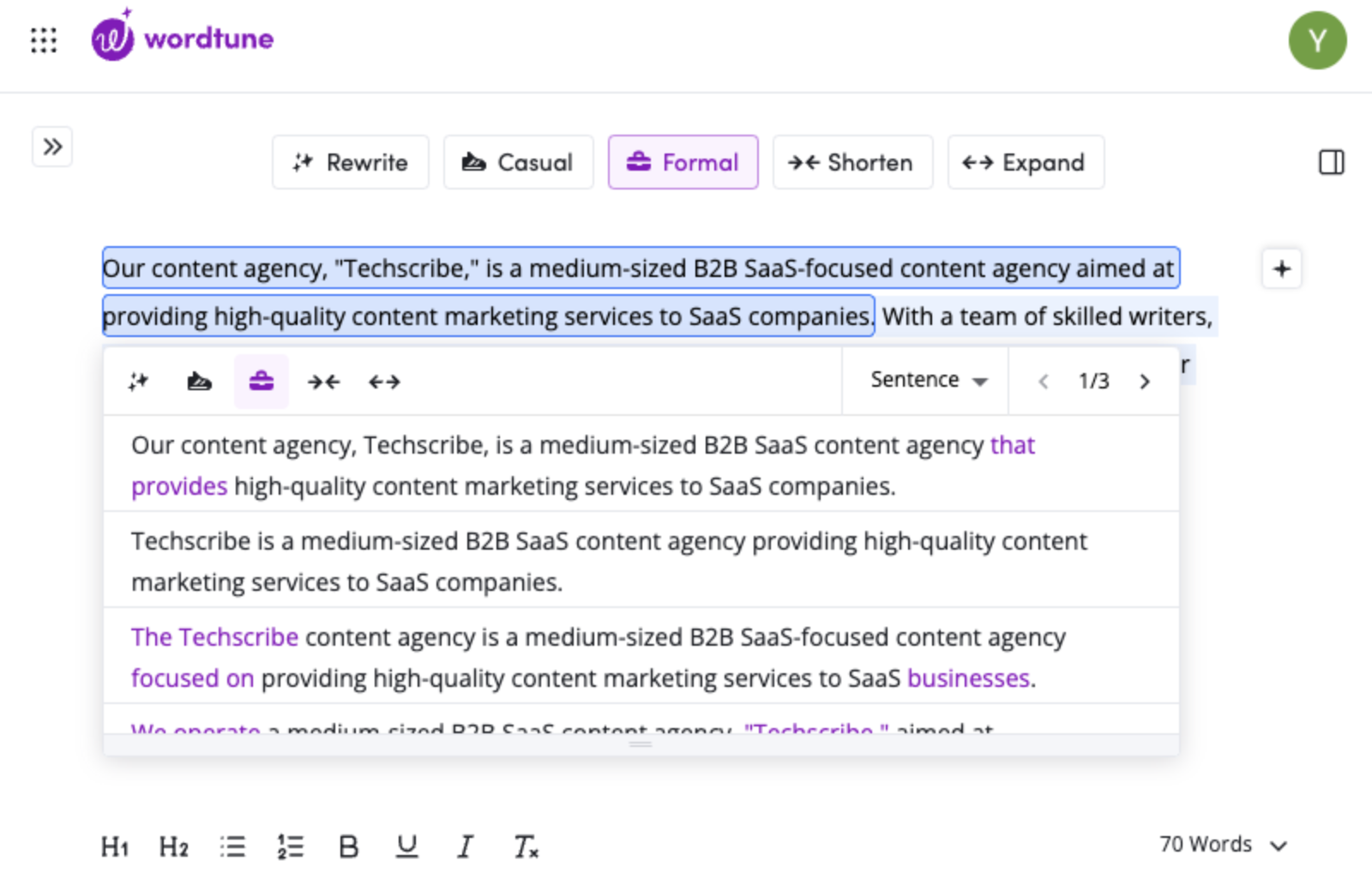
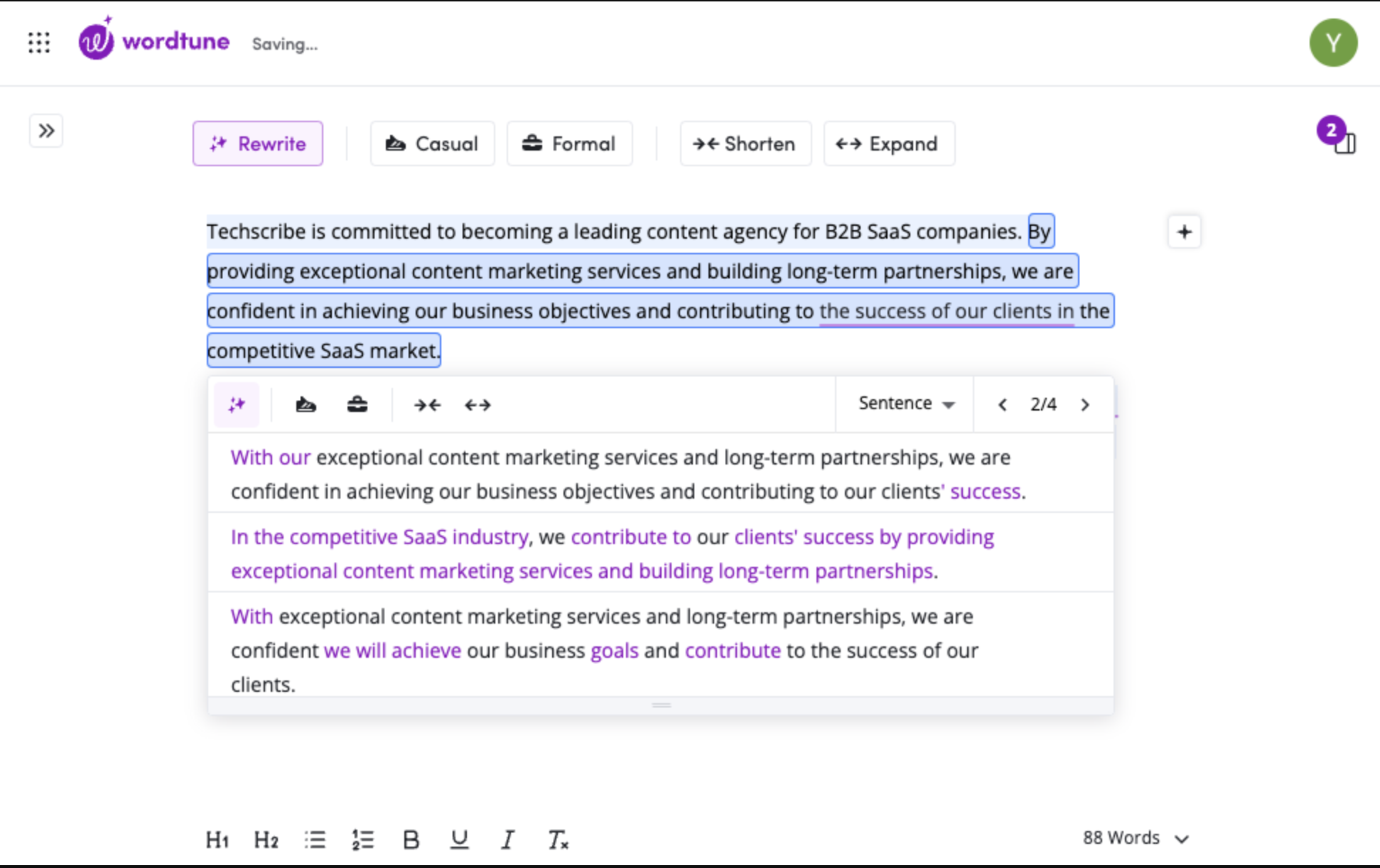
It can be helpful to use Wordtune to generate and examine many wordings of the same phrases because word choice can be important in conveying your message. You can ask Wordtune to "rewrite" a sentence by pasting in your text, and it will respond with a few possibilities for you to select. You can evaluate these on your own or show a handful to coworkers to discover which works best.
Furthermore, you can use Wordtune to change the formality to informality in your company description. This could be helpful if, for example, your brand voice is more formal and authoritative or extremely informal and welcoming. Your stakeholders will be better able to connect with you and your brand if you use a clear tone in your company description.
3. Describe your company's objectives.
Your company's objectives should be stated properly and concisely. Here is when applying the SMART goal approach can be useful. Thus, you should make sure that your objectives are:
- Particular: "reach 5 million people" as opposed to merely "improve many lives"
- Measurable: based on quantifiable numbers that you can verify, such the quantity or value of sales.
- Realistic: objectives should be more focused than to "change the world," such as "get 100,000 people to save more into their pension."
- pertinent; they ought to be in line with your company's goals.
- Time-bound, such as "by 2026, we will reside in 3 million homes." This is particularly crucial for financial objectives, which ought to have deadlines.
Incorporate both short- and long-term objectives (e.g., what you hope to accomplish in the next six months vs. six years) if possible. You and the stakeholders can refer back to a helpful road map if you arrange things in order of completion and priority.
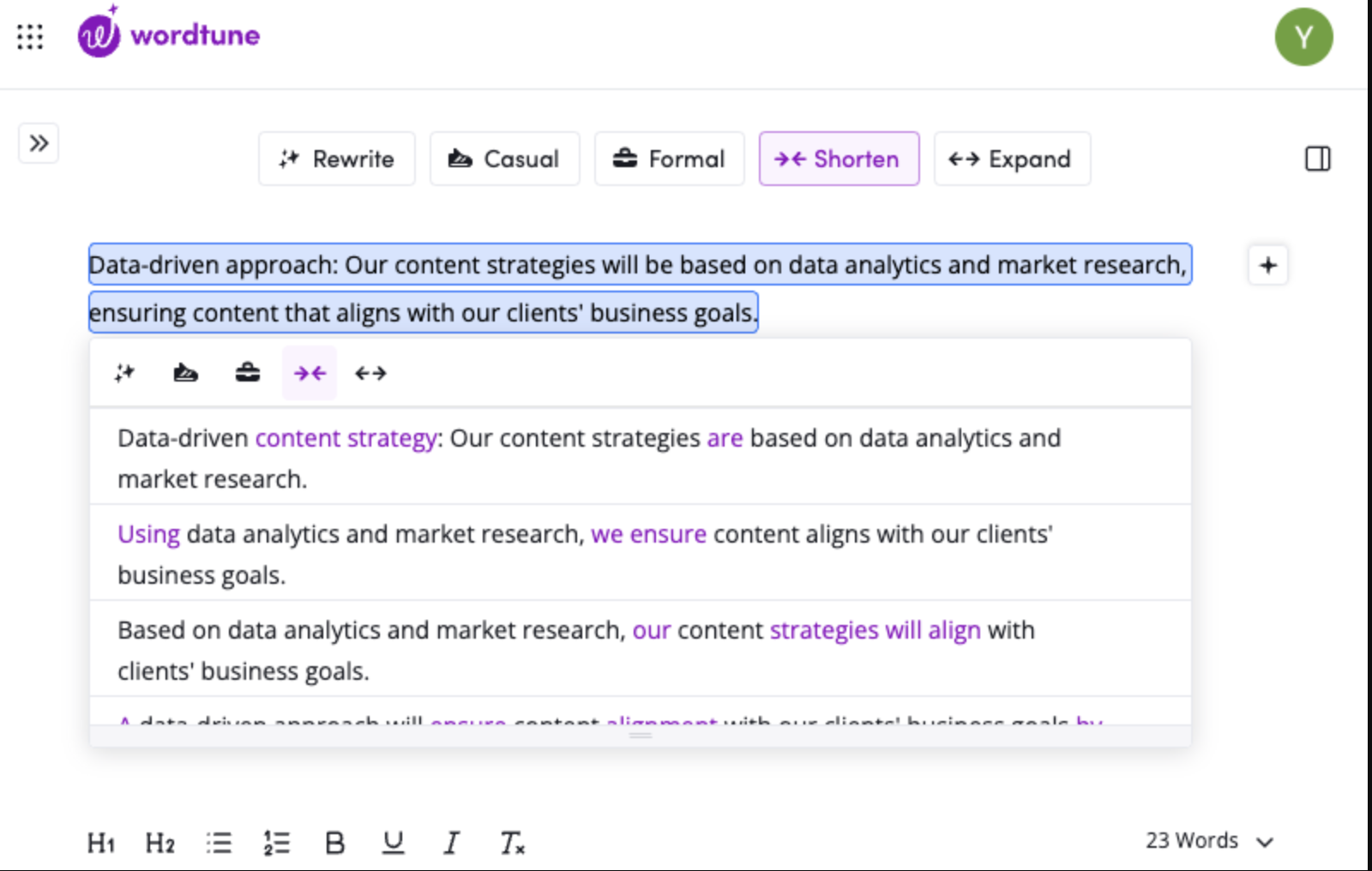
Here again, Wordtune can be useful. Any statement can be condensed by the tool to make it more concise. This can assist you in effectively expressing your objectives.
4. Give an overview of your goods and services.
This section of the business plan must have a significant impact because it should let the stakeholder truly connect with what your company has to offer! Here, you should emphasize the special qualities of your good or service and demonstrate how it adds value.
To do this, you can consider discussing the following topics:
- Product summary: summarise your offering in a few sentences.
- Identify your target customer's pain points and explain how each feature of your solution would help them.
- Product market fit: show that there is a real market need for this product and that there are buyers out there who could purchase it!
- Gain a competitive edge by demonstrating your knowledge of the market and how your product differs from the competition.
- Development stage: Describe your progress to date and future plans if your product is still in development. To establish your trustworthiness, state here that you are applying for patents, certifications, or other forms of intellectual property protection.
- Future development: suggest possible directions for your product.
- Pricing and revenue: simply state the product's cost and provide an overview of your pricing approach. In order to attract investors, who would want to have a clear understanding of the financials, this is very crucial.
- Operations and logistics: if you sell tangible goods, explain how you plan to purchase, stock, and ship them. You might wish to discuss supply chain hazards as well as your suppliers and the selection process you used.
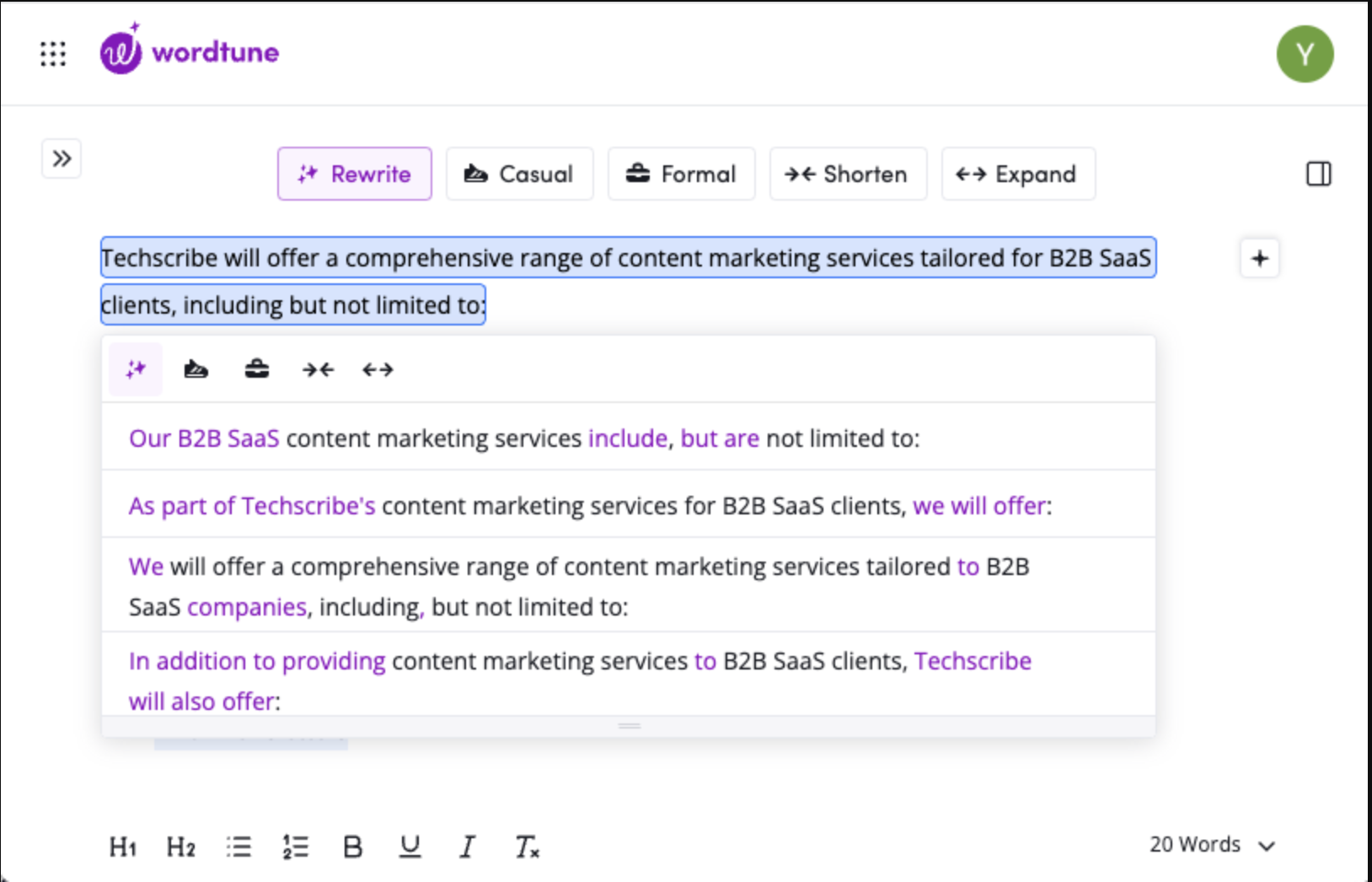
You might find it easier to keep these portions succinct if you use Wordtune's sentence or paragraph shortening feature. To ensure that every sentence is designed to have an impact, you can also use the rewrite function.
5. Conduct market research
Here's where you may go into detail and truly convince your reader of the potential of your product, even if you will have already discussed the larger market in passing in the preceding parts.
Finding your ideal client could be a good place to start. Are you trying to help drivers, parents, entrepreneurs, or teenagers? You may even find previously untapped market sectors in new markets.
Research should identify the issues that your target market is encountering and, preferably, provide data to support this. For instance, it makes sense that a product or service that makes childcare arrangements less stressful would be highly popular with parents if we are aware of the huge percentage of people who find this task difficult.
A thorough market analysis should include information on competing goods and services so that you can position yours against them. For instance, are there any other businesses carrying out a comparable task? What makes you unique? Alternatively, how will this brand-new product fit on shelves? How are you going to promote a unique idea?
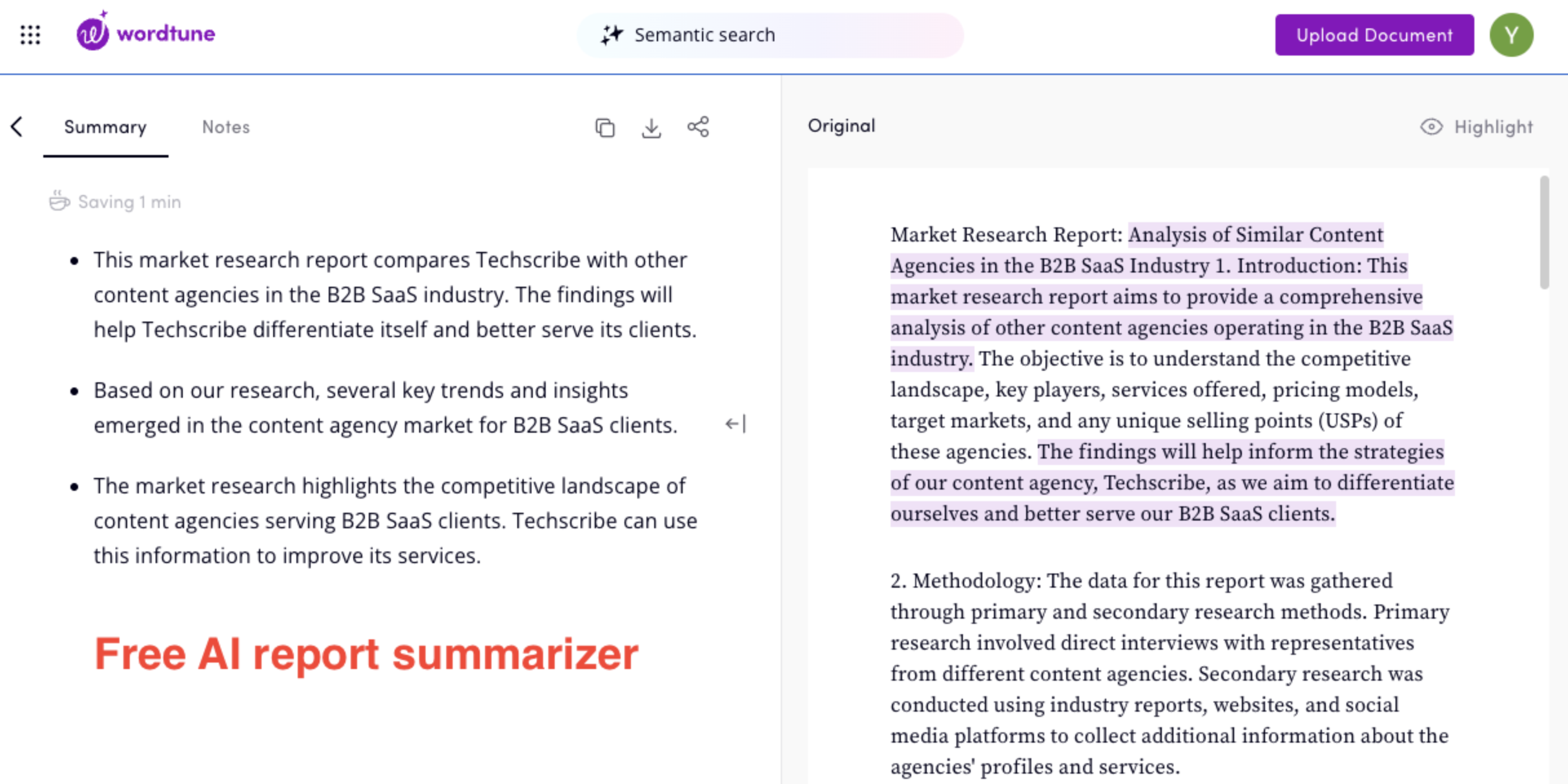
Here, Wordtune Read might be useful. You can save a lot of time by uploading pre-written reports and research papers to create concise summaries that you can read quickly. If your research papers aren't entirely and directly linked to your issue, you may simply summarize the pertinent sections by setting up Direct Read to summarize based on specific subjects or keywords. For instance, you may wish to concentrate on "women" or "health problems" in your summary. Wordtune will read the text aloud to you and provide a synopsis that is specifically tailored to your selected subject.
6. Describe your sales and marketing strategy.
It will be important for your stakeholders to know that you can make sales of your goods. It also entails having a clear marketing plan.This should illustrate how you will appeal to each target client by drawing on the market research that was previously discussed in the sections.
In order to create the perfect client profile that will serve as the foundation for your marketing plan, this could be the time to dive into additional information about your target market. Important demographic information such as age, gender, geography, habits, demands, and other items they purchase should all be included in your customer profile. This might assist you formulate your marketing messages and determine which distribution channels would be most useful in reaching prospective clients.
You might additionally
- Describe your main marketing message and the aspects of your product that you want to highlight.
- Establish your marketing goals and make sure they are SMART. For instance, producing 100 leads by the end of the first year, or within five years, dominating your niche.
- Describe your marketing strategy. Included in this should be the primary platforms that you want to employ, including blogs, emails, social media, print media, and search engine optimization (SEO).
- Determine your main points of message. This section of the strategy could incorporate AI tools. Wordtune, for instance, could assist with A/B testing your messaging by generating various iterations of your copy for you to test out.
- Organize any sales, discounts, or other resources, such as countdowns, to make your prospects feel more obliged to respond.
- Establish a precise budget for marketing so that you know exactly how much to spend and where to spend it.
- Describe your process for reviewing and assessing your marketing results, taking into account your KPIs.
You should also outline your sales strategy if you have a distinct sales track, meaning that you are not a direct-to-consumer company but rather require sales representatives to close purchases. This needs to account for both short-term (first) and long-term (repeat) sales. Will you be conducting simple informational calls for customers to learn more about your service? What is the anticipated number of sales meetings along the customer journey? How are you going to handle complaints and consumer relations?
7. Conduct a financial study for your company.
Your stakeholders should be assured by the financial analysis that this will be a successful corporation that operates profitably. There will be no question about return on investment (ROI) with a strong company plan.
The important financial statements that you can attach or include as an appendix should be consulted here. These may consist of your cash flow statement, income statement, and balance sheet. Your plan should concisely summarize the key aspects even though you will be providing the real financial records. This way, readers who lack the time can skip over reading each attachment and jump straight to the action. They will be able to understand the main ideas of this section more quickly if they use charts and graphs.
It's crucial to discuss potential risks in this situation. Can you pay your bills in the event that your firm fails? You must demonstrate your ability to pay for everything that, in the event of your business failure, needs to be repaid, such as loans, contracts with customers, or stock expenses.
8. Create financial forecasts
A financial forecast is another useful tool for outlining the future developments of your financial plan. This ought to address the various facets of your company and their potential developments over the following year, five years, or ten years. A sales estimate, for example, can reassure prospective investors about your company's financial viability. You can be ambitious, but it must be reasonable. To emphasize the potential return on investment, present the best-case scenario.
9. Include more details in an appendix
Any other materials that could be helpful in providing further context and depth should be included in the appendix. This might consist of:
- Financial records, such as predictions and statements
- Deeper market research (reports, demographic information, competitor product examples)
- Contracts and legal documents (signed stock production contracts, for example)
- Product documentation includes reports on prototype testing, patents, and manuals.
- Marketing materials such as pamphlets or films
- Organizational structure diagrams that illustrate the personnel requirements to achieve your goals and how your teams will be managed
- Extra graphs or charts to highlight important ideas in your plan
To make it easier for readers to discover what they need, make sure the appendix is numbered, labeled, and has a contents page.
Resources and advice for business plans
If you divide your business plan down into digestible portions, it doesn't have to be as intimidating as it might initially seem. Here are some more pointers to assist you in creating a successful business strategy.
Conduct research: Fortunately, there is a wealth of knowledge available regarding the composition of a business plan. Before you start, take some time to do some study on the subject (you can also use Wordtune Read to quickly summarize the recommendations). Many useful ideas can be found on websites such as the Small Business Administration (SBA).com.
Additionally, there are a ton of sample plans available online (like this one from Hubspot), or you may be able to obtain some through your network. Examine the work of others and identify the elements that make it compelling.
Strike a balance between optimism and realism. While giving out exaggerated estimates may seem thrilling, doing so may cause your readers to lose faith in you. According to the Harvard organization Review, you should carefully consider and ensure that your plan accounts for the costs that your organization will incur. Furthermore, keep in mind that many startups fail to meet their initial estimates; investors will take this into account when making offers, so you should also consider your backup plans.
Describe the withdrawal plan: The most effective business plans chart the company's development from inception to completion. Is it feasible for you to sell to a larger player, and do you want to do that? At some time, will you be listed on a stock exchange where investors can sell their shares and make money? You must demonstrate to your stakeholders how they may profit; a concrete advantage is always appealing.
Check for mistakes in spelling, grammar, and punctuation when proofreading your plan. If not, readers can think it's unprofessional and lose faith in it.
When you run your work through Wordtune, it will point out any errors and offer rewrite suggestions to improve the flow of your descriptions and explanations.
 In summary
This is your opportunity to compile all of your hard work into a business plan and present your ideas to the world. Make sure you conduct thorough research and compile all the data necessary to demonstrate that you have a lucrative, intriguing business idea that would pique the interest of potential investors.
It can take some time to create a comprehensive plan, so it's critical to locate the resources and tools you need to complete this task. One approach to make sure the writing in your business plan truly shines and you make the most effect possible is to use artificial intelligence (AI) writing software such as Wordtune.
