





Programmatic SEO: What Is It?
Large-scale landing page creation is required for programmatic SEO in order to rank on search engine results pages (SERPs). It's also known as pSEO at times.
The template for each landing page is the same and has the same components (e.g., photographs, pricing, reviews, etc.).
Next, you use automated tools to build different versions of the same page. Every page focuses on a distinct low-competition term.
Throughout its website, Expedia employs this content marketing technique.
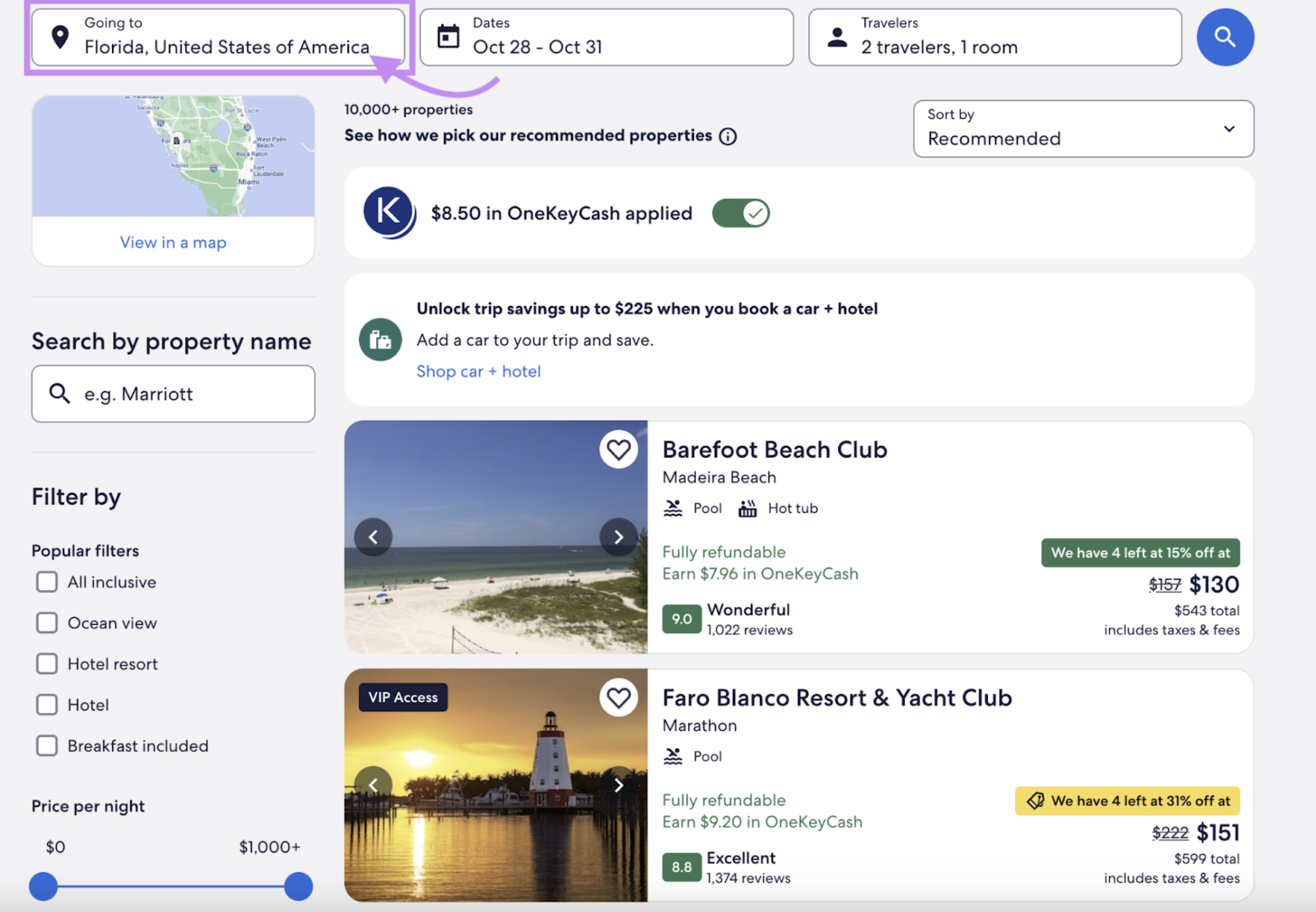
Assume you look for "best hotels in [location]." An Expedia page will most certainly appear among the top results.
The outcome for "top hotels in Florida" is as follows:
Moreover, "best hotels in California":
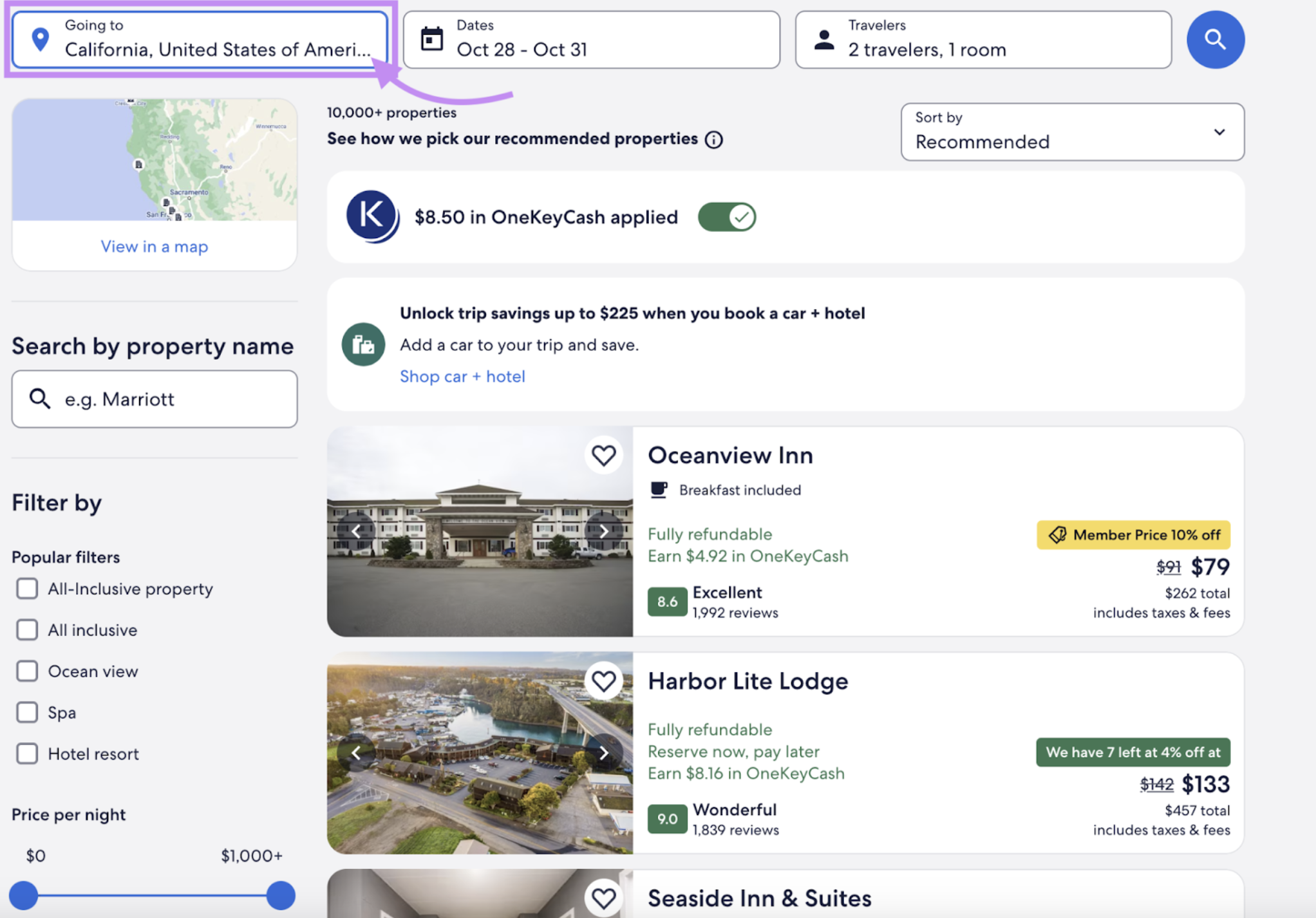
Observe how the content and position of the landing page vary, but the layout remains the same.
Expedia does not start from scratch when creating these pages for each city, state, and nation. The outcome of programmatic SEO is this.
Programmatic vs. Conventional SEO
The aim of both programmatic and traditional search engine optimization is to increase organic traffic.
However, the methods used by each to increase your website's exposure in search results vary.
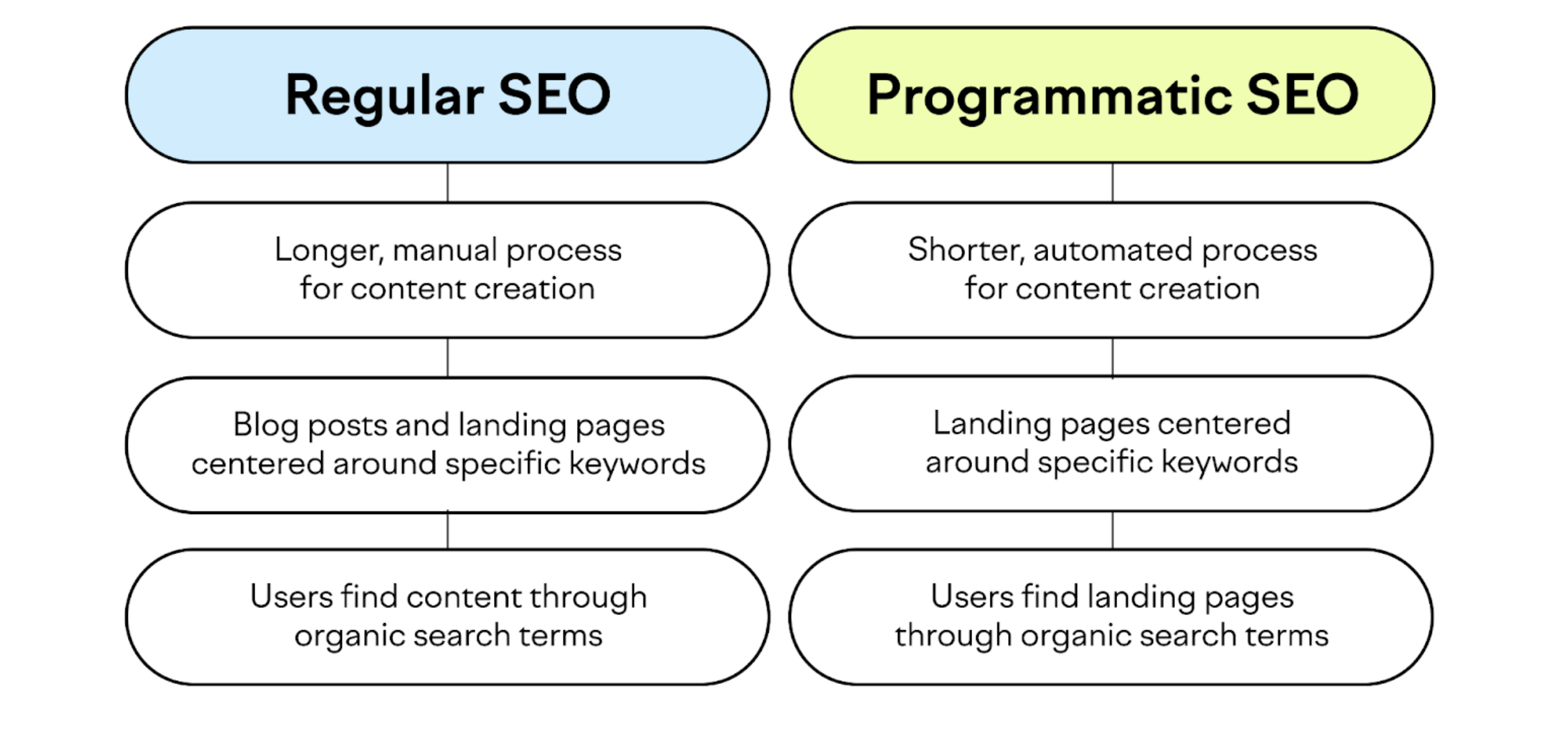
The goal of regular SEO is to increase your website's exposure in search engines (like Google). It's a long-term plan that prioritizes excellent content.
Regular SEO tactics include crafting blog entries and landing pages with a focus on particular keywords. This is where programmatic SEO varies the most from this.
The process of creating original material for regular SEO is even more time-consuming. It can also aim for terms with more competition.
To rank on Google, programmatic SEO is a speedier way to accomplish the same objective. It's a technique for making several landing pages for searches that have the same design.
These landing pages are made using automation, templates, and databases. Additionally, a single database and template can create thousands of pages.
Similar to standard SEO, these pages also require specific keyword research.
Programmatic SEO's Benefits and Drawbacks
Compared to traditional SEO, programmatic SEO takes a different strategy. Nevertheless, pSEO is a valid means to supplement your standard approach with increased traffic and conversions.
The following are a few benefits of programmatic SEO:
- Once you have your landing page template built, scaling websites is simple.
- With only one effort, you may rank for all relevant searches and target whole keyword groups.
- Your search visibility is increased when you rank well on Google and target low-competition keywords.
- You are more likely to develop backlinks the more exposure and search traffic you receive.
- More sales can arise from targeting consumers who are prepared to make a purchase.
Prior to getting started, you should be aware of the following:
- To create a programmatic SEOtemplate, one must be proficient in code.
- Purchasing the appropriate no-code tools will cost more up front.
- The creation of duplicate or low-quality content may be against Google's spam policies.
- Indexing every page on your website might be challenging.
- Even now, programmatic SEO is a labor-and research-intensive procedure that needs constant upkeep and observation.
There are three key areas you need to be aware of before you attempt it.
Programmatic SEO's Three Foundations
The keywords with the best conversion rate and the least amount of competition are the main emphasis of a successful programmatic SEO campaign.
After that, you use those keywords to produce excellent landing pages with original content.
1. Low-Target Keyword Competition
To improve a page's chances of ranking, programmatic SEO focuses on picking keywords with less competition.
For example, websites like Expedia, TripAdvisor, and Airbnb will target the low-competition phrase "places to stay in Nevada."
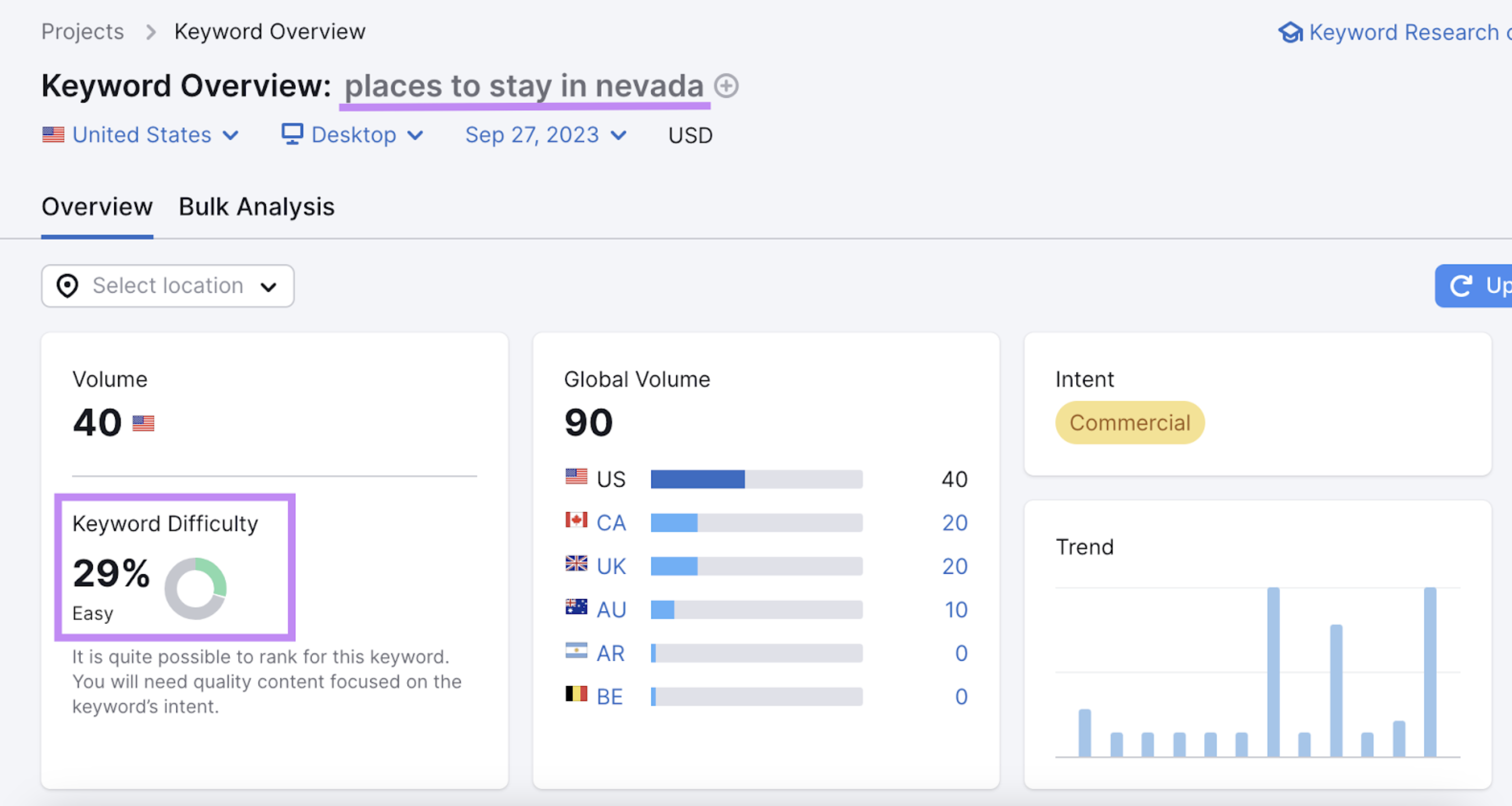
By utilizing a statistic known as keyword difficulty (KD), which gauges how competitive search phrases are, you can identify these kinds of keywords.
You may locate it in the Keyword Overview tool as follows:
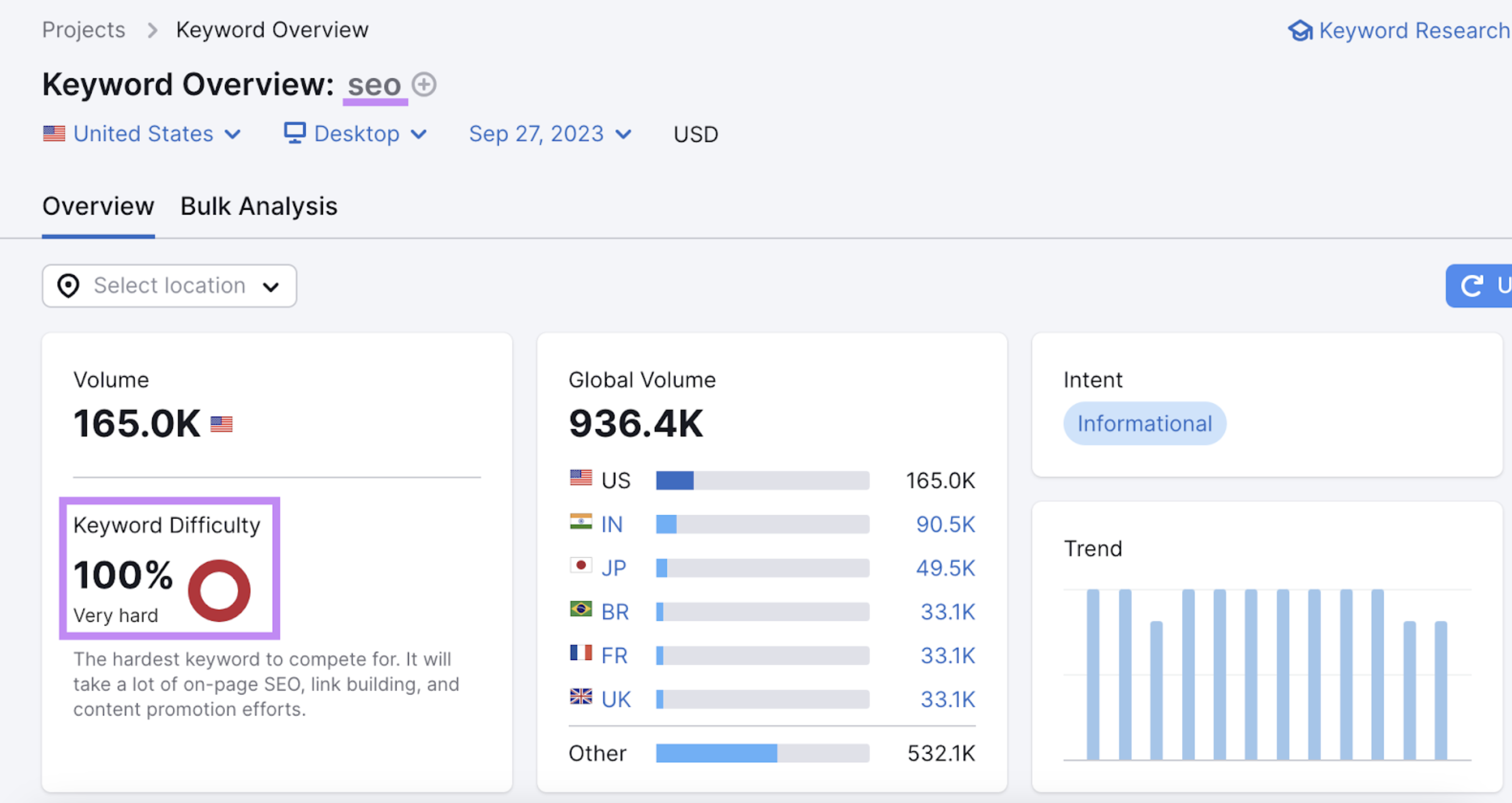
The terms with a low KD% will be the focus of your programmatic SEO project. It's "very easy" from 0–14, and "easy" and reasonably attainable from 15–29.
In order to provide the quality necessary to compete in the SERPs, difficult keywords usually demand for a rigorous SEO strategy. Select keywords for pSEO that have a lower KD%.
By conducting keyword research, you can discover relevant low KD search keywords.
2. Intent to Search
The primary objective of a visitor that visits your website is referred to as search intent.
Four primary categories of user intent exist:
- Navigation: People search for a certain page (like "Gmail login").
- Informational: People attempt to find out more about a subject (such as "what is Search Console").
- Commercial: Before making a purchase, users conduct research (e.g., "best programmatic SEO tools").
- Transactional: Users attempt to carry out a particular transaction or action (such as "buy ecommerce domain").
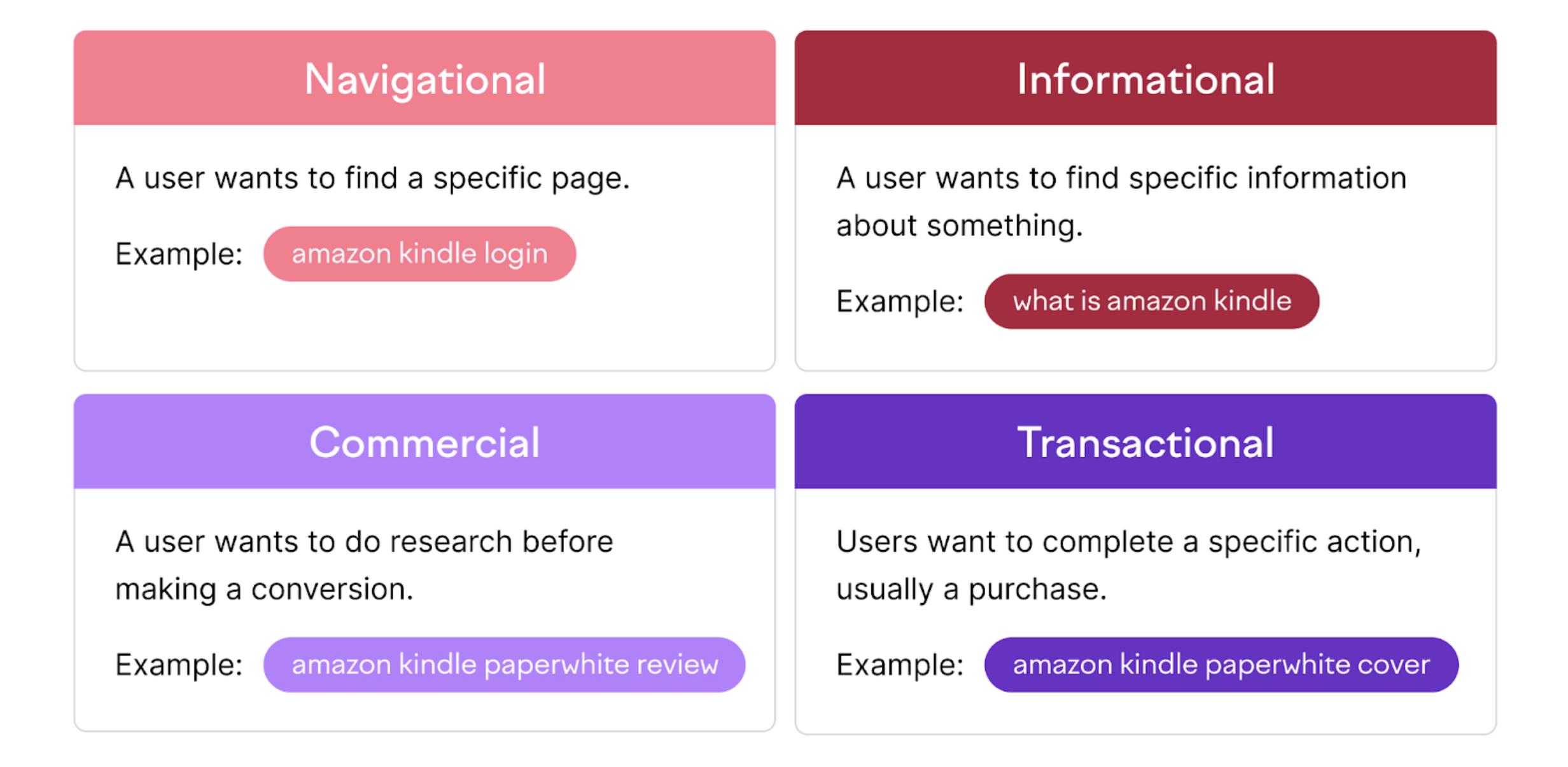
Aiming for keywords with transactional or commercial search intent is a common practice in programmatic SEO. For instance, "amazon kindle paperwhite review" or "amazon kindle cover."
Therefore, programmatic pages are most effective for buyers who are near the bottom of the marketing funnel.
Your landing page should meet search intent early on to reassure users that they are in the proper place. It increases the likelihood that they will stay on the page.
Using "top Italian restaurants in London" as an example, the following Time Out listicle appears:
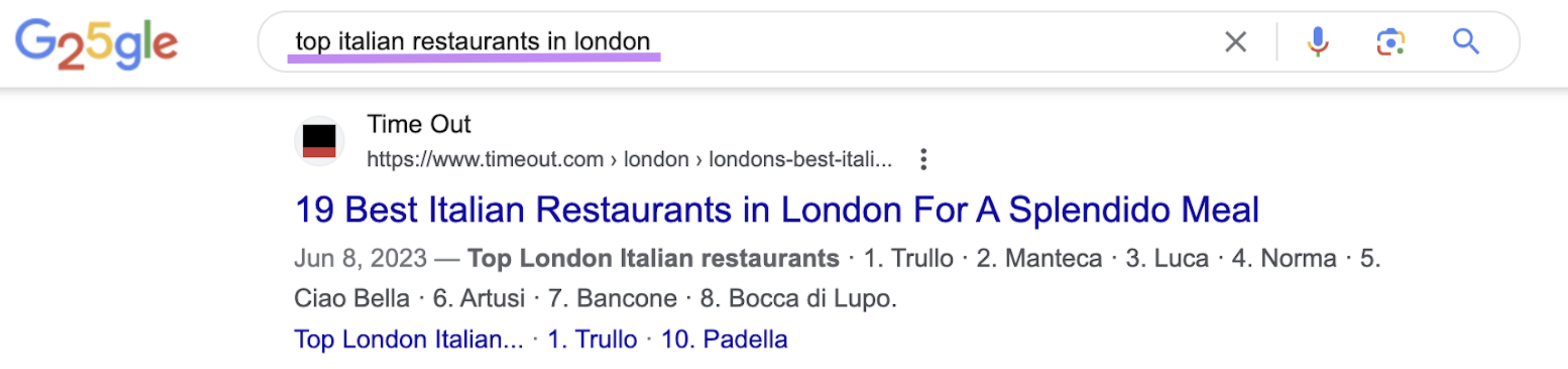
The people who are looking for these terms are ravenous. Time Out provides an excellent user experience by offering 19 locations where you may do it immediately.
3. User Interface (UI)
Visitors to your page who have a positive experience will stay and become converts. However, the automation that enables landing page growth may have an impact on user experience.
This means that each of your pages needs to load quickly and have original, useful content.
For instance, thousands of pages on the review website G2 have the same design:

These pages include a great deal of information. Nevertheless, everything loads quickly and operates without stuttering, making for a light-hearted and delightful experience.
Similar landing pages can be produced with programmatic SEO. However, you must continue to produce work of a high caliber.
Make your landing pages with automation tools. Next, have the content written by a human, or at the very least, carefully edited.
When low-quality or thin material is used as a landing page template with the same AI-generated copy for ranking purposes, penalties may result.
Doorway pages, according to Google:
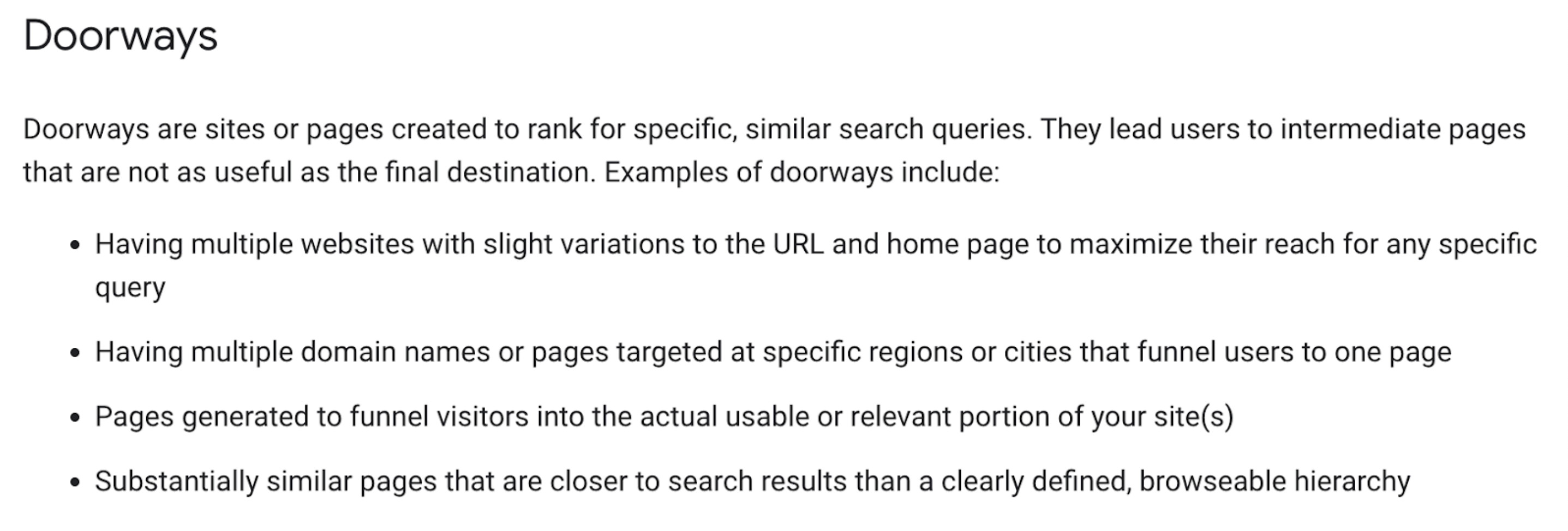
By adding value to pages with engaging design and original content, you can prevent this.
See our guide on Google penalties for additional information on similar concerns.
How to Execute a Programmatic SEO Strategy in 5 Easy Steps
The first step in a successful programmatic SEO strategy is to conduct competitive and target audience research before selecting long-tail keywords that are pertinent to your industry.
Create your landing page template when you have determined your keywords. Additionally, enhance the user experience to persuade visitors to become converts.
Here's how to do it:
1. Examine Your Market and Rivals
To decide on the landing page type you want to use, do some research on your niche. To get more ideas, see what your rivals are doing as well.
To start, consider what your audience is interested in:
- Diverse applications for your service or product
- The places you collaborate with
- The integrations you provide
- Lists of the top 10 items related to your niche
- Models that you could create
Make a list of all the topics you could write about that are pertinent to determine your emphasis. Using a spreadsheet to keep organized is a healthy habit.
These abstract subjects will become your "head terms." These will be discussed in the following section.
In addition to themes, think about your rivals.
In terms of the travel sector, this comprises Expedia and TripAdvisor. Regarding real estate, consider Realtor.com and Zillow.
Make a list of the rivals you are aware of along with the designs and structures of their landing pages. They might serve as an inspiration for you. After completing that, cast a wider net.
How then do you locate other rivals?
Use Semrush's Organic Research tool to follow this methodical competitor analysis methodology.
Launch the tool, then type your domain in. Next, click "Search."
Let's say you are a local hardware store owner who wants to research your rivals. You may look up Home Depot first:
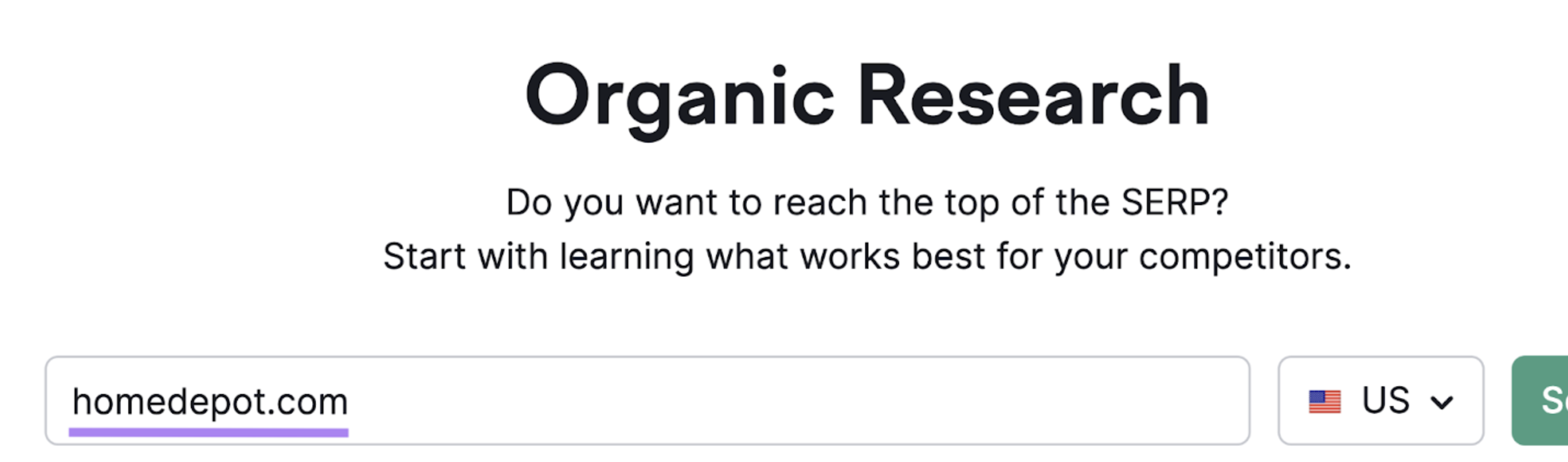
Navigate to the "Main Organic Competitors" section of the study.
The websites listed below are those with which Home Depot is in competition for the same keywords:
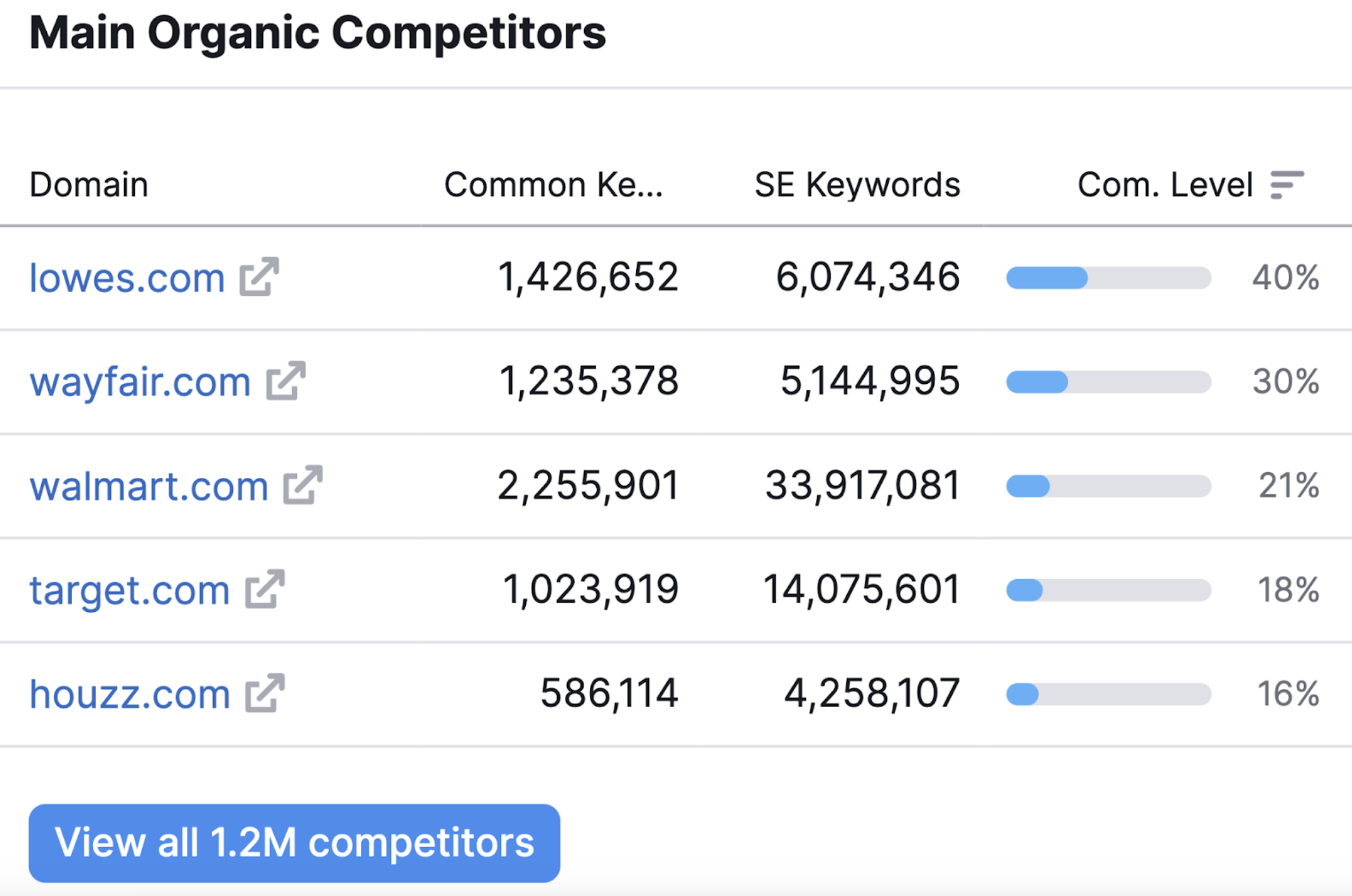
Click "View all competitors" to get the complete list.
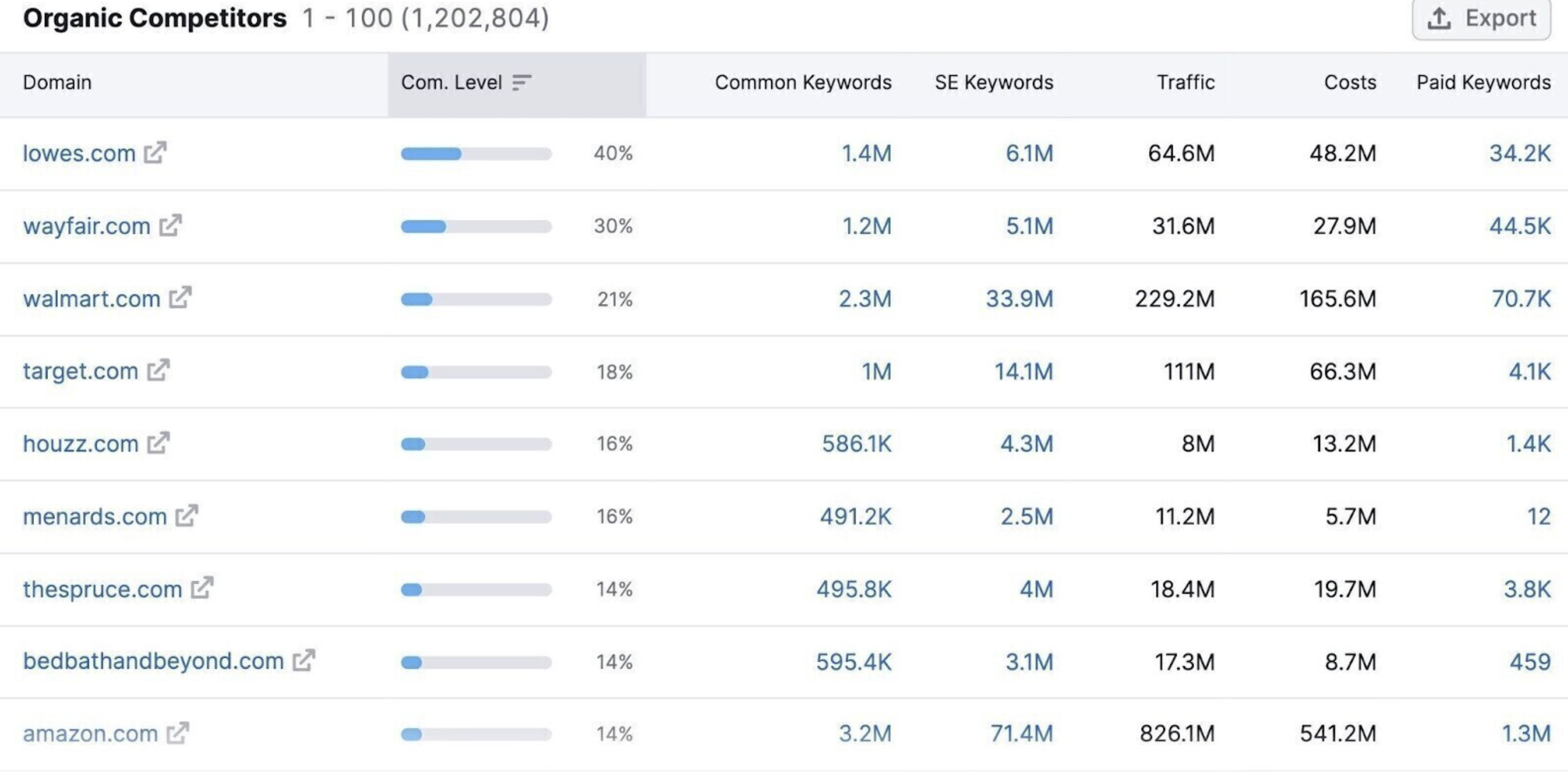
You can click on each domain from this point forward. Next, observe the organic keywords that they appear for.
This technique can help you understand the kinds of pages that your audience—as well as that of your competitors—look for and find valuable.
Include every one of these subjects, keywords, and rivals in your spreadsheet.
You may next use the Topic Research tool to assist you come up with more content ideas that are relevant to your website and include head terms and modifiers.
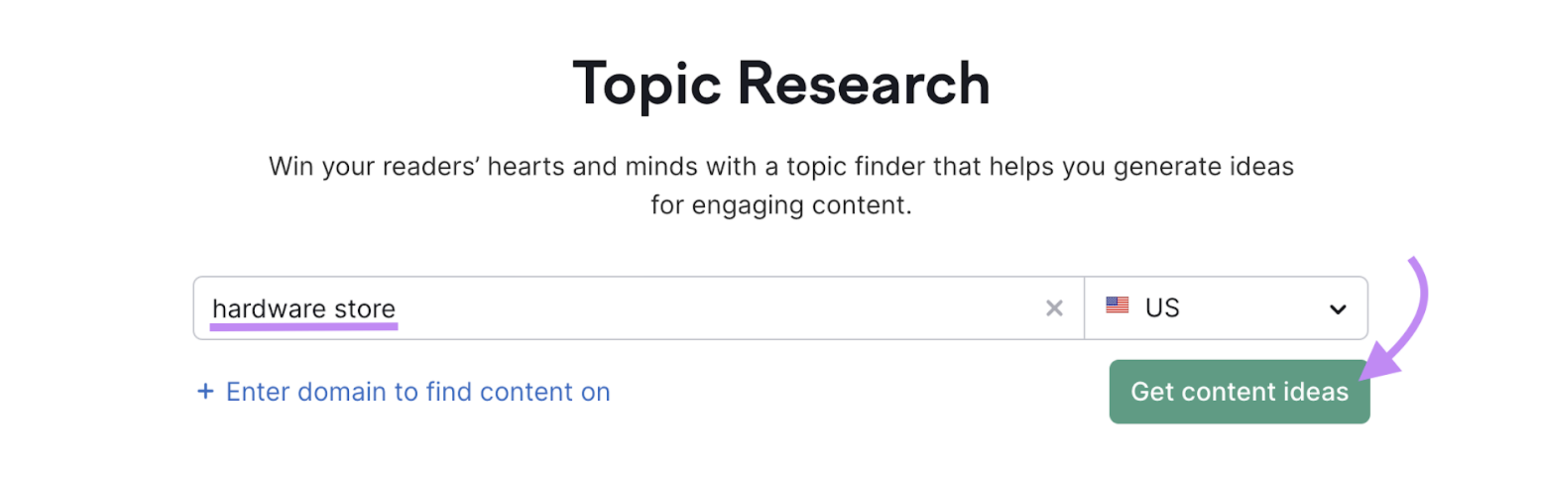
2. Identify Your Main Concepts and Descriptive Words
Head phrases refer to the main categories of keywords that you will target. Your modifiers transform your head terms into long-tail keywords.

Long-tail keywords are very precise search queries with relatively low search volumes.
(Additional information about those will be provided shortly.)
For instance, you can select a suitable search word for your specific area of interest (your main term). Next, include the particular places individuals search for (your modifier).
TripAdvisor utilises modifiers based on geography. Two of the most frequently used main terms are "top hotels" and "top vacation rentals."
Another option is "activities."
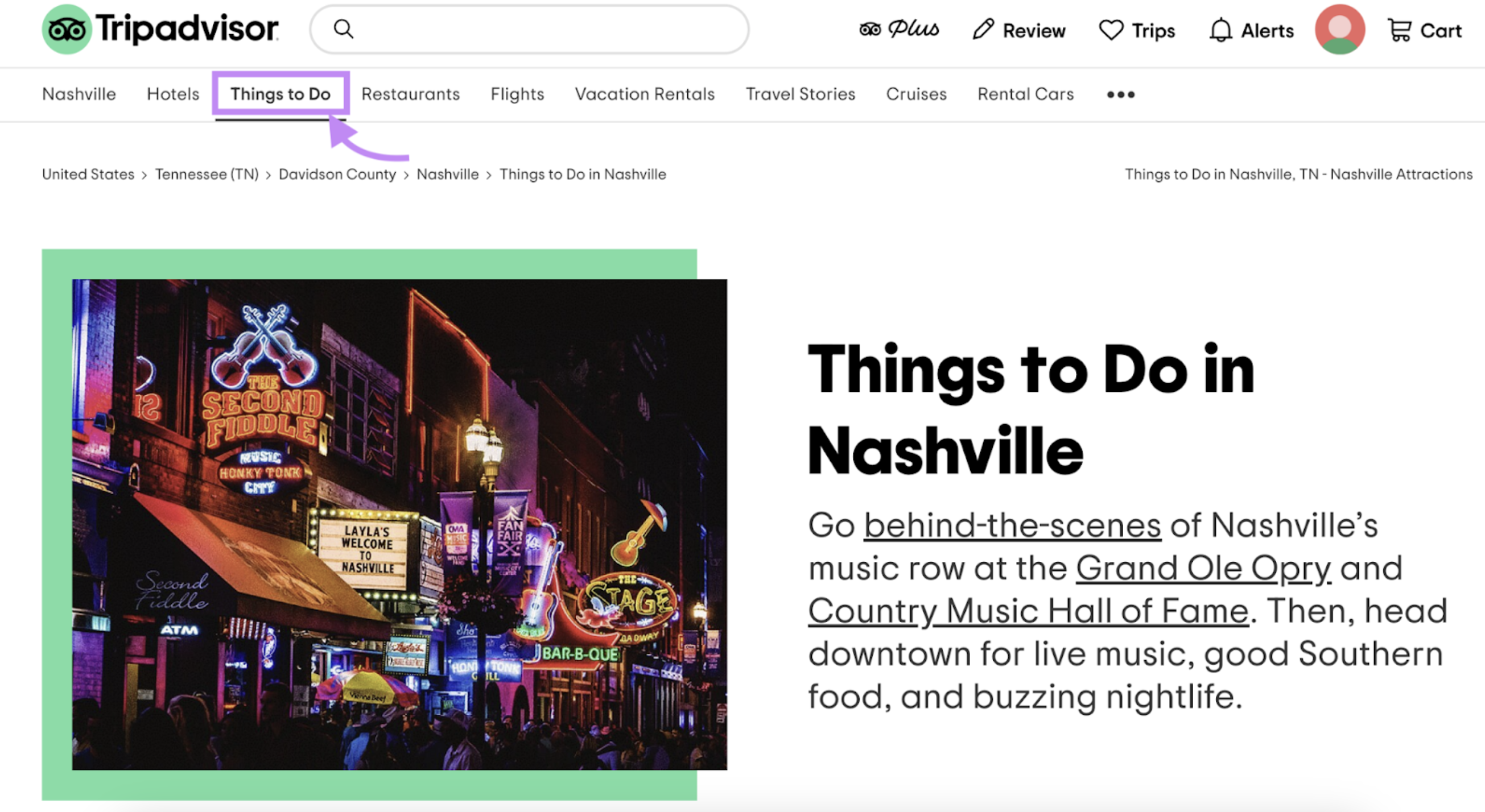
Since it is a website for travel, the modifier indicates the place with "in [location]."
For instance, "activities in Nashville."
You can also include an additional modifier to further refine the search. For example, "Activities to do in Nashville with children."
Due to the specificity of your search phrase, secondary landing pages may have a significantly altered layout compared to your primary modifiers:
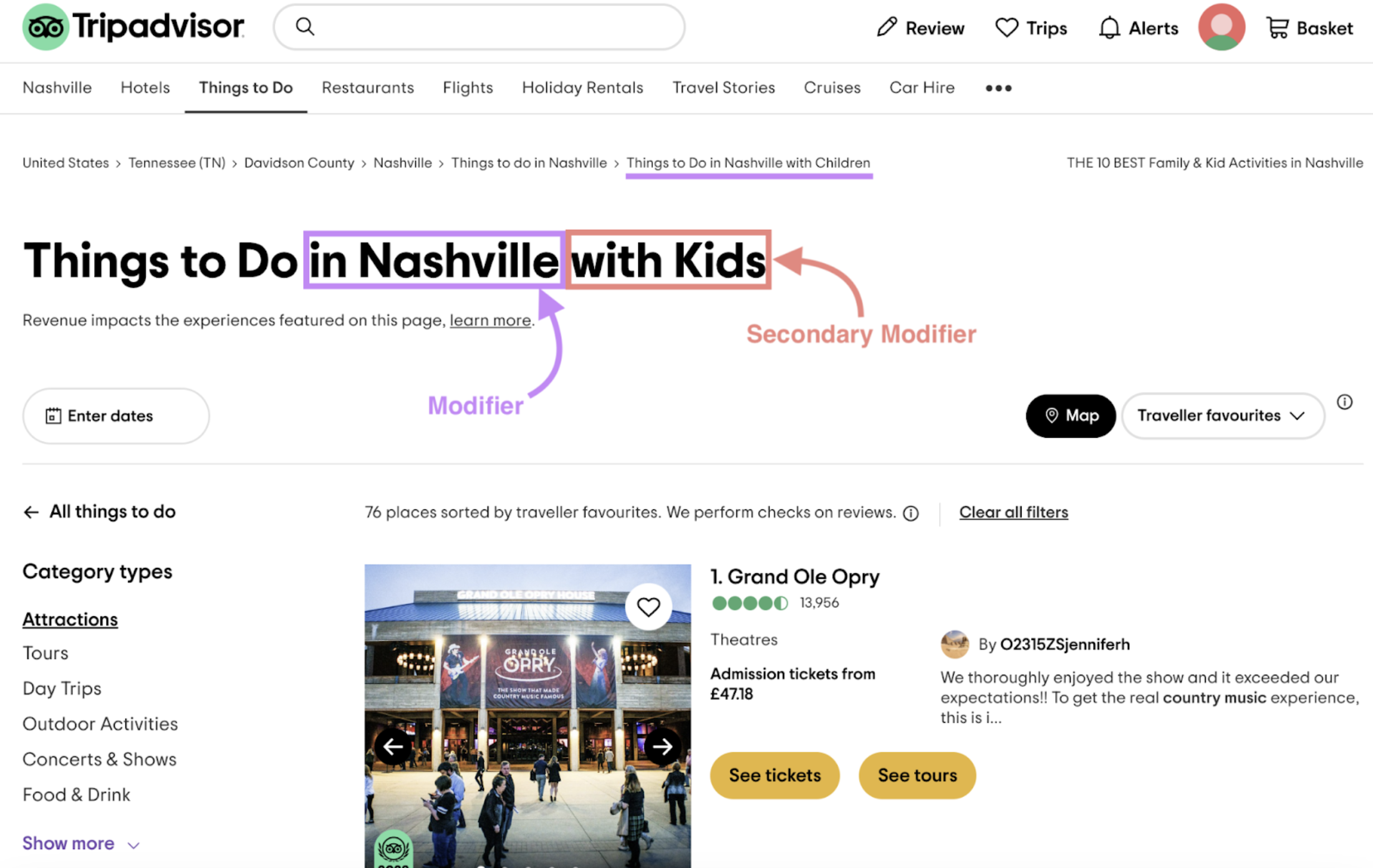
Alternatively, you could maintain uniformity among them. The decision is yours.
Here are some further programmed SEO examples of main keywords and descriptive words:
- Zapier: "Connecting [app] and [app] made easy"
- Yelp: “Best restaurants in [location]”
- Zillow: "Homes for sale in [location]"
- Canva: "Design template in a graphic format"
- Airbtics: "Airbnb Trading in [location]"
- DelightChat: “Best Shopify [app type] apps”
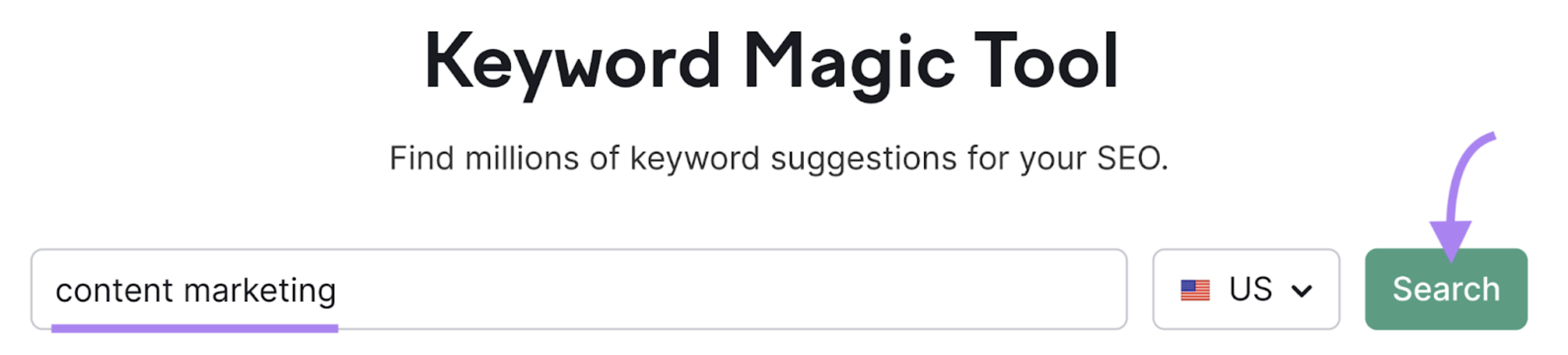
To discover your long-tail keywords, go to Semrush's Keyword Magic Tool.
Enter one of the main phrases from your spreadsheet.
Let's use "content marketing" as an illustration.
Next, you will observe many versions of your main word.
Keyword Magic can provide suggestions for modifiers.
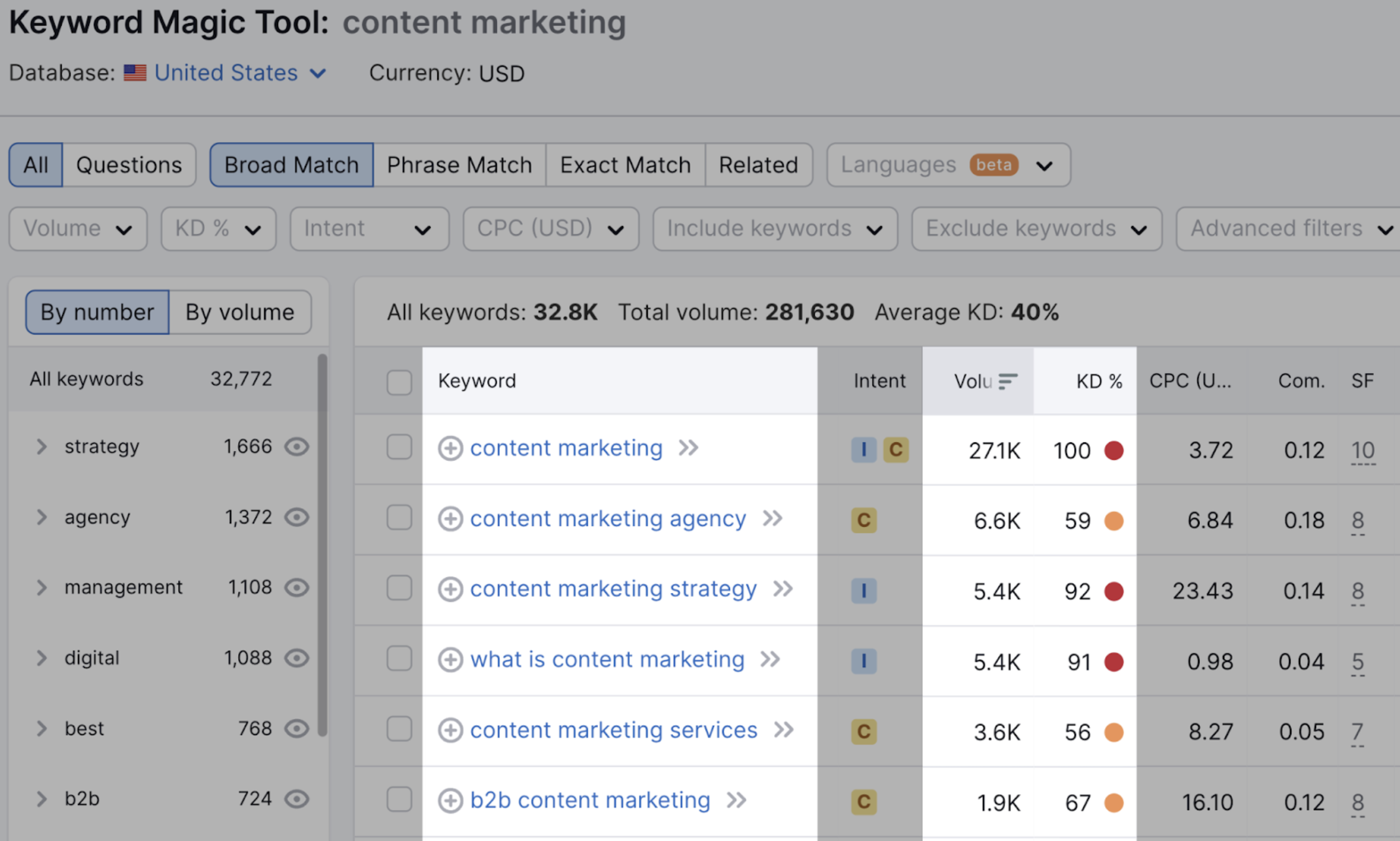
The first few have high search volume and high KD. That means these aren’t suited for programmatic SEO.
Keep in mind, we are looking for long-tail keywords that have a low KD and search volume. So let’s narrow down the list.
Adding a KD filter means we can opt to only show keywords with a low-ranking difficulty.
Click on the "KD" dropdown menu and choose "Easy."
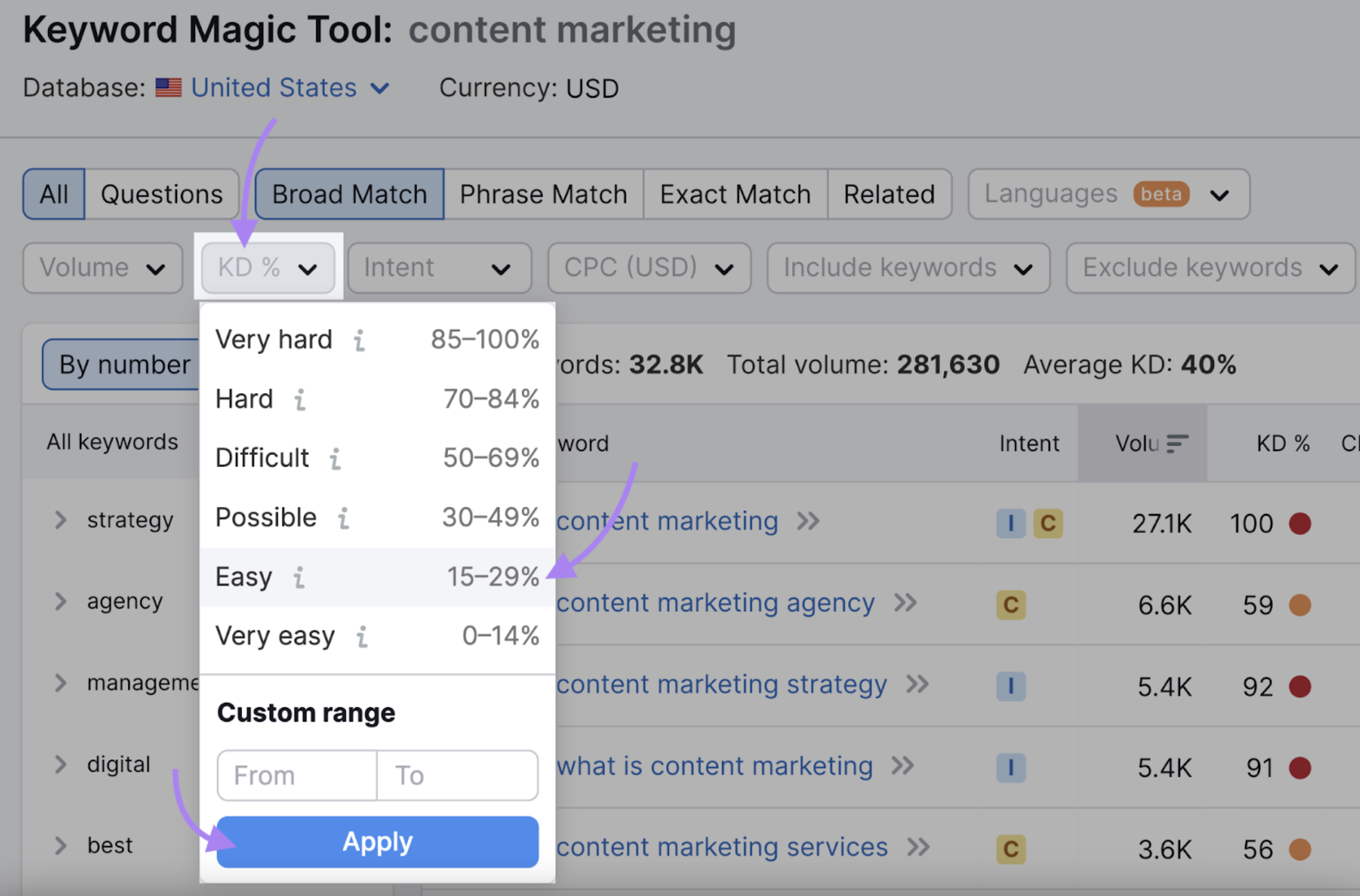
Currently, we only possess ideas for long-tail keywords.
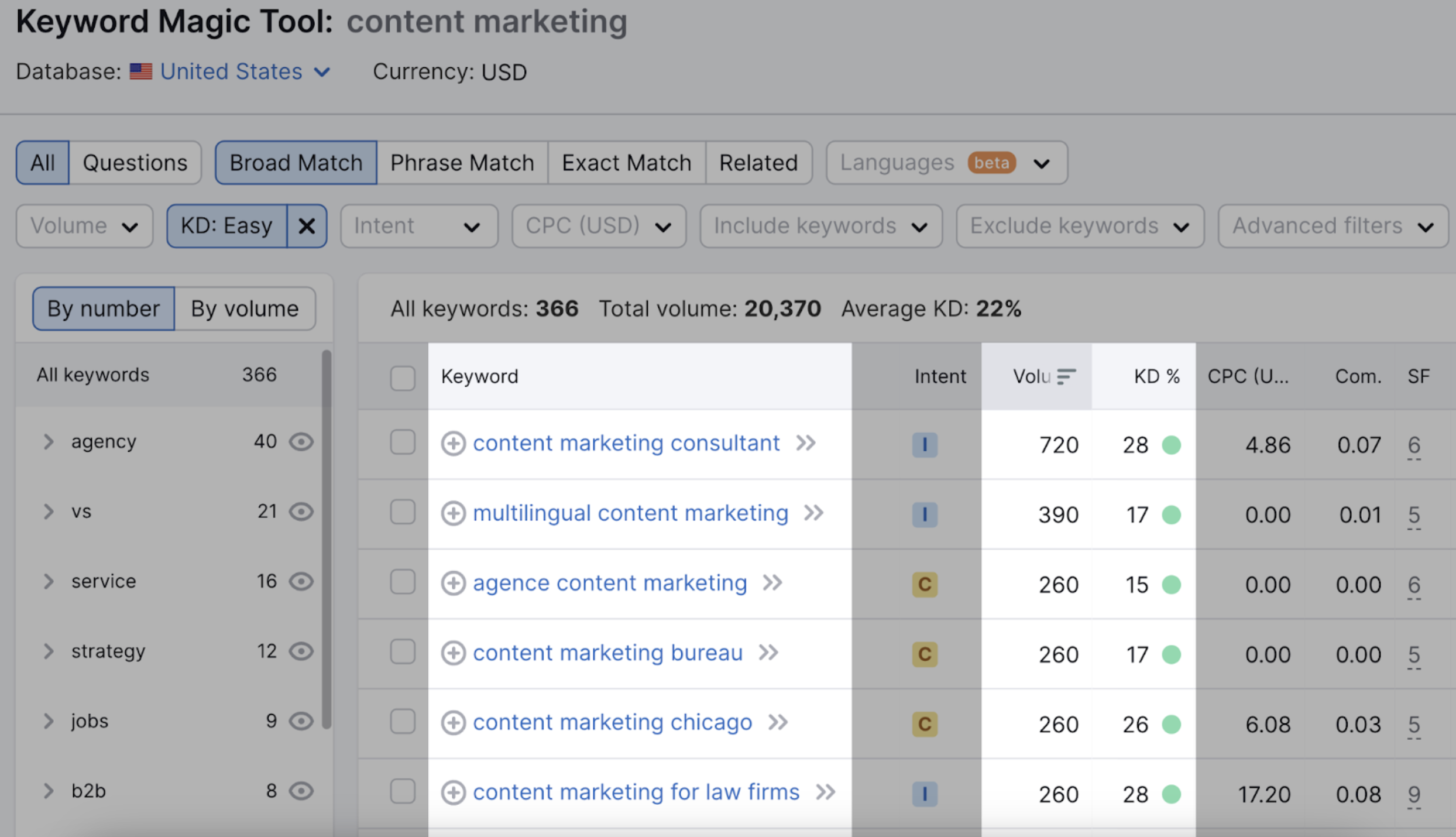
While 366 keywords may appear to be a large number, you won't create landing pages for each one of them.
3. Choose Your Long-Tail Keywords
By combining the head phrases you have selected with modifiers, you will generate an extensive list of long-tail keywords.
Now, we must take into account the purpose of the search and those that might be repeated for landing pages.
Return to the Keyword Magic Tool to discover options with low keyword difficulty. We will once again utilize our example of "content marketing".
In the dropdown menu beside KD, choose "Intent."
We'll begin with individuals who wish to make a purchase.
Therefore, select "Transactional" and then proceed to "Apply."
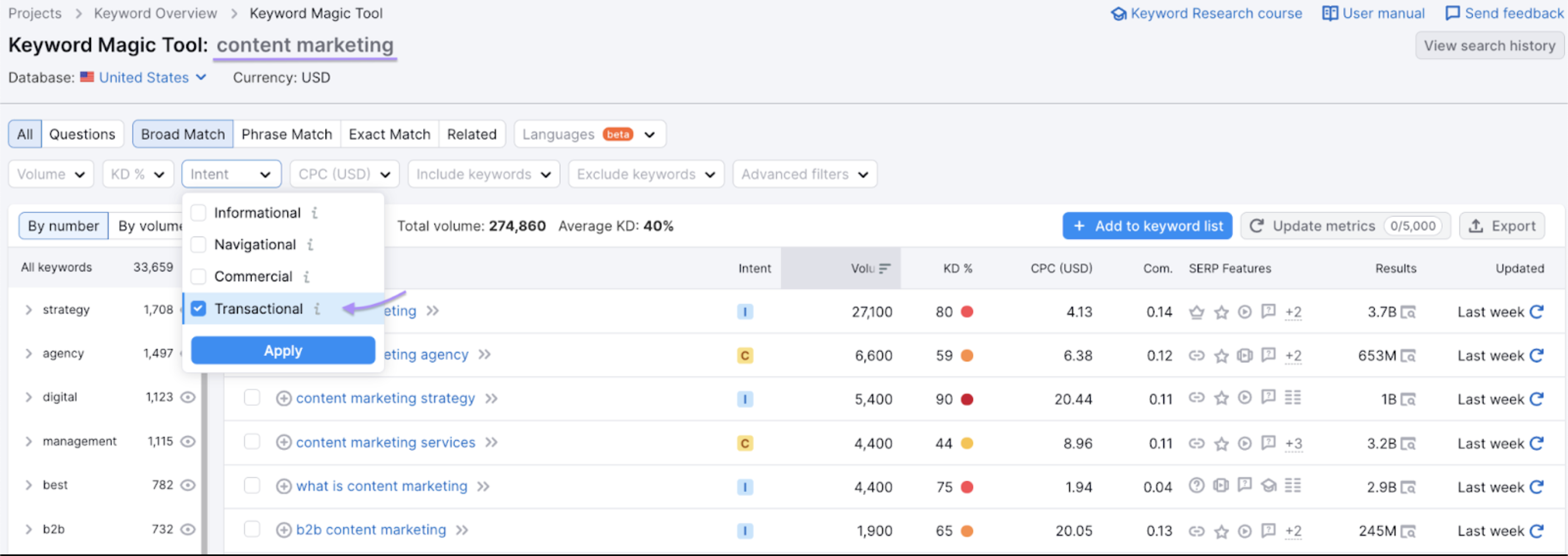
You’ll then have a list of long-tail keywords with a low KD. In addition, the appropriate search purpose.
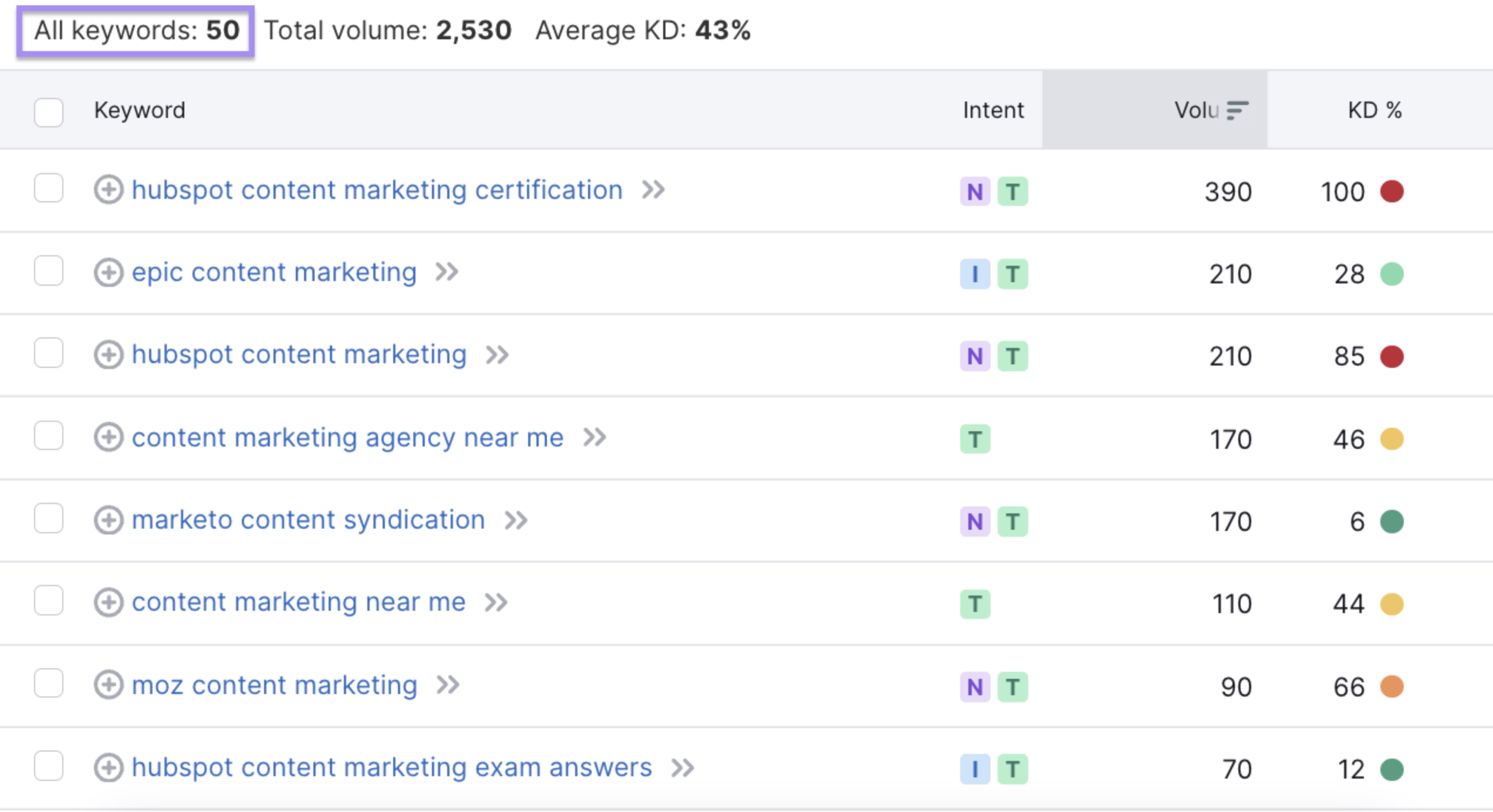
Observe that the overall quantity of keywords has decreased to 50.
Terms such as "hubspot content marketing" could motivate you to develop landing pages for comparing different options.
For instance, "[your app] compared to [competitor app]."
Alternatively, you might opt for a modifier based on location.
Similar to "content marketing agency in my area."
To do this step again, go back to the dropdown menu and select the "Commercial" intention.
After obtaining a collection of long-tail keywords that have the appropriate intent, include them in your spreadsheet.
Narrow them down more using these questions:
- Is it possible for me to generate numerous variations based on these keywords?
- Will my material meet the search intent?
- Will my material be sufficient to rank for these terms?
- Will these landing pages generate traffic for me?
- Will these landing pages generate revenue for me?
- If you answer "yes" to all of them, then you have your keywords.
Any keywords that do not meet all of the criteria mentioned above should be discarded or saved for another use, as they are not suitable for your pSEO.
4. Create Your Landing Page Template
You require a single template to generate numerous duplicates of the identical landing page. Therefore, create and construct a single webpage to serve as the foundation for your programmatic SEO project.
The initial element to establish is your content.
Every landing page will likely contain the same elements (e.g., visuals, reviews, lists, etc.), but they can’t have the same information if you don’t want Google to punish them.
Therefore, choose the design of your landing page according to your keywords.
For instance, you may provide templates similar to Canva:
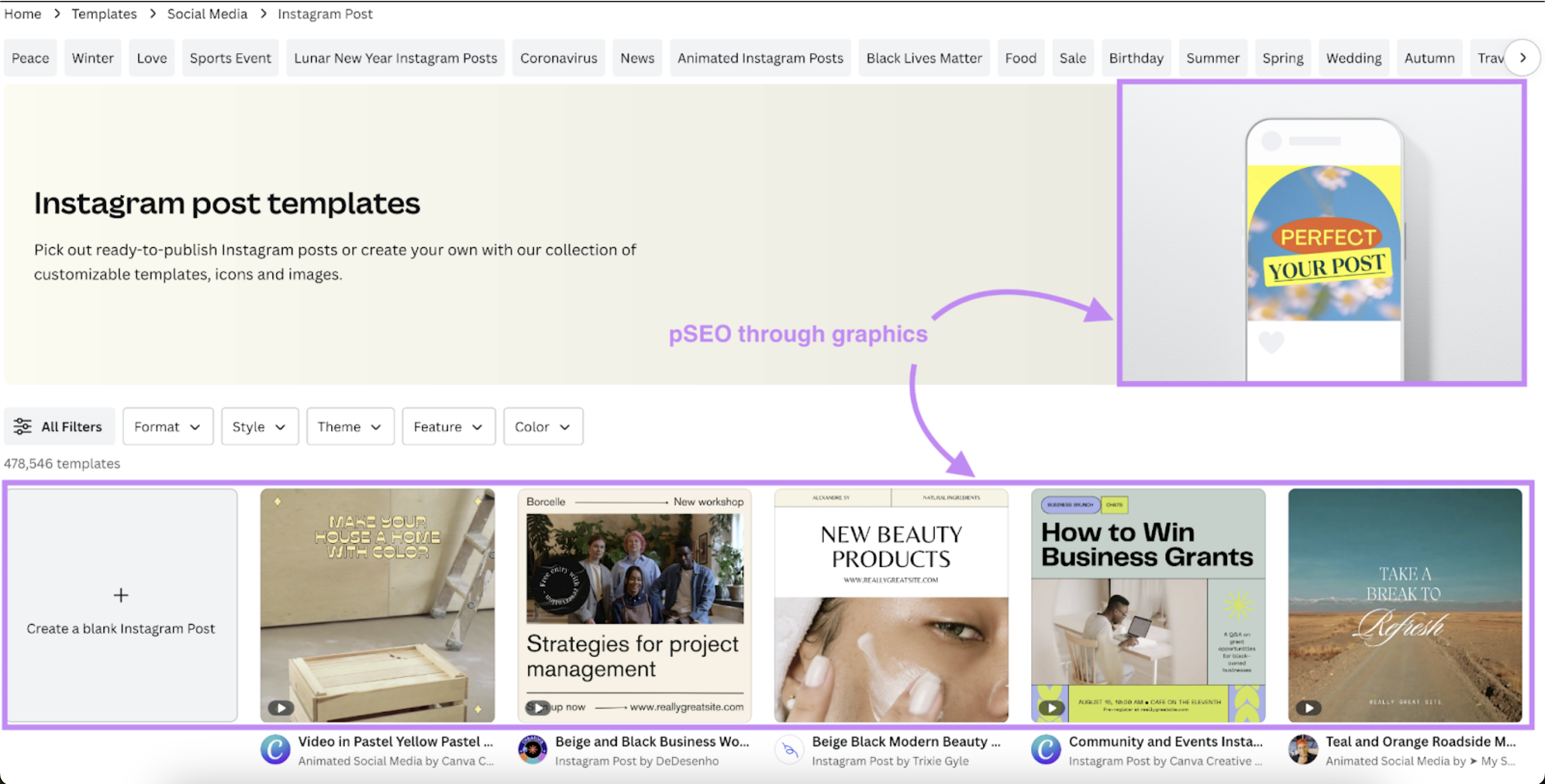
For these kinds of programmable pages, you'll give more importance to images than to text.
Alternatively, you can opt for a marketplace design (like to Rover) where suppliers and customers contribute content:
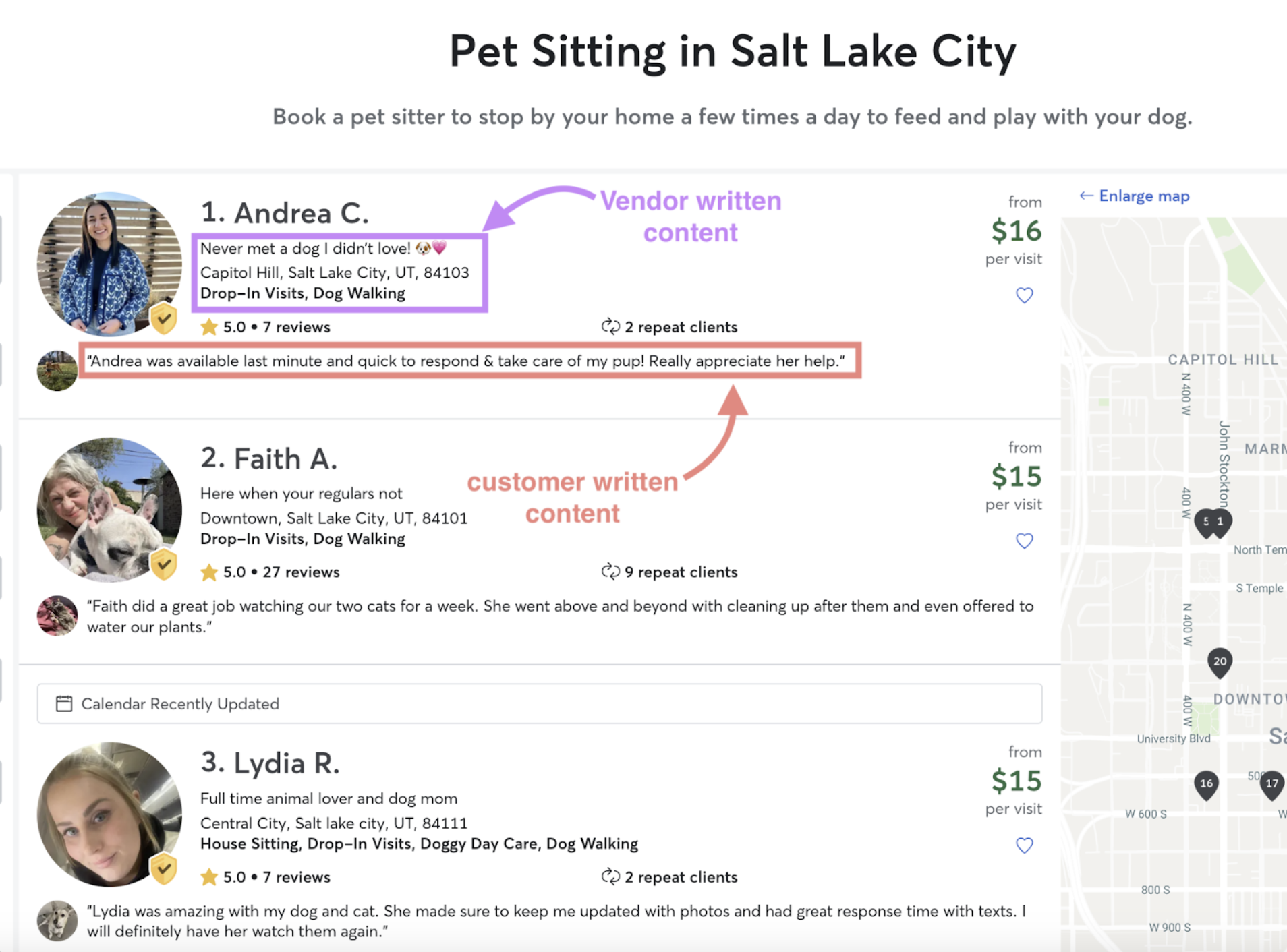
Here, the content written by third parties and the locations of pet sitters are of utmost importance. You will also need to make sure there is enough room for a map on these kinds of landing pages.
The design you select relies on what you provide and the kind of landing page that would go well with it.
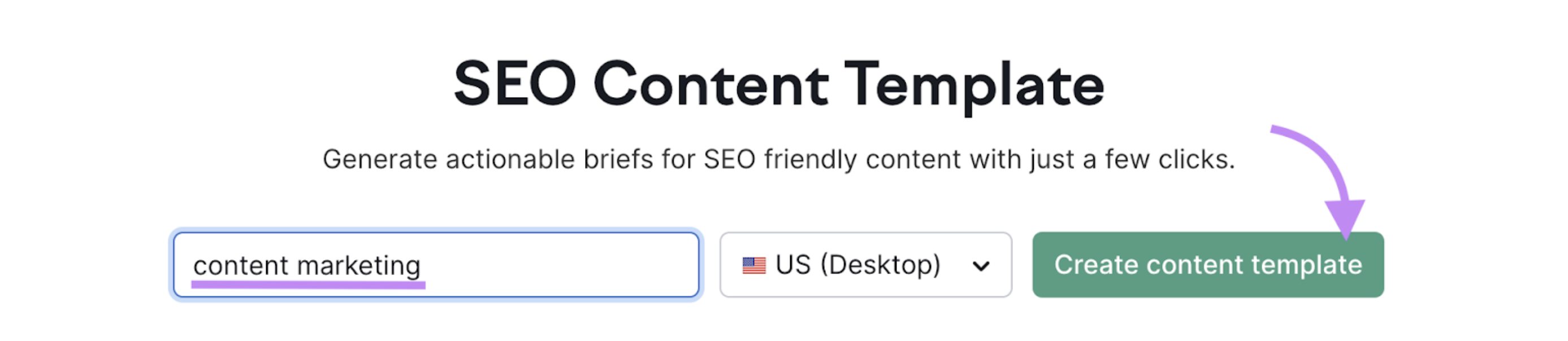
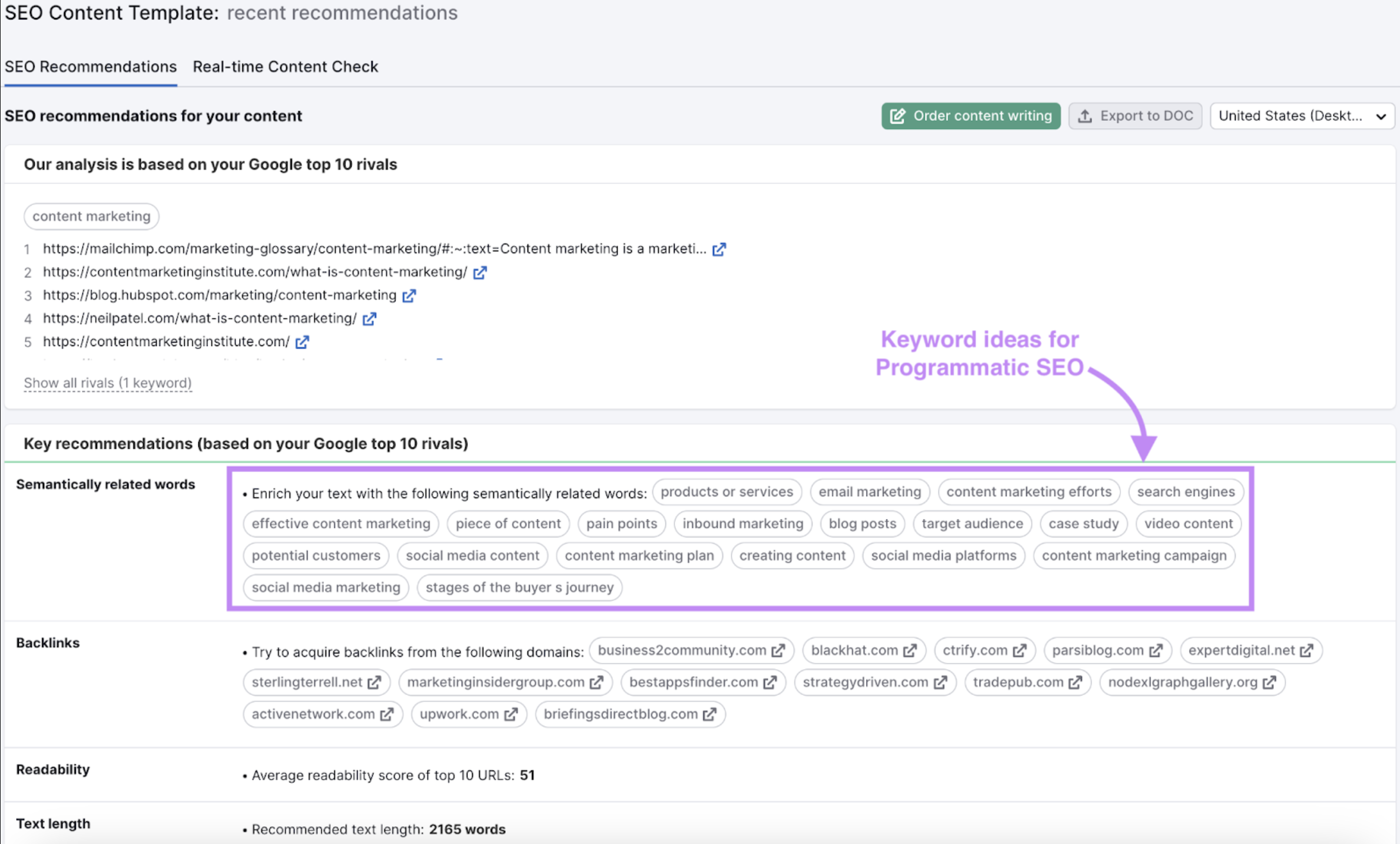
You can find further suggestions for the kind of keywords and material to incorporate using Semrush's SEO material Template tool.
The tool offers terms that are connected in meaning, which may be utilized to create content for your programmatic landing pages.
Once you have that figured out, it's time to create your landing page.
Select a Landing Page Builder
You can create a landing page using WordPress plugins such as WP All Import or a website builder like Webflow.
The second option offers free templates that are simple for beginners to use in designing their own website.
Webflow additionally provides HTML embeds for inserting your data into dynamic components:
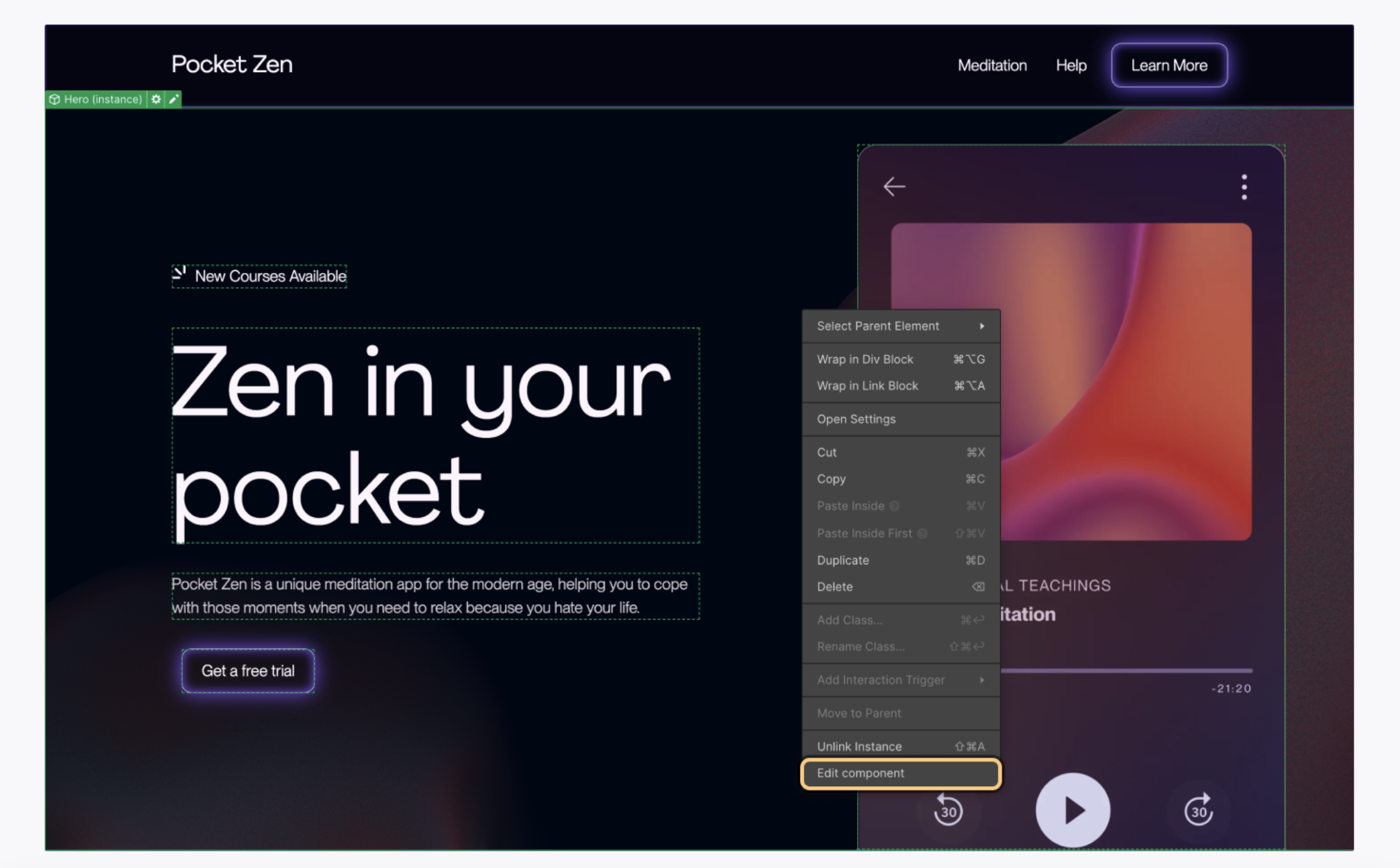
Additionally, it possesses an extensive repository of information for utilizing its API for programmatic SEO. An API enables software developers to integrate Webflow directly into your landing page.
So, take a look for a whole guide.
Select a Database
Now you are aware of the location to construct your template. However, where is the information stored that comprises these components?
You can utilize a simple Excel spreadsheet.
Alternatively, you can utilize a tool such as Airtable, which simplifies the process of creating tables to arrange and oversee your data.
Think about AI writing tools
The SEO content Assistant from Semrush can assist you in evaluating the originality and SEO-friendliness of your content. It can also provide appropriate keywords to enhance your text and you can also receive assistance from AI when generating material to populate your database.
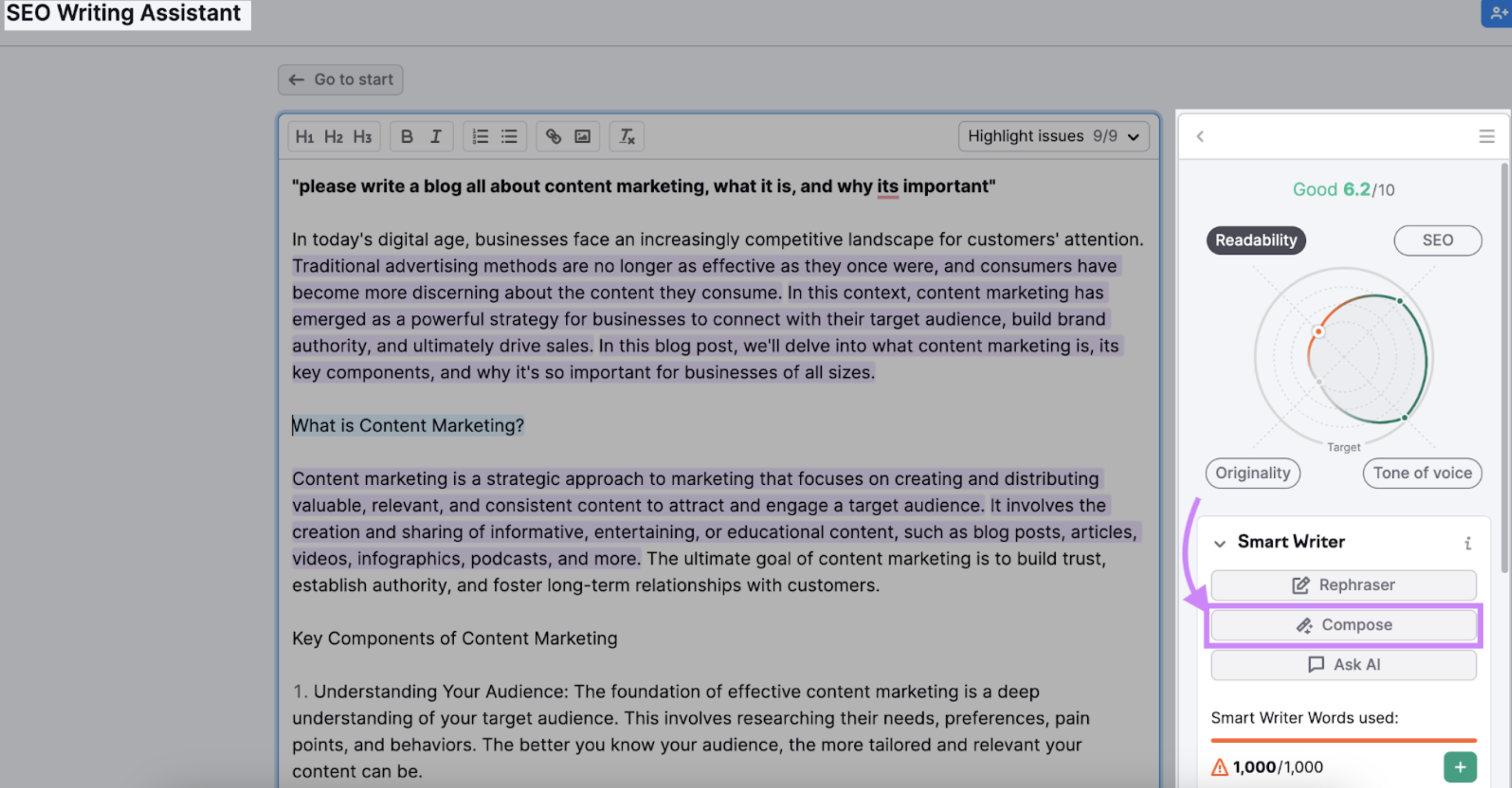
Using the SEO Writing Assistant tool, you can easily provide a prompt for additional information or for writing. In this situation, we requested "please create a blog post about content marketing, explaining what it is and why it holds significance."
By selecting compose afterwards, the SEO Writing Assistant will automatically populate the box with text on the chosen subject.
You also have the choice to inquire AI directly to generate content. This option can be chosen right underneath the compose option.
Note: These elements are not meant to substitute the human aspect of written content—they act as a useful tool in the writing process. Apply basic logic and keep in mind the Google Developer guidelines for utilizing AI-generated material.
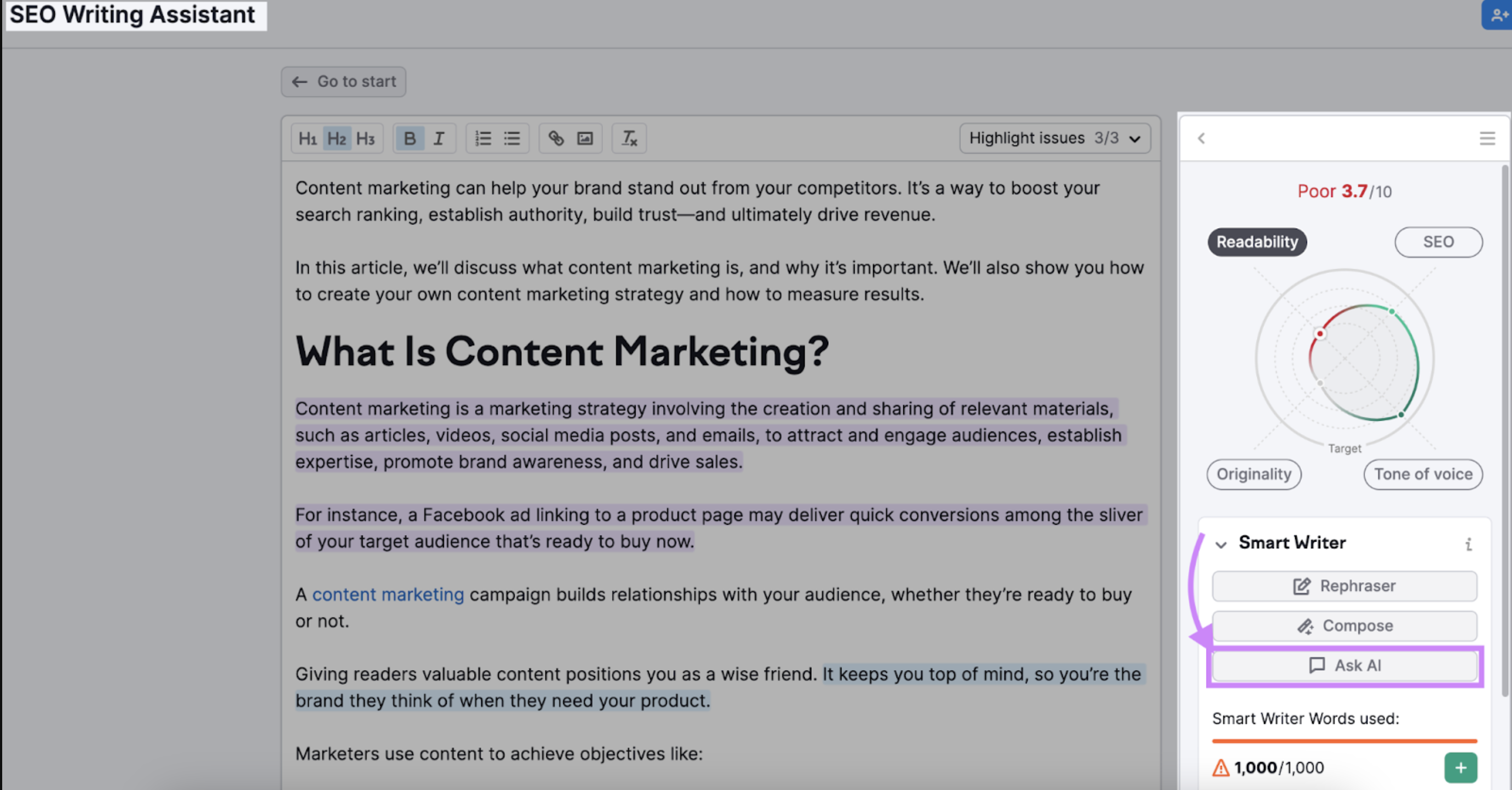
By scrolling down on the right side column, you can also view the readability score of the project you are working on, which enhances user experience and time spent on the page.
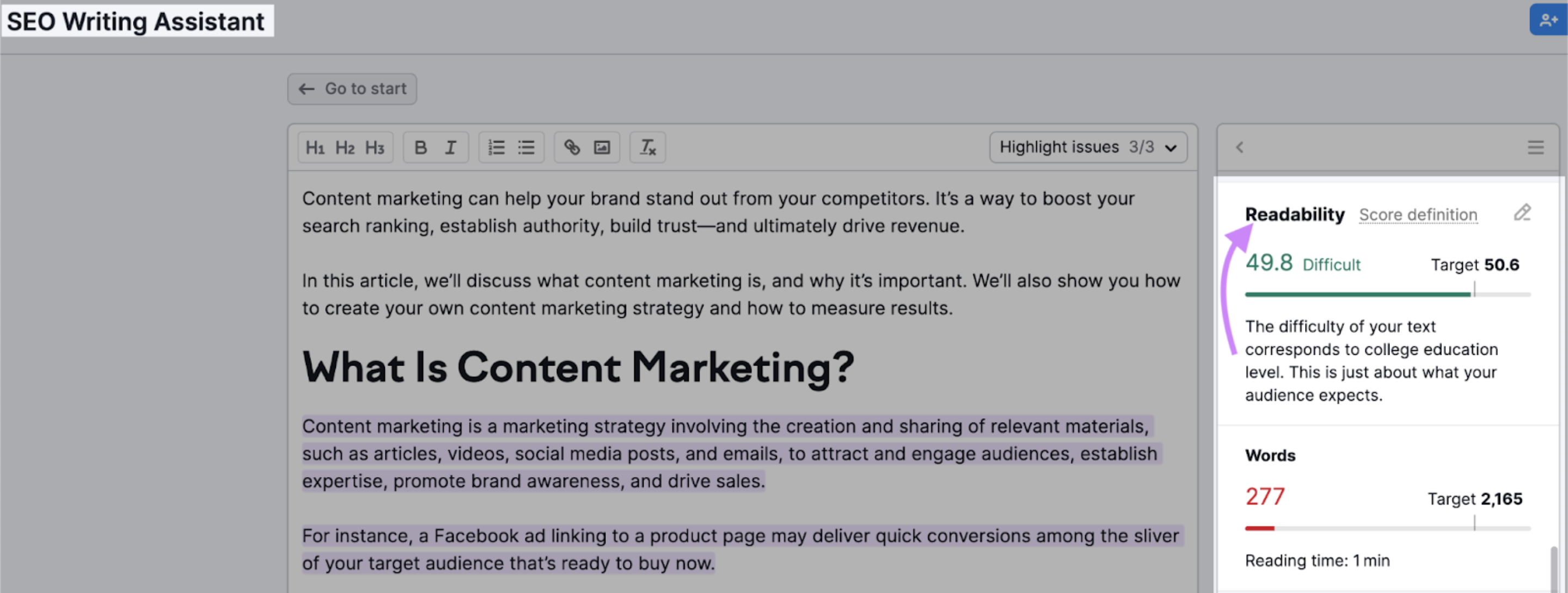
Additionally, the Rephraser tool can be utilized to propose alternate options for chosen paragraphs.
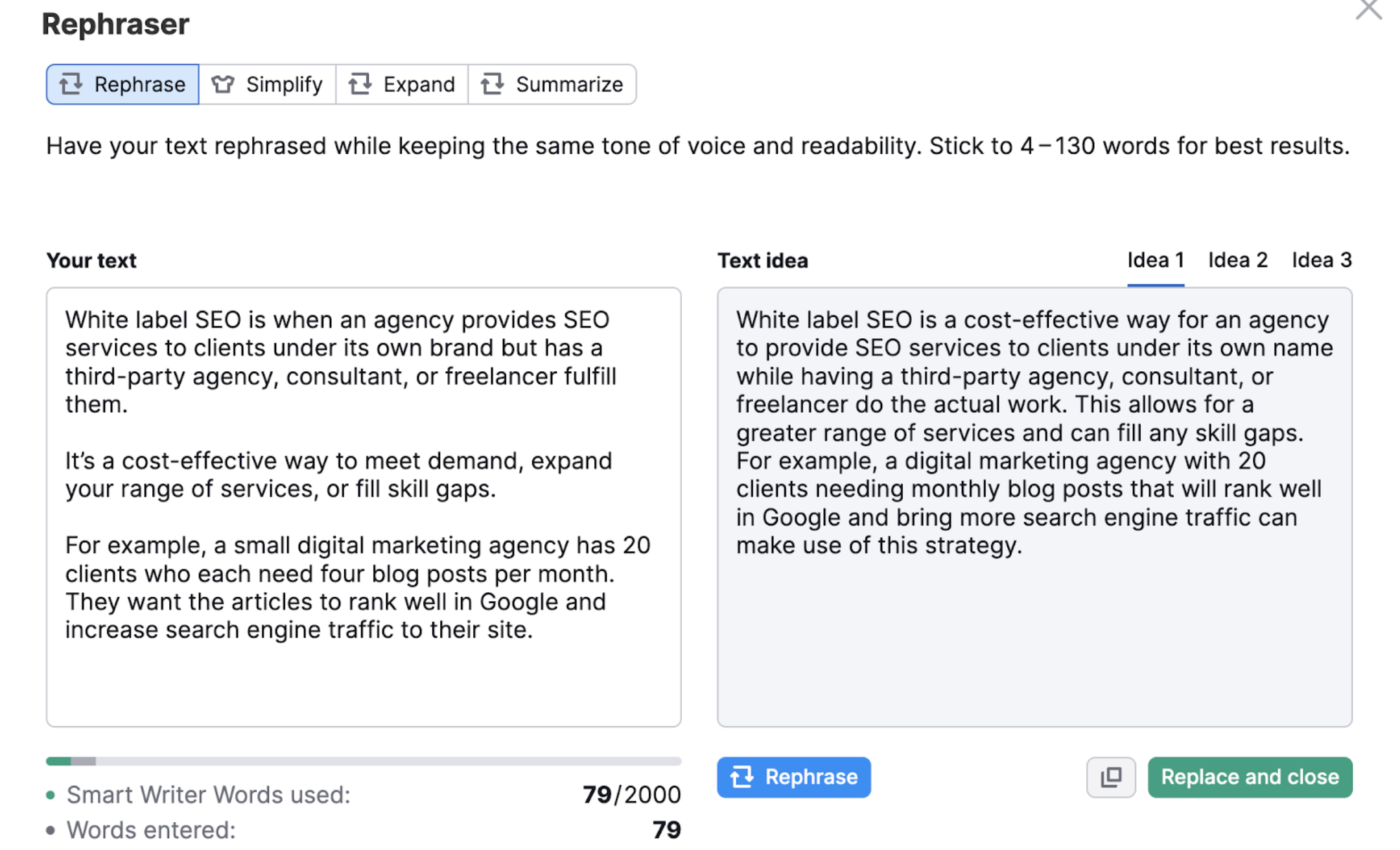
This can help you avoid Google's detection for content that is not original or copied.
Is the design, data, and copy prepared and ready? Now, you have to merge everything.
Utilize a Synchronization Mechanism
A solution such as Whalesync can assist you in transferring your data from Airtable to your Webflow template.
You simply need to ensure that the fields are the same in both tools:
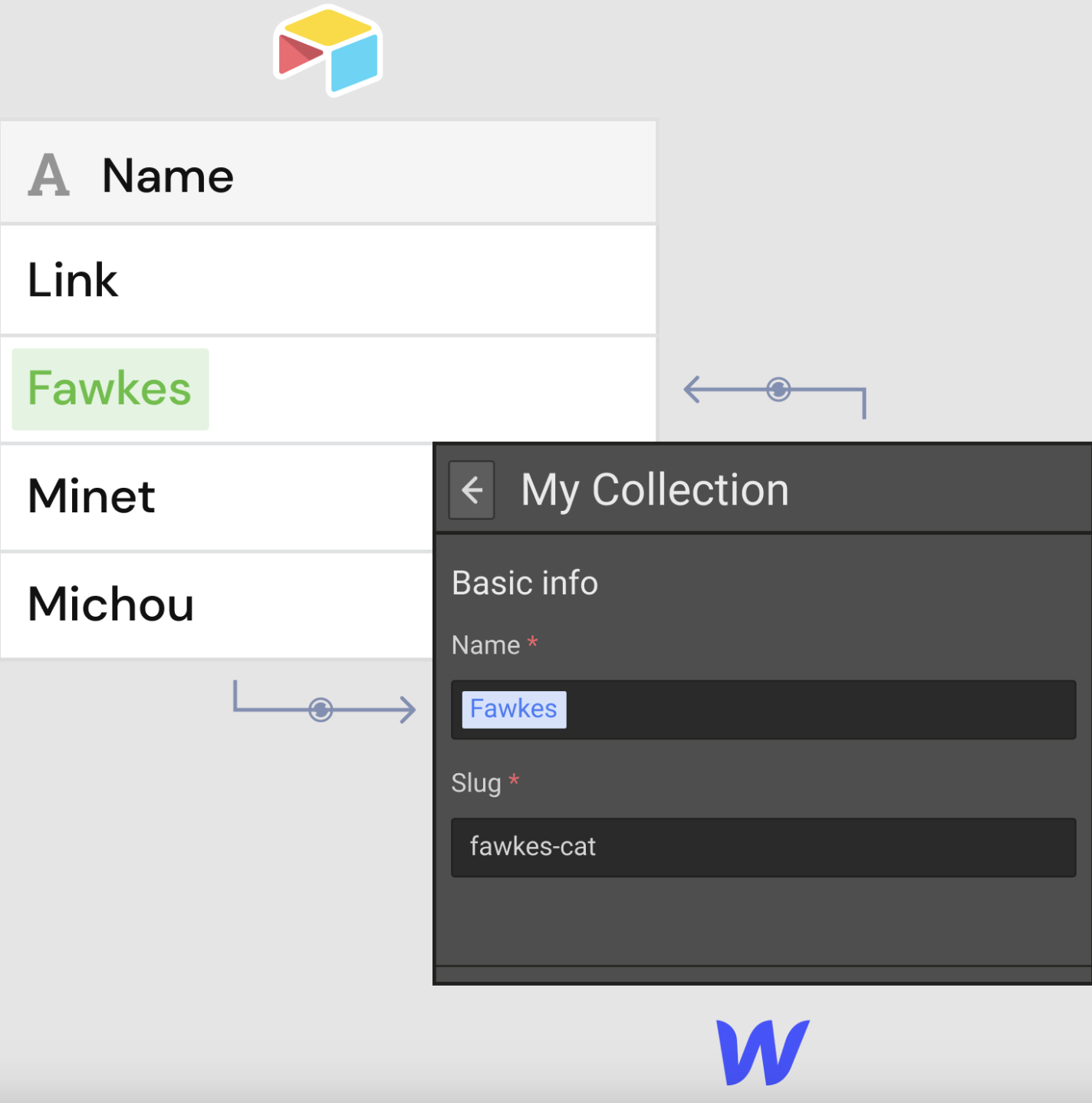
Once they accomplish this, combine them. Whalesync will handle the remaining tasks.
The automatic processes that occur in the background generate all of your programmed pages.
5. Optimize Your UX
Once they are live, your landing pages do not only need to be optimized for SEO. They also have to meet several UX standards to convince people to convert.
Here are five key UX criteria for programmatic SEO sites.
Begin with an appealing design
You need an eye-catching landing page to grab a visitor’s attention. However, it doesn't have to be complicated.
Zapier use straightforward visuals to demonstrate the simplicity of connecting applications with their tool:
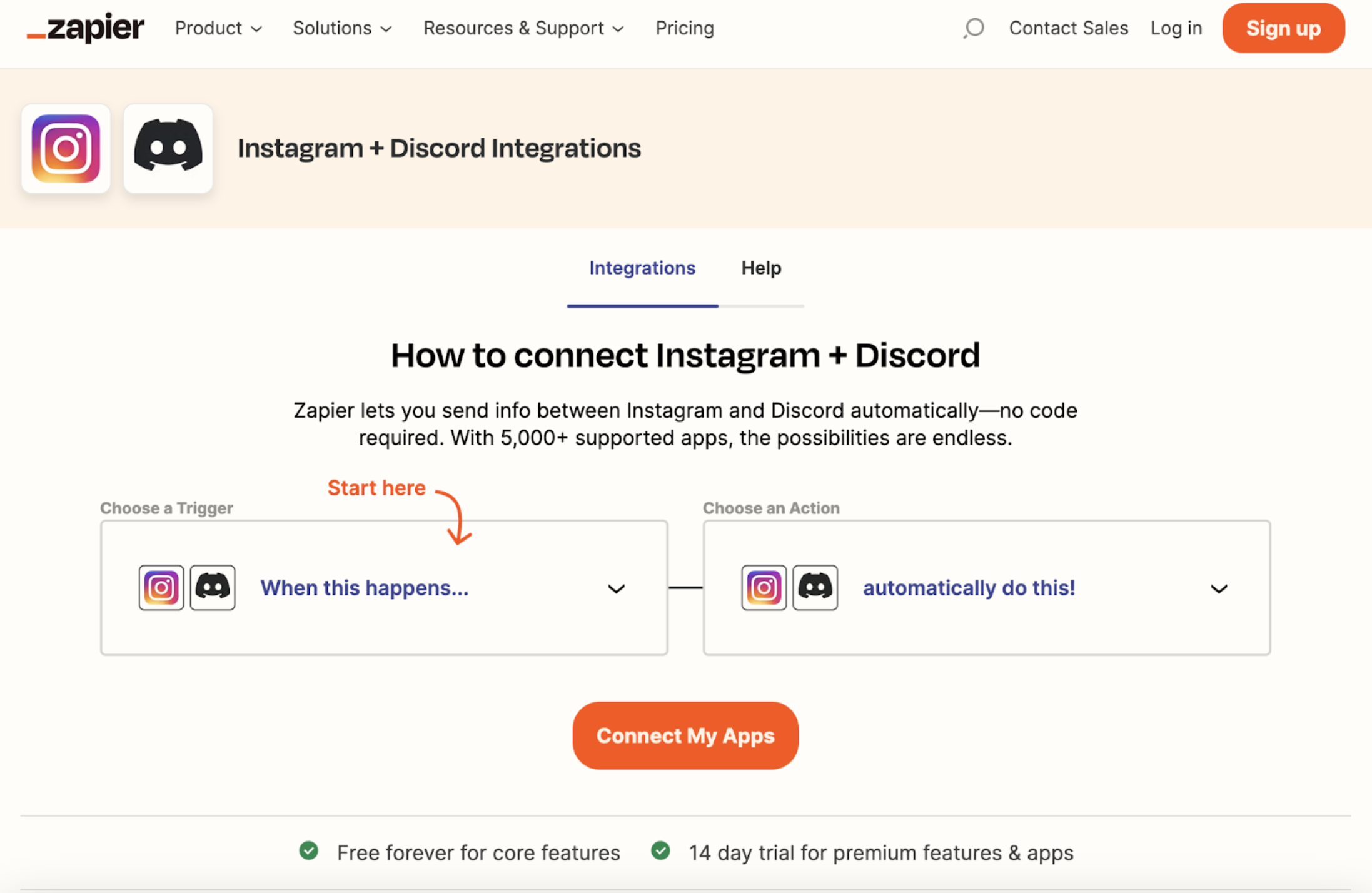
It depends on a significant amount of empty space, which directs focus towards the "Connect My Apps" button.
The subtle complementing colors also help to maintain the visitor's attention on the written content.
Ensure that the content is in line with the expectations of your audience.
Your copy must convince them to take action.
That implies the content on your landing page should match what your audience expects.
When individuals visit Airbnb's homepage for highly-rated accommodations in Alaska, they anticipate discovering a compilation of residences:
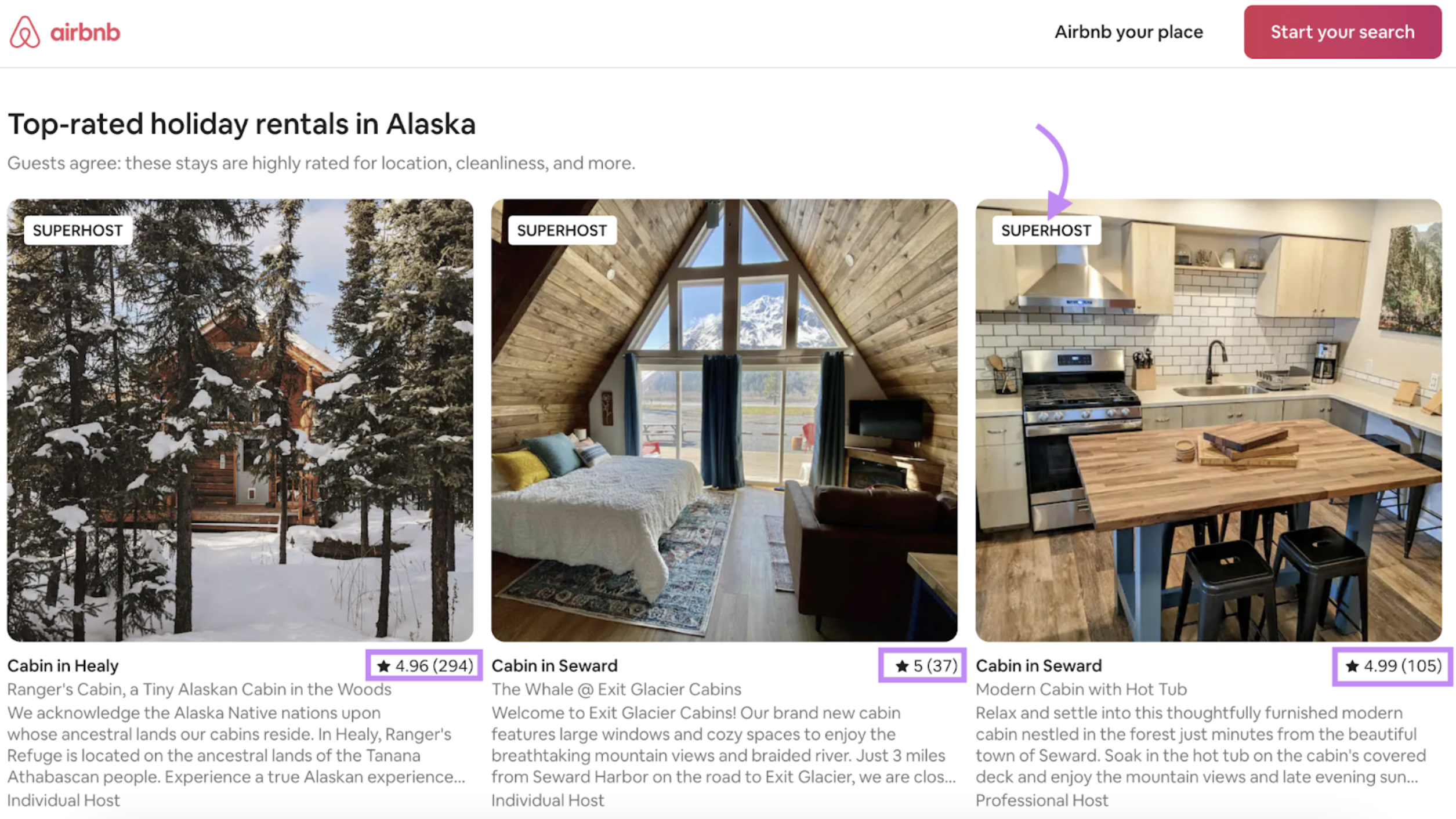
If the content did not align with the promise, visitors would leave quickly. If this occurs frequently, it can negatively impact your rankings.
Enhance Your AI Copywriting Skills
When utilizing an AI copywriting tool, it is important to ensure that each page is valuable and not a duplicate of the others.
Adjusting it yourself will also assist in making it sound more in line with your company's brand language and tone.
If you do not, and your landing pages appear automated or unhelpful, Google may identify them as spam.
Platforms such as TripAdvisor and Yelp employ creative techniques to prevent being fined.
Instead of composing the content themselves, they have businesses complete profiles. Then, urge customers to provide reviews.
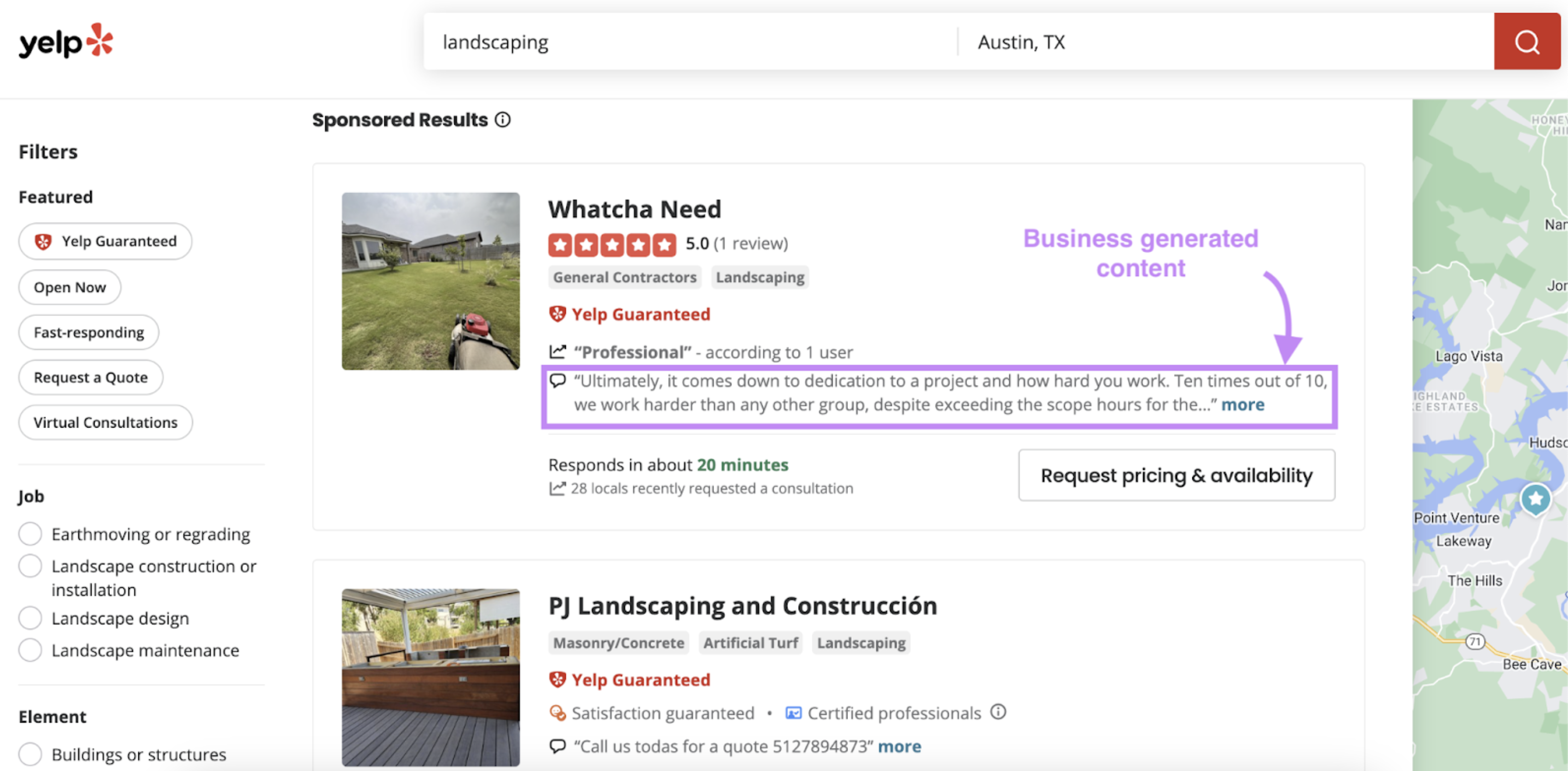
Every landing page created through programming is filled with sections of distinct material.
Include a single, straightforward call-to-action.
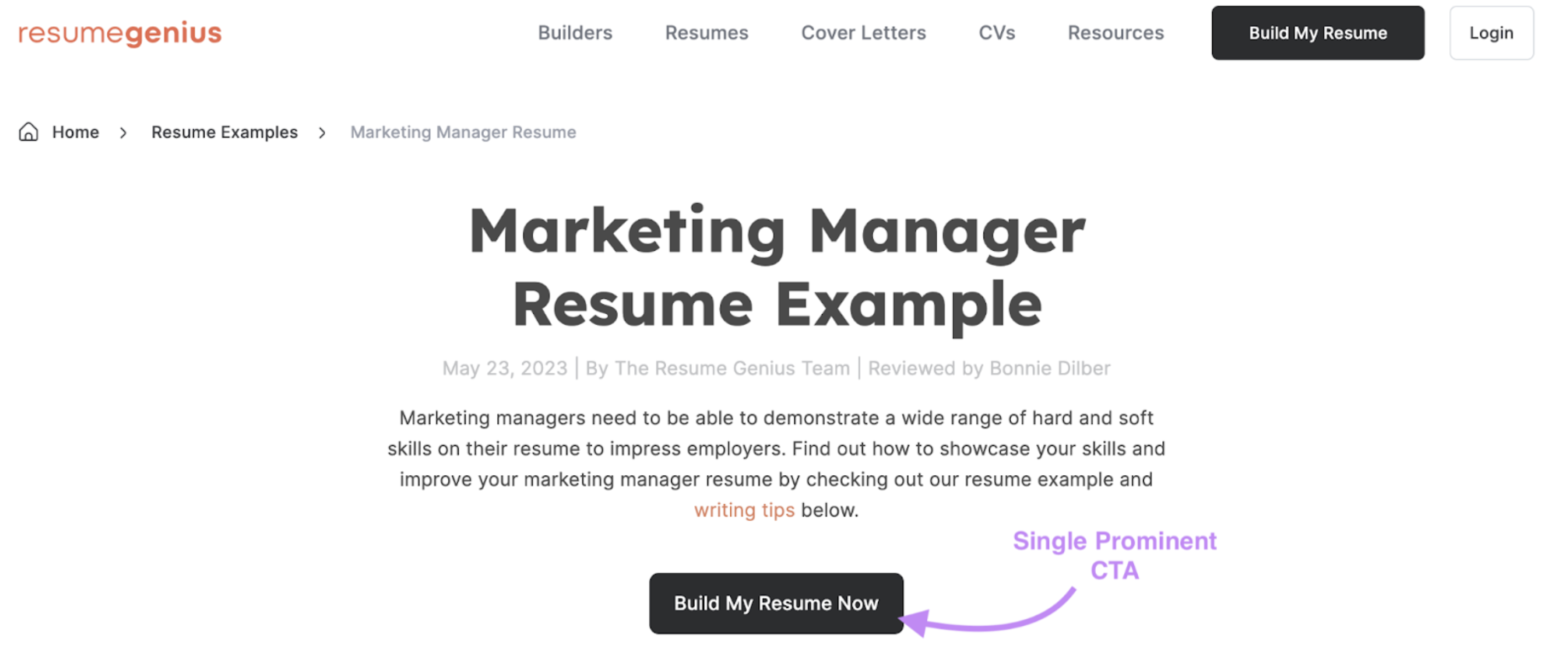
Based on your design and format, it can be beneficial to use a single prominent call to action (CTA) on each page.
After you successfully please your audience with your offer, a solitary button assists in directing their focus towards the conversion step.
Here's how Resume Genius use a single CTA for their programmatic pages that showcase resume examples for certain job titles:
If your design comprises several various elements (such as markets and travel sites), ensure that each one has its unique call-to-action (CTA).
Keep an eye on your web pages once you go live
The effort doesn't end when you launch your landing pages. Monitoring them once you start is crucial to meet user experience requirements and encourage visitors to take action.
The Site Audit tool from Semrush can assist you in identifying the most important technical problems to determine areas for improvement.
For instance, damaged external or internal links and page performance have a negative impact on user experience (UX).
Quick loading speed is easy to utilize. Sluggish loading can annoy users to the extent that they leave your page.
To verify yours, go to Site Audit, input your domain and set up your audit. Next, you will receive a list of problems and recommendations in order of priority.
To check the speed of your website, go to the "Site Performance" report on your dashboard and click on "View details":
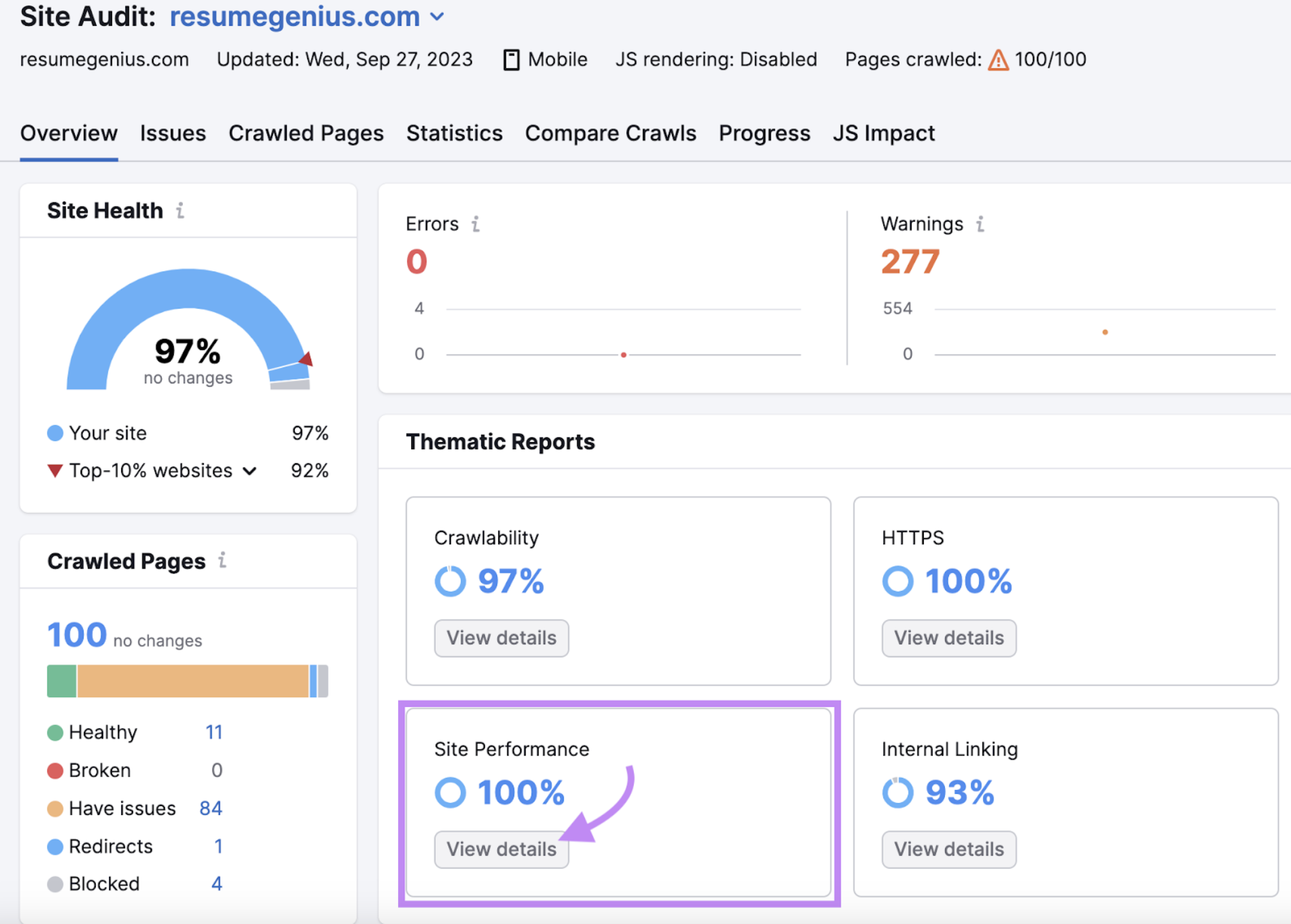
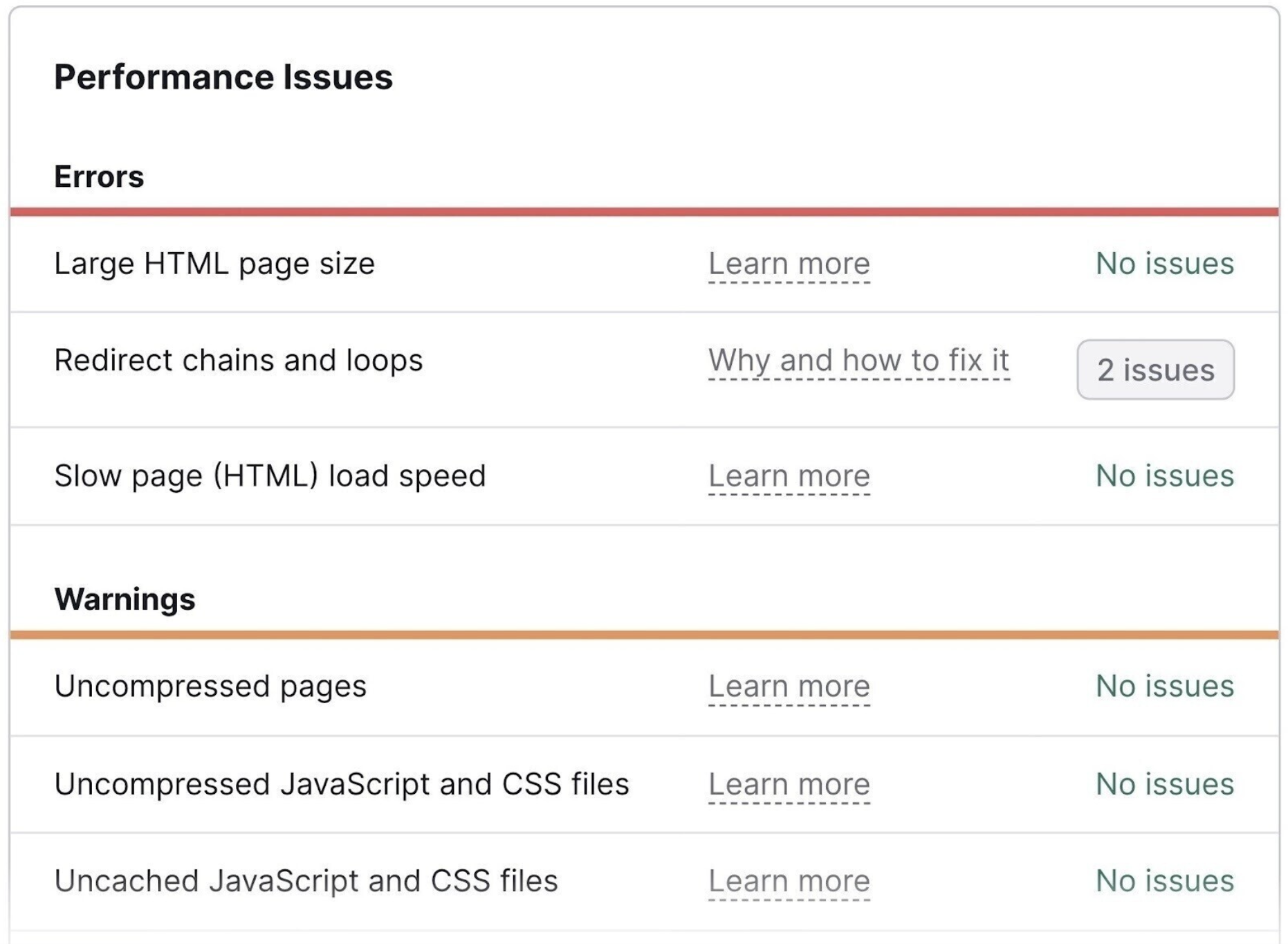
The tool provides a comprehensive list of performance issues along with specific recommendations for resolving them.
To verify your internal links, go to "Internal Linking" (located under the "Thematic Reports" category).
Next, select the option labeled "View details":
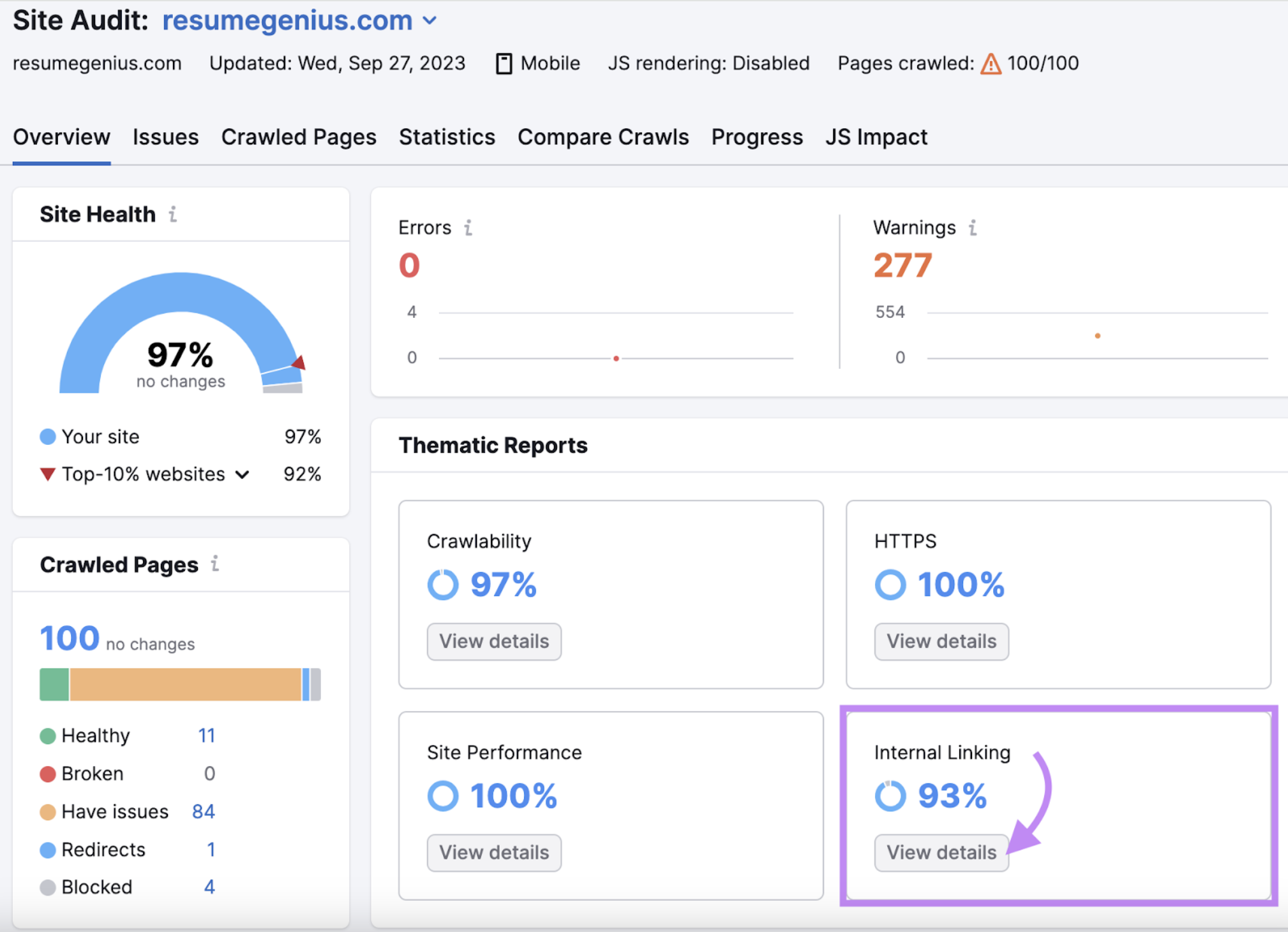
Once more, you will be presented with a list of problems along with suggestions on how to resolve them.
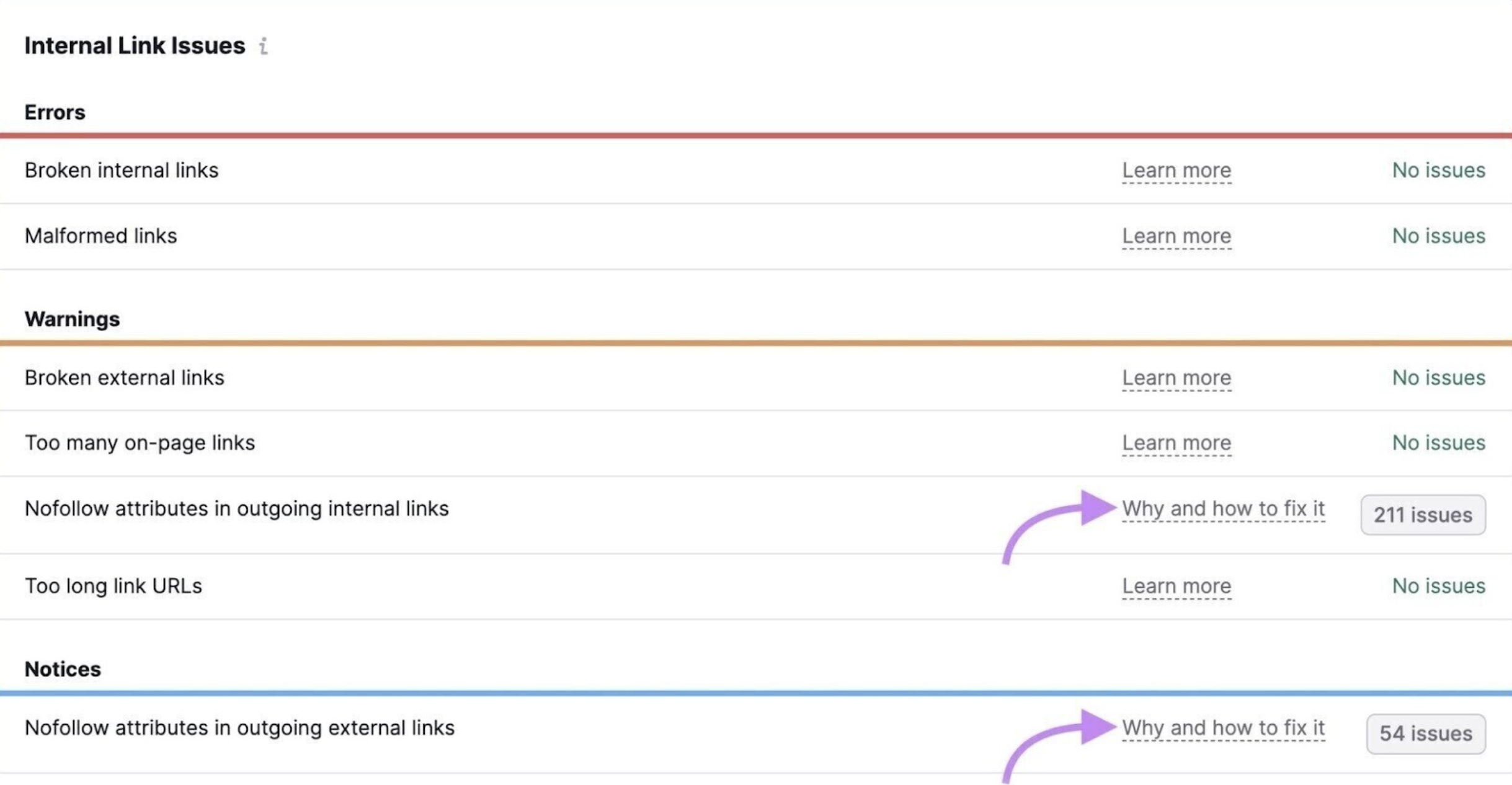
Once your website is problem-free, you can consider enhancing other aspects of your user experience.
For instance, you may also consider conducting A/B tests on several versions of your landing page to determine which one works the most effectively.
Are you prepared to begin your programmatic SEO journey?
Automated SEO is not a substitute for traditional SEO. Both can function together.
With a wide range of user-friendly tools that are readily accessible (and reasonably priced), now is an ideal opportunity to give pSEO a try.
Both pSEO and SEO begin with a robust keyword research technique. However, identifying the main concepts and descriptive words is the most difficult aspect of the procedure.
Therefore, visit our Keyword Magic Tool to uncover your keywords and initiate your own programmatic SEO journey.
