







It is unlike anything we've seen before; the legal profession has to adapt to intelligence (AI) development. This technology is already transforming how lawyers work, and its impact on AI-powered legal marketing strategies is incredibly profound. AI offers law firms unprecedented opportunities to automate tasks, enhance marketing strategies, and connect with potential clients more personally and meaningfully. Now is the time to start if you're not leveraging AI digital marketing tools for law firms.
This blog post will serve as your practical guide to understanding and harnessing the power of AI in legal industry AI applications. We'll explore the capabilities of AI tools for law firm marketing, examine real-world success stories, discuss ethical considerations, and provide actionable tips for implementation. By the end, you'll clearly understand how to use artificial intelligence in legal marketing to elevate your law firm's marketing to new heights.
The Transformative Potential of AI in Legal Marketing
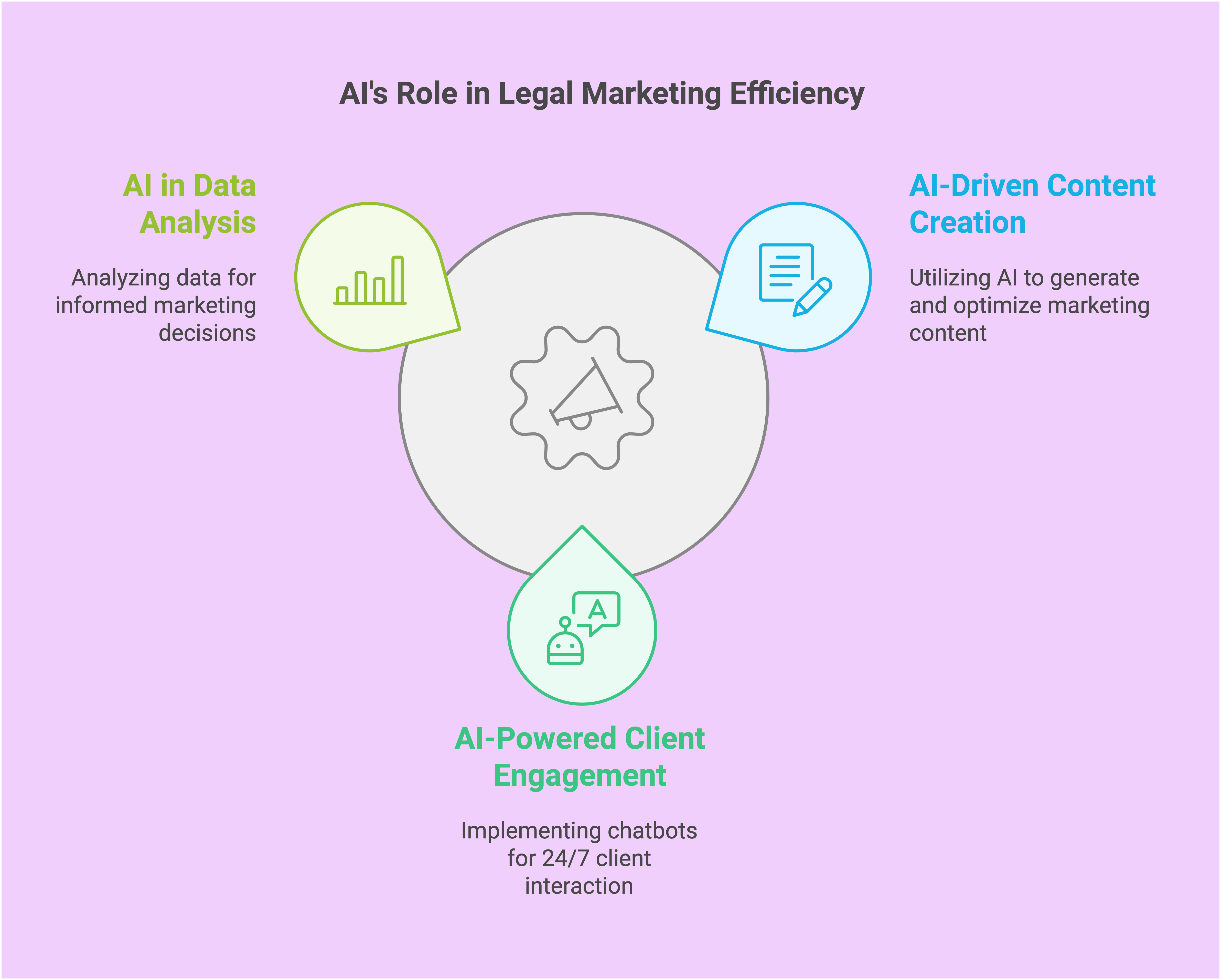
AI is revolutionizing AI-enhanced legal marketing efficiency by automating repetitive tasks requiring significant time and effort. Here's a glimpse of how AI is transforming key aspects of legal marketing:
- Content Creation: Say goodbye to writer's block and hello to AI-driven content creation for attorneys. Platforms like ChatGPT can brainstorm blog post ideas, generate outlines, draft content, and even optimize it for search engines. AI can also help you personalize marketing for law firms using AI based on client data, ensuring it resonates with your target audience. Imagine crafting website copy that speaks directly to the needs and interests of each visitor—AI makes this possible.
Equip your practice with the latest AI Tools for Law Firm Marketing to stay ahead in the competitive legal landscape. View tools
Here are the best AI tools for content generation in law firm marketing:
| AI Tool | Purpose for Legal Industry |
| ChatGPT (OpenAI) | Assists lawyers in drafting contracts, demand letters, blog posts, and other legal content using natural language processing. |
| Jasper | Tailored for lawyers to write engaging LinkedIn posts and other professional content for the legal industry. |
| Surfer | Provides SEO-focused content optimization, helping law firms improve their online presence with AI-driven insights. |
| Perplexity | Aids legal professionals in researching topics, generating SEO outlines, and finding authoritative sources for legal citations. |
- Client Engagement and Service: AI-powered chatbots are revolutionizing how law firms interact with potential and existing clients. Available 24/7, chatbots can answer common questions, provide basic legal information, schedule appointments, and qualify leads, freeing your staff to focus on more complex tasks. Platforms like Ross Intelligence, LawDroid Copilot, and Convey Law offer sophisticated chatbot solutions tailored to the legal industry.
Here are the best AI Chatbot tools in law firm marketing:
| AI Chatbot Tool | Description |
| Ross Intelligence | Specializes in legal research, understanding complex legal questions, and providing accurate responses. Saves lawyers time by streamlining research. |
| LawDroid Copilot | Assists with answering legal queries, automating document generation, and conducting legal research. |
| Convey Law | Enhances client engagement by answering questions, scheduling appointments, and providing basic legal information. |
| ChatInsight.AI | Improves customer service for law firms with 24/7 availability, answering queries, and assisting with scheduling. |
| Smith.ai | Supports client communication, interacts with website visitors, and aids lead generation by collecting preliminary information. |
- Data Analysis and Decision Making: There is no doubt that AI excels at analyzing vast amounts of data to grab the insights that can inform your marketing strategies. AI in legal marketing analytics can track campaign performance, identify trends, analyze competitor strategies, and predict future legal needs and industry shifts. This data-driven approach allows you to make more critical, informed decisions, optimize your campaigns in real-time, and stay ahead of the competition.
Here are the best AI-driven marketing analytics:
| Tool | Description |
| Clio | A cloud-based legal software suite with features for client intake, CRM, case management, billing, and accounting. It also evaluates AI-driven marketing performance to assess marketing effectiveness. |
| Cyfe | An all-in-one business dashboard consolidating data from various sources. Tracks marketing metrics, website analytics, and social media performance for a comprehensive view of law firm performance. |
| HubSpot | A marketing automation platform offering tools for content creation, SEO, social media, email marketing, and analytics. Its AI features personalize campaigns, optimize content, and track performance. |
| Google Analytics | A free, powerful website analytics tool tracking metrics like traffic, bounce rates, and conversions. It provides insights into user behavior and helps improve your law firm’s online presence. |
| Lawmatics | A legal CRM and marketing automation platform for law firms. Manages leads, automates client intake, nurtures relationships, and tracks marketing performance with AI-powered lead scoring and workflow automation. |
But don't just take our word for it—the results speak for themselves. Law firms nationwide are already leveraging AI to achieve remarkable marketing success. For more insights into AI applications in the legal industry, check out Top 15 Real-Life Use Cases for AI in the Legal Industry. These are just a few examples of how AI empowers law firms to reach more clients, increase brand awareness, and grow their businesses.
Choosing the Right AI Tools for Your Law Firm
With the abundance of AI-powered marketing automation for law firms available, it's crucial to select the ones that best align with your firm's unique needs and goals. Here's a step-by-step guide to help you make the right choices:
- Identify Your Needs: Define your firm's specific marketing challenges and objectives. Are you struggling to generate enough leads? Do you need help creating engaging content? Do you wish to raise your website's search engine ranking?
- Explore the Options: Research different AI tools and platforms designed for AI tools for law firm marketing.Consider the following categories:
- Content creation and SEO: ChatGPT, Surfer, Perplexity, Headline Studio
- Image generation: DALL-E, Midjourney
- Chatbots and client communication: Ross Intelligence, LawDroid Copilot, Convey Law, ChatInsight.AI
- Website ranking and SEO: Ranking.AI
- AI-powered legal research: Westlaw Precision AI, Casetext, OneLaw.ai, CARA by Casetext
- Evaluate and Select: Consider the following factors when evaluating each tool:
- Features: Does the tool offer the specific functionalities you need?
- Pricing: Is the pricing structure suitable for your firm's budget?
- Integration: Can the tool integrate seamlessly with your existing systems and workflows?
- User-Friendliness: Is the tool easy to use and navigate for your team?
- Customer Support: Does the supplier provide prompt, dependable customer service?
- Ethical Considerations: Does the tool adhere to ethical guidelines and data privacy regulations?
- Data Security: Does the provider have strong security measures to protect private customer data?
Remember, the most expensive or feature-rich tool isn't always the best fit. The key is to find tools that align with your firm's size, practice areas, target audience, and budget. Don't be afraid to experiment with different platforms and try free trials before committing to a paid subscription.
Implementing AI Tools and Strategies Effectively
Implementing AI for law firm lead generation successfully requires a strategic approach. Here's a roadmap for seamless integration:
- Develop a Strategic Plan: Outline your goals for using AI in marketing, the specific tools you'll implement, and how to measure success. Include your marketing team and essential stakeholders in the planning phase to guarantee alignment and buy-in.
- Embrace the "Trust, but Verify" Principle: AI tools can generate impressive results but are not foolproof. Always carefully review, edit, and fact-check all AI-generated content before publishing. Ensure it meets ethical standards, aligns with your brand voice, and is accurate and relevant to your target audience.
- Master the Art of Prompt Engineering: The quality of your AI outputs depends heavily on the quality of your prompts. Learn to write clear, specific, well-structured prompts that guide the AI tool towards the desired outcome. Experiment with different prompts and refine them iteratively based on the results.
- Train Your Team: Investing in training is compulsory to ensure your team understands how to use specific AI tools effectively and ethically. Emphasize the importance of data privacy, prompt engineering, content review, and the need for human oversight.
- Set Realistic Expectations: AI is a powerful tool but not a magic bullet. Don't expect AI to replace human expertise entirely. Understand the limitations of AI and be prepared to adjust your strategies as the technology evolves.
Following these steps, you can integrate AI tools into your law company's marketing process.
How to Train Your Team to Use AI Effectively
Training your team to use AI effectively is essential for maximizing the potential of AI digital marketing tools for law firms. Here's how to get started:
- Provide Hands-On Training: Offer practical, hands-on workshops where team members can learn how to use specific AI tools. Focus on tools for tasks like content creation, client engagement, and analytics.
- Focus on Ethical Use: Train your team to understand the ethical considerations of AI. Ensure they know how to handle client data securely and comply with privacy laws like GDPR.
- Encourage Collaboration: Create enough chances for team members to collaborate and share AI-related insights. Encourage brainstorming sessions where employees can discuss improving marketing strategies with AI.
- Offer Continuous Learning: Technology evolves quickly. Provide access to regular training updates, online courses, and webinars to keep your team informed about the latest AI trends and tools.
- Assign AI Champions: Identify a few team members who can become "AI champions" for your firm. These individuals can lead AI implementation efforts, provide ongoing training to colleagues, and act as a resource for questions and troubleshooting.
By equipping your team with the knowledge and special skills to use AI tools effectively, you ensure that your firm can leverage the full potential of AI while upholding strict moral principles and a human-centred approach.
Ethical Considerations in AI-Driven Legal Marketing
As with any powerful technology, AI raises important ethical considerations that law firms must address:
- Data Privacy and Security: Protecting client data is paramount. When using AI tools that collect or analyze client information, ensure compliance with all relevant data privacy regulations, such as the GDPR. Securely store data, obtain informed consent from clients and be transparent about how you use their information.
- Algorithmic Bias: Biases from the data that AI algorithms are trained on may be inherited by the algorithms, thereby producing discriminating results. Recognize possible sources of bias in your algorithms and data and take action to reduce them. Regularly audit your AI systems to ensure fairness and equity.
- Maintaining Human Judgment and Expertise: While AI can automate many tasks, it should not replace human judgment and decision-making, especially in the legal field. Lawyers must remain responsible for overseeing AI tools, reviewing outputs, and making final decisions that affect clients.
- Transparency and Disclosure: Be open with your clients about your firm's use of AI in marketing and legal services. Explain the benefits of AI, but also acknowledge its limitations and the importance of human oversight. Transparency builds trust and ensures ethical practices.
Law firms can proactively address these ethical considerations by leveraging AI's power while upholding their professional responsibilities and maintaining client trust.
The Human Touch in the Age of AI
In a world increasingly driven by technology, the human touch remains a vital differentiator for law firms. Clients search for legal expertise, empathy, understanding, and personalized service. Here's how to maintain the human element in the age of AI:
- Create Authentic Content: Use AI tools to enhance your content creation process, but don't let AI take over entirely. Infuse your content with your firm's unique personality, values, and insights—present case studies, true tales, and professional viewpoints that emotionally engage potential clients.
- Build Genuine Relationships: AI can help you automate outreach and communication, but it's up to you to build genuine relationships with your clients. Respond to inquiries promptly, personalize your interactions, and demonstrate a genuine interest in their needs. Remember, clients choose lawyers they trust and feel comfortable with.
- Invest in Human Skills: As AI automates routine tasks, the demand for uniquely human skills will increase. Focus on developing your team's creativity, critical thinking, problem-solving, communication, and emotional intelligence. These skills will become even more valuable in the AI-powered future.
By prioritizing the human element, you'll create a law firm that stands out in a crowded market and attracts clients seeking legal expertise and a genuine human connection.

Future Trends: AI and the Evolving Legal Landscape
AI is a quickly evolving science, and its influence on the legal industry will only grow in the coming years. Here are some future trends to watch:
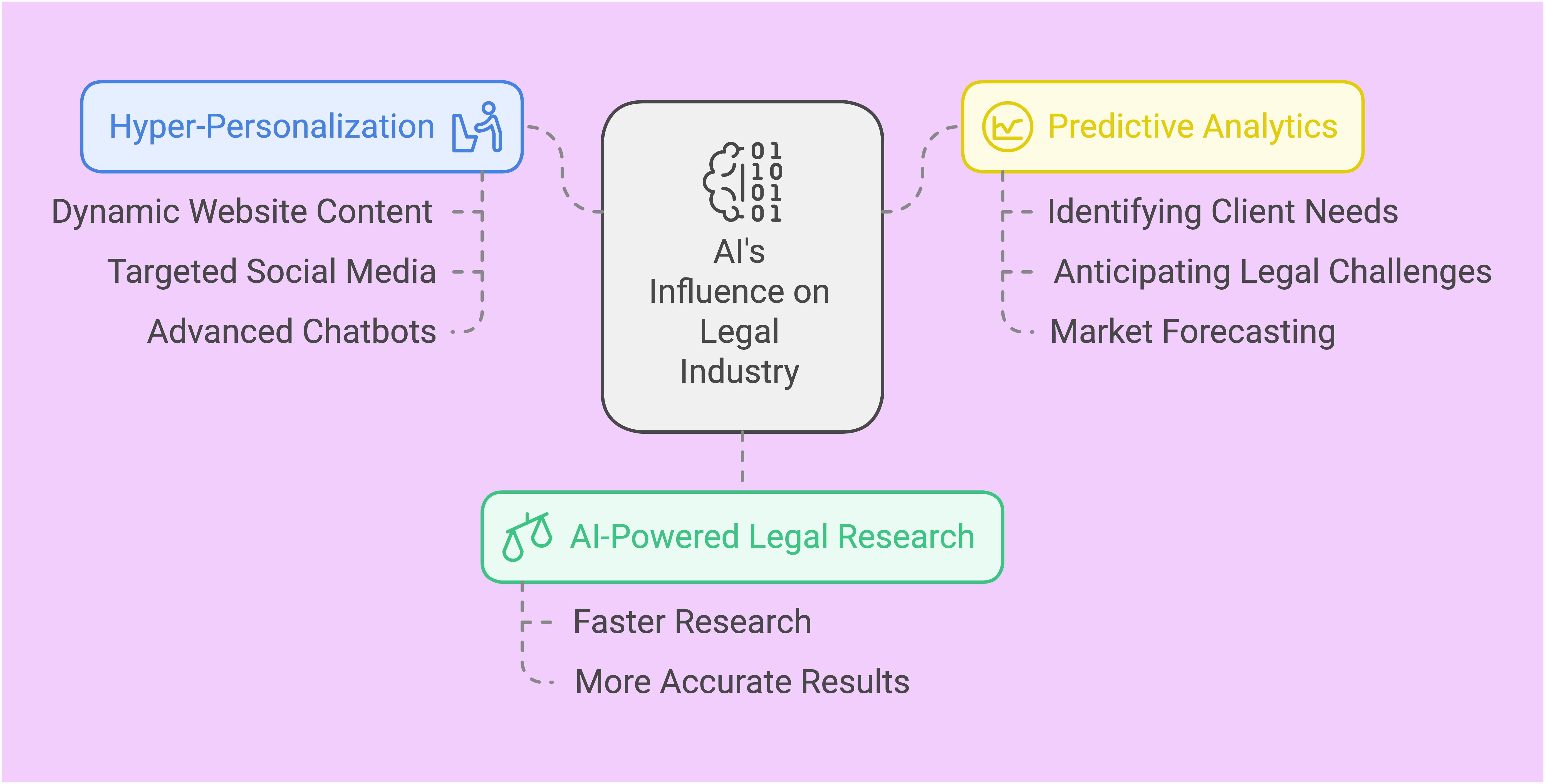
- AI-Powered Legal Research: AI is already transforming legal research, making it faster, more efficient, and more accurate. This will significantly impact how lawyers work and how law firms market their services. Expect more AI-powered tools that analyze case law, statutes, and legal documents, enabling lawyers to give their clients more thorough and wise advice.
- Hyper-Personalization: AI will take personalization to a new level. Imagine websites that dynamically adapt their content based on each visitor's needs and interests. AI in law firm social media strategies will deliver highly targeted messages tailored to each recipient's preferences and behaviour. And chatbots will become increasingly sophisticated, engaging in more natural and personalized conversations with potential clients.
- Predictive Analytics for Strategic Advantage: AI will empower law firms to predict and adapt to emerging trends in the legal industry. AI can identify shifts in client needs, anticipate new legal challenges, and forecast market changes by analyzing vast amounts of data. This will enable firms to adjust their services, marketing strategies proactively, and business development efforts to stay ahead of the curve.
The future of legal marketing belongs to firms that embrace AI and leverage its transformative potential. By understanding AI's capabilities, addressing ethical considerations, and prioritizing the human touch, your law firm can succeed in this exciting new era.
Conclusion
The rise of AI is a game-changer for legal marketing. It offers law firms an unparalleled opportunity to automate tasks, enhance marketing strategies, personalize client interactions, and drive business growth. By carefully selecting the right AI digital marketing tools for law firms, implementing them strategically, and always prioritizing ethical considerations, you can unlock the full potential of AI and position your firm for success in the ever-evolving legal landscape.
Remember, AI is a tool to empower, not replace, human expertise. By combining the power of AI with your team's legal knowledge, creativity, and commitment to client service, you can create a law firm that thrives in the age of artificial intelligence.
