



Rewording sentences while preserving their original meaning can be an effective strategy to evade AI content detection. Employing a straightforward writing style that incorporates personal anecdotes and experiences further contributes to avoiding AI detection in your content.
Initially, AI writing was confined to basic tasks such as completing sentences and identifying grammatical errors.
However, with significant advancements in algorithms, AI writing has surged onto the content marketing scene, reaching a point where utilizing an AI writer has become almost essential to keep pace.
The crucial factor in circumventing AI content detectors is ensuring that the writing generated by AI appears human-authored rather than machine-generated, appealing to both readers and search engines.
This article will unveil various techniques to make your AI-generated content indistinguishable and undetectable.
What is AI detection?
AI detection is the process of distinguishing between content created by artificial intelligence software and content generated by humans. Typically, AI content detection involves scrutinizing writing patterns, sentence structures, and the presence of redundant words to identify characteristic indications of AI content generators.
The identification of AI in content has become increasingly vital for digital publishers engaged in SEO, content marketing, as well as the creation of images and videos.
Recognizing AI in content is crucial because the utilization of AI-generated content can influence the perceived quality and authenticity of a piece of content. Human-authored content is often erroneously deemed to possess more value than AI-generated text.
This misconception may arise from the fact that human writers invest more time and effort in their writing. A common fallacy is to equate more time with higher value.
Identifying the use of AI writers can also prove valuable in other scenarios, such as when outsourcing content creation or conducting original academic research.
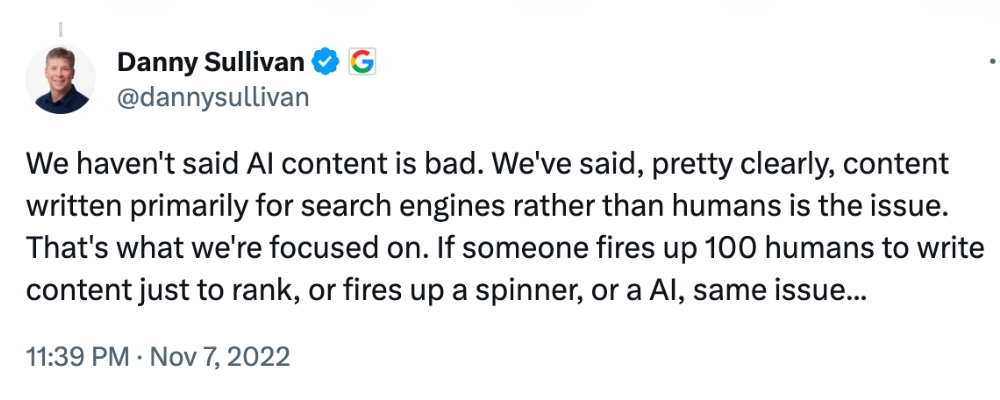
However, AI detection may not be necessary when creating articles to enhance search engine rankings. Google has consistently emphasized that its focus lies not in the method of content creation but in the value it provides. This sentiment has been reiterated by Google's search liaison on multiple occasions.
What is an AI detection engine?

Presented below are four AI detection tools:
- Grammarly: Primarily recognized for its grammar and spell-check functionalities, Grammarly extends its capabilities to identify AI-generated content. By evaluating writing style, tone, and clarity, it can pinpoint inconsistencies or anomalies indicative of AI authorship.
- Copyscape: Widely used for plagiarism checks, Copyscape is also effective in spotting AI-generated content. If AI-generated material closely resembles existing online content, Copyscape can detect these similarities.
- Turnitin: Commonly employed in academic settings for plagiarism detection, Turnitin is proficient in identifying AI-generated content as well. It scrutinizes writing style and compares submissions against an extensive database comprising academic papers, web pages, and other sources.
- Originality. AI: This tool prides itself on being the most accurate AI content detector and is specifically tailored to identify content generated by advanced language models.
Do AI detectors have the capability to identify content generated by AI?
AI content detectors are not always shown to be 100% accurate and can often lead to false positives. Since AI detection tools rely on writing patterns and language structures that are characteristic of AI-generated content, they can incorrectly flag human-written articles that mimic a similar style.
These techniques are not flawless, and for a variety of reasons, they sometimes falsely identify information created by humans as AI-generated.
- Writing style: You could unintentionally employ linguistic constructions or expressions that resemble those produced by AI algorithms.
- Ideas or phrases that you use again: It's possible that you use the same phrases often in your work. One of the most frequent causes of false AI content detection is this.
- Unusual syntax or grammar: If the grammar or sentence patterns in your writing are unusual, AI detection systems may mistakenly believe that the content is artificial intelligence (AI) generated.
- Limited training data: In order to understand how to differentiate between information generated by AI and human content, AI detection tools rely on training data. The accuracy of the instrument may be impacted and misleading readings may result from biased or insufficient training data for the AI detector.
- Changing AI algorithms: It's getting harder for detection systems to reliably distinguish between content produced by AI and human content as AI writing models get more sophisticated and can imitate human language patterns.
AI detection systems must continuously advance and change to keep up with the latest advancements in material created by AI. However, the aforementioned characteristics may still lead to false positives for AI-generated material when it comes to human-written content.
I do not advise using AI content detectors exclusively at this time to differentiate text generated by AI from that created by humans.
To distinguish artificial intelligence (AI)-generated content from that created by human authors, ChatGPT and other AI tools have promised to watermark the text they generate.
In the future, this might improve the accuracy of AI detectors.
9 techniques to evade content detection by AI
It is simple to understand how AI writing tools can increase scale and efficiency while lowering effort and time given the broad acceptance of AI in the writing and research sectors.
Yes, AI content generators simplify things, but they can also save you time so you can stop worrying about writer's block and concentrate on improving your piece with facts, figures, and examples.
We've talked about using AI content detectors and why you shouldn't rely too much on them to check the information you publish. Sometimes, though, you might wish to get around AI content detection.
For the best pass rate, I'd advise using many evasive techniques rather than just one.
To prevent AI content detection in your work, heed these nine tips.
1. Rephrase the format and sentence structure.
Rewriting and rearranging your phrases is the easiest technique to avoid AI content detection.
This entails changing the order in which words and phrases appear in a sentence, which may cause detection systems that rely on word combinations and grammatical patterns to malfunction.
AI content detectors are able to identify patterns in the way you phrase your sentences.
Overuse of terminology is a penchant of ChatGPT's that is now evident in its writing.
Here's an illustration.
Sentences can be combined to produce a more complicated sentence structure that is more difficult for AI to understand.
As an example, "The sun rose." can be joined to create "As the sun rose, it revealed a beautiful morning." It was a gorgeous morning.
Conversely, text that is broken up into shorter sentences tends to come out as more human.
Let's see an illustration of a word replacement for ChatGPT material.
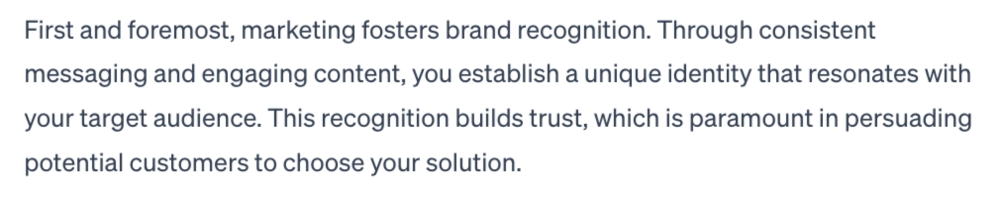
This is a passage from ChatGPT's response to the question, "How to become a good marketer?"
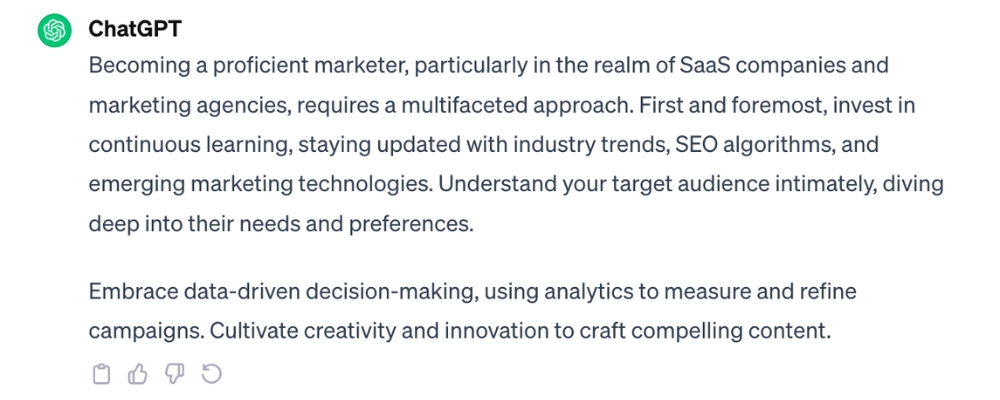
This is another way we may say it without changing its meaning.
There are a few things you need do in order to become an effective marketer for SaaS companies or marketing agencies. First, make an investment in continuing education to stay current with emerging marketing technologies, SEO algorithms, and industry trends. Second, you should be extremely familiar with the demands and desires of your target audience.
Make data-driven decisions by employing analytics to monitor and enhance campaigns. To produce content that readers will want to read, promote originality and innovation.
This is an easy technique to ensure that your material retains its original meaning and that AI systems are unable to recognize language that has been generated by AI.
2. Make use of synonyms and related terms
It is still possible to communicate the same idea without being noticed when specific words are replaced with their counterparts.
You'll see that AI writing tools frequently utilize a word's formal or most widely used form. Thus, for instance, employing an AI writer for this piece would result in terms like "evade AI detection" or "avoid AI detection."
These are simple, easily understood words that are pretty prevalent.
I could, however, replace these with things like "sidestep AI content" or "circumvent AI content," etc.
Let's apply the previously provided example.
Here's a synonym-based rewriting of it.
A diverse approach is necessary to become a proficient marketer for SaaS enterprises or marketing agencies. Begin by learning as much as you can about industry trends, search engine optimization methods, and new developments in marketing technology. Make sure you know the demands and preferences of your target market.
Make data-driven decisions by optimizing marketing initiatives with analytics. Take an innovative and creative approach to producing engaging content.
Of course, when utilizing alternative phrases, you want to be mindful of your reader's sensibilities. It is advised that content for the internet be created with a Flesch Reading Ease score of 60.
Furthermore, you don't want to confound readers or flaunt your vocabulary.
Excessive use of synonyms and antonyms can make your writing seem unnatural, which turns off readers. Thus, utilize them sparingly to avoid having your writing come across as forced or artificial.
3. Steer clear of cliched words and phrases.
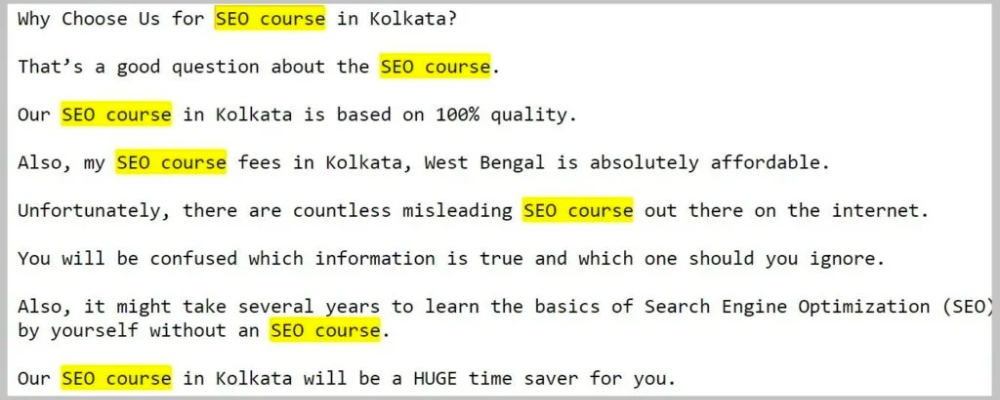
Machine learning and natural language processing are used by AI detection techniques to find formulaic or repetitive language that might point to AI authorship.
For instance, ChatGPT is well known for utilizing phrases over and over again. It's so horrible that Reddit has an entire topic about it.
Removing redundant phrases and words from your AI content can influence how AI-detection tools perceive your content.
Detecting repetitive language can prove challenging at times, so I suggest reading your content aloud. You'll quickly notice when something doesn't flow smoothly.
To mitigate this issue, minimize the use of repetitive keywords and phrases, and strive to write in a more conversational and natural tone.
Achieving a natural tone involves:
Writing in a conversational style
During the editing process of AI-generated text, ensure that it adopts a conversational tone, creating the impression of a dialogue with your reader. Employ everyday language, incorporating contractions like "it's" instead of "it is," to enhance the approachability of your writing.
Steer clear of using technical jargon and intricate terms.
Utilize straightforward language and common vocabulary to communicate your message. If you need to incorporate technical terms, make sure to provide clear explanations for readers who may not be acquainted with the subject matter.
Opt for the active voice.
Choosing the active voice can enhance the directness and engagement of your sentences. You can also transform passive voice sentences into active voice.
For instance, the sentence "I was in awe of the Eiffel Tower" can be rephrased as "The Eiffel Tower left me in awe." This way, you maintain the core idea of your message and reduce the risk of detection by algorithms that may be scanning for specific patterns or word combinations.
Diversify the length and structure of your sentences.
Blend both short and long sentences to establish a natural rhythm in your writing. This approach not only enhances the readability of your content but also sustains the reader's interest, minimizing the likelihood of detection by AI checkers.
Pose questions.
Incorporating questions into your content prompts readers to contemplate the topic and actively engage with your writing. This approach enhances the natural flow of your writing, as asking questions is a common aspect of everyday speech.
4. Convey personal anecdotes and viewpoints.
Leveraging real-life examples, stories, or analogies enhances reader comprehension and adds a captivating element to your content.
Incorporating personal anecdotes and firsthand experiences brings a unique touch that AI often finds challenging to emulate. For brands and content creators, establishing trust and credibility with the audience is paramount. Readers prefer content they can trust, created by real individuals possessing expertise or personal experience.
If your audience senses that your content may be AI-generated, it could affect their trust in your brand or the perceived authority of your content. However, this doesn't imply that you must personally craft all your content
Consider it akin to the period before the Industrial Revolution when the majority of goods were crafted by hand. Although the advent of machinery automated many tasks, the finest products still demanded meticulous intervention from humans.
Relying solely on AI-generated content can occasionally result in a more mechanical tone in your final article. The robotic quality of exclusive AI-generated content might not only bore your end users but also trigger alerts from AI checkers.
Rather than making an exclusive choice between human and AI content, it's often beneficial to combine both. Incorporating some content written by yourself helps prevent the potential detection of AI-generated content and adds a more human touch.
A primary objective should be to offer valuable advice to your audience. Introducing human-written content to your project increases the difficulty of detecting computer-generated content for AI recognition tools.
5. Employ prompts with vivid descriptions
It's crucial to not merely request an AI generator to generate content and consider the task complete.
Enhancing the quality of your AI content requires crafting more detailed prompts that can circumvent search engine detectors.
Composing a descriptive prompt is more likely to yield emotionally rich and sentimental text with a conversational tone.
For instance, using a prompt like "Write a story about a forest" might result in bland, low-quality content. On the other hand, employing a more descriptive prompt will likely yield higher-quality text.
Portray a tranquil and serene forest, highlighting the visuals, sounds, and scents enveloping you as you stroll through it during the early morning.
To enhance your ability to create more effective descriptive prompts, build upon the core concept of your initial prompt and instruct the AI to depict the scenario utilizing various senses.
For instance, consider a prompt such as:
"Write a story about a day at the beach."
To enhance its descriptive quality, envision and express how the situation would appear, sound, and feel.
Create a scene where a character undergoes the excitement and liberation of a coastal beach on a warm summer day, accentuating the sensations of sand, surf, and sun on their skin.
Alternatively, you can generate top-notch AI content by employing the "in the style of" approach. Simply include this phrase in your initial prompt.
For instance, rather than using a plain prompt like:
"Write an ad for AI software."
You can enhance it by adding a specific tone or emulating a creative individual:
"Write an ad for AI software in the style of Quentin Tarantino."
With a prompt structured in this manner, you should obtain content that can seamlessly navigate through any AI detection tool:
In a realm where every ordinary task seems like an endless routine, a groundbreaking piece of software boldly challenges the established norms. Brace yourself for an exhilarating, awe-inspiring, and unrestrained journey into the future of artificial intelligence.
Ensure to select a tone or style that aligns with the product you are promoting, and let the AI handle the remainder.
Leverage Surfer's AI editing assistant, Surfy, to refine sections of your content using more effective prompts.
Consider the following example within a subheading labeled "Brainstorming Techniques."
I aimed for the guidance to be more personable and adopt a conversational tone. In my prompt, I specifically requested Surfy to embody such a tone and speak as if representing a professional screenplay writer.
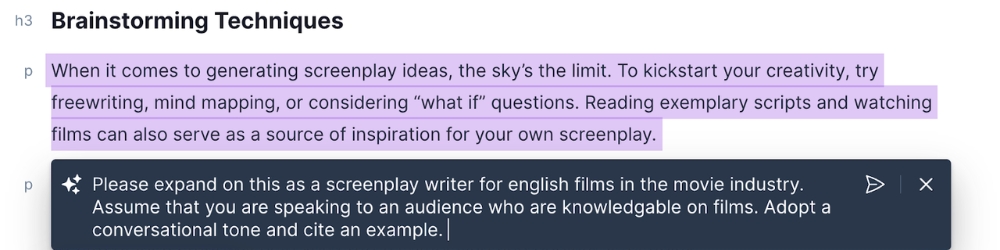
As evident, the content flows more smoothly and effectively conveys my message.
There is no discernible indication that a human did not author the content.
6. Employ paraphrasing tools

If you encounter AI-generated content that appears excessively robotic or spam-like, utilizing a paraphrasing tool can assist you in replicating human writing styles more effectively.
The use of paraphrasing tools facilitates quicker content creation while successfully evading AI-checking software.
These tools contribute to enhancing the tone of your AI-generated content and are compatible with AI detection software.
Here are four paraphrasing tools to consider.
Surfy
Surfy, the built-in editing assistant of Surfer AI, facilitates effortless rephrasing of sentences or entire paragraphs.
Choose the paragraph or sentence you wish to edit and click on the Rephrase option.
Certainly, you have the option to input a more detailed prompt if you desire precise paraphrasing of your content.
Subsequently, you can either accept the newly generated content or begin anew.
Grammarly
Although Grammarly is predominantly recognized as a grammar and spell-checking tool, it can also function as a proficient paraphrasing assistant.
Grammarly assists in achieving clarity and conciseness, crucial elements for effective paraphrasing. Additionally, the program corrects punctuation or grammar issues in your text and identifies any potential problems related to plagiarism or AI-generated content.
Quilbot
Quillbot is a specialized paraphrasing tool crafted to assist users in effectively rewriting and rephrasing text.
Employing cutting-edge AI algorithms, this tool generates text that comprehends context, meaning, and the nuances of human speech.
Quillbot's AI-powered paraphrasing features empower users to swiftly rewrite substantial amounts of text, saving time and effort while generating unique and high-quality content.
Wordtune
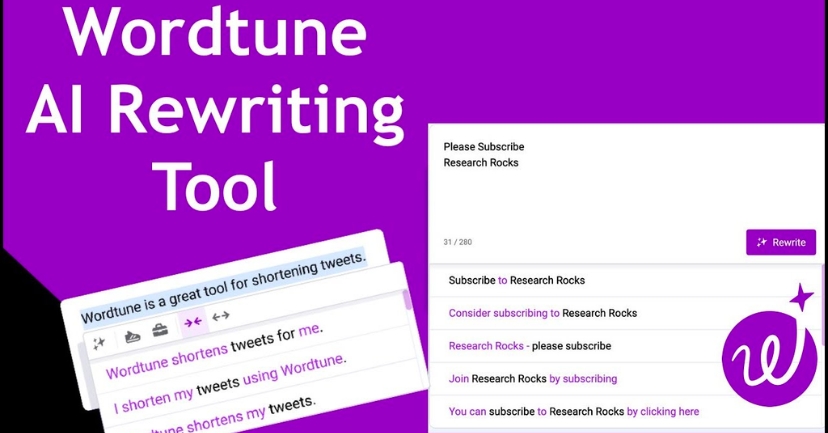
Wordtune stands out as a robust AI-driven writing tool proficient in paraphrasing. It utilizes context-aware AI technology to transform your text into a more human-like structure.
Additionally, Wordtune provides several rewriting alternatives, enabling you to select the version that best suits your preferred writing style and tone.
7. Employ proficient AI writing tools.
While free AI generators, such as ChatGPT, showcase impressive capabilities, they are often easily detectable by AI detectors.
To mitigate the risk of AI detection, opt for specialized AI writing software that centers on generating content with a human-like touch. Unlike mere content spinning from other sources, these tools are engineered to craft content that genuinely adds value to readers.
Utilizing a top-tier AI writer for your articles eliminates the need to spend hours rephrasing or editing your AI content to successfully navigate AI detection.
Surfer AI, for instance, serves as an AI writing tool enabling you to compose comprehensive articles optimized for search engines, effectively evading AI content detectors.
The AI tool from Surfer produces top-notch content that outperforms AI detectors. It provides the flexibility to select your tone of voice and organic competitors, ensuring your content doesn't appear as if it were written by a robot. Simply activate the anti-AI detection switch to generate content that is indistinguishable from human-authored writing.
Evaluate the AI-generated outline for your article and allow Surfer AI to compose a full article for you within minutes.
For instance, here are two articles on the topic "essential tools for gardening," both crafted by Surfer AI.
To showcase its effectiveness, we will activate the anti-AI detector for one article and compare it to an article generated without the anti-AI boost.
The first article was produced without utilizing the anti-AI detection option.
Despite not using the anti-AI detection feature, it is a well-written article that comprehensively covers the topic and is poised to perform well in search engine rankings.
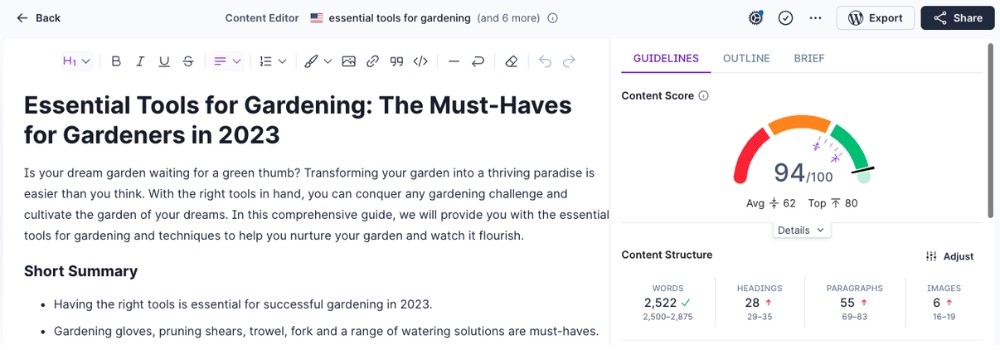
However, if you maintain a stringent stance on AI-generated content, the material may not successfully pass through an AI text detector.
In the second article, we activated the anti-AI feature and produced a fresh piece of content.
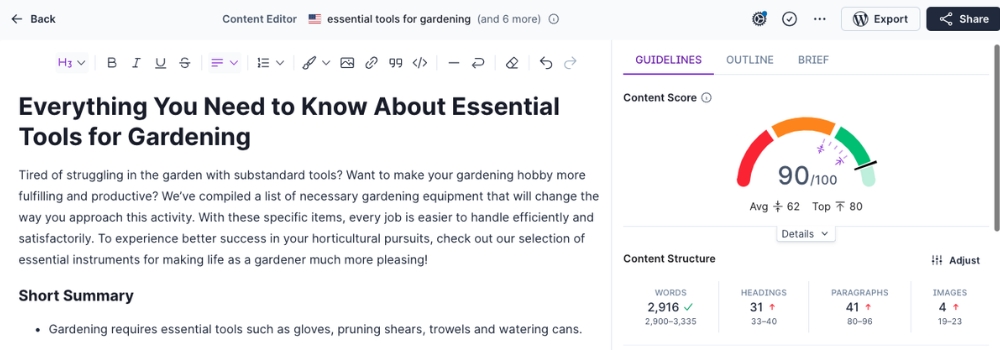
Subsequently, we employed Originality. AI, a widely used AI content detection platform, to identify any AI-generated content in our article.
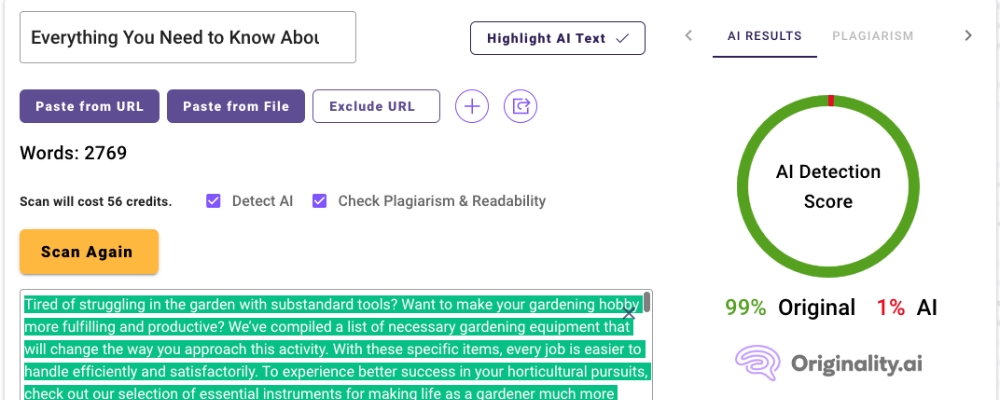
With Surfer AI, you not only obtain top-notch content capable of surpassing Google's detectors but also achieve this with minimal prompts, resulting in SEO-ready content.
In contrast, other AI generators do not tailor content specifically for search engine algorithms.
8. Employ human moderators.
Enlisting human editors to review AI-generated content is crucial for identifying areas that require improvement and ensuring the content is both easy to comprehend and engaging for human readers.
When scrutinizing AI-generated content, guide your editors to be vigilant for repetitive or formulaic language, awkward sentences, and any evident indications that the content originated from AI tools.
Particular attention should be given to verifying the accuracy of all claims presented in the content. While poor grammar might warrant a mild rebuke, making false claims could lead to serious consequences in the realm of content creation.
9. Add complexity to your writing
I don't endorse this approach to outsmart AI content software, as it depends on perplexing the detector with text that is challenging to analyze and comprehend.
You may obscure your content by incorporating irrelevant synonyms and words, but proceed with caution.
Although this may lead to challenges for AI content detectors in effectively analyzing and comprehending the content, it will also create confusion for your readers.
Substituting letters in words with punctuation and symbols can aid in evading AI content detection. For instance, transforming the word "data" to "d@t@" or altering "digital" to "d1g1tal."
This technique introduces subtle textual variations that can confound AI detection tools while remaining largely legible to human readers.
Another potential strategy is to replace specific letters or symbols with visually similar Unicode characters, altering the visual appearance of words without changing their meaning.
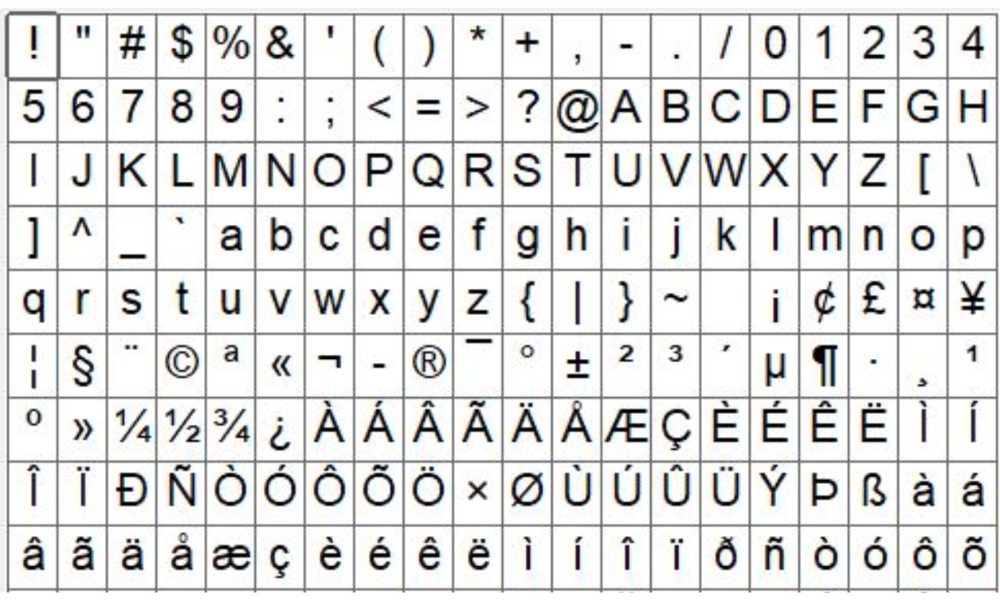
You can also substitute certain letters or symbols with their visually similar counterparts, known as homoglyphs. Examples of homoglyphs include characters from the Latin alphabet and those that bear a resemblance from other alphabets or scripts.
For instance, the Latin lowercase letter "a" (from the English alphabet) and the Cyrillic lowercase letter "а" (used in Russian and other Slavic languages) appear almost identical but are distinct characters with different Unicode values.
The letter "o" can be exchanged with the number "0," or a Cyrillic character resembling a Latin one can be utilized.
It's advisable to consider this method as a last resort in exceptional circumstances, as it makes it more challenging for search engines and readers to comprehend your writing.
Is Google capable of detecting AI-generated content?
While it's not definitively established, there is a high likelihood that Google can recognize AI-generated text through natural language processing (NLP) and machine learning algorithms.
Given Google's extensive data access and ongoing development of AI tools, it seems plausible that the search engine giant possesses the capability to identify AI-generated text.
In the grand scheme, it's not crucial if Google identifies your content as AI-generated, as per Google's search guidelines, which emphasize rewarding original, high-quality content regardless of its production method.
Here's a snippet from their documentation regarding AI content.
Google aims to reward content of high quality that is beneficial for individuals, prioritizing human-centric writing over catering solely to search engines.
Therefore, AI-generated content is acceptable as long as it is crafted with the primary focus on providing value to people.
Is it advisable to conceal AI-generated content?
There's no need to be overly concerned about concealing AI-generated content because, as we've recently covered, the method of content generation doesn't significantly impact search engines.
The primary goal of Google and other search engines is to recognize and reward high-quality content that enhances the user experience, regardless of whether it's created by AI or a human.
Numerous major corporations worldwide leverage AI-generated content to propel their success to new levels. Some of these prominent companies include:
Google utilizes AI technologies for ad creation, automating the writing of ads, comprehending the context of ad copy, generating ad suggestions, optimizing bidding strategies, and enhancing audience targeting.
BuzzFeed
Buzzfeed utilizes AI-driven technologies to enhance content optimization, personalize user experiences, and generate both entertaining quizzes and entire articles through AI.
BankRate
BankRate harnesses the power of AI to drive its chatbots, aid in fraud detection, and generate AI-written content for human review.
When is it advisable to refrain from employing AI-generated content?
Refrain from utilizing AI-generated content when writing for YMYL (Your Money or Your Life) niches or when it is necessary to showcase expertise derived from personal experience in your profession.
One of the key factors to bear in mind when employing AI-generated content is ensuring compliance with Google's E-A-T (Expertise, Authoritativeness, Trustworthiness) guidelines.
E-A-T stands for experience, expertise, authority, and trustworthiness. It constitutes the set of guidelines employed by Google to assess the legitimacy and quality of the content provided to users.
Genres related to health and finance, often categorized as YMYL (Your Money or Your Life) niches, should incorporate a combination of human oversight and AI-generated content.
There are specific situations when relying solely on AI content should be avoided.
Intricacy and personalization
Health and finance represent intricate domains that frequently necessitate personalized guidance tailored to individual preferences and risk tolerance. AI algorithms are unlikely to possess the sophistication required to take into account all these factors and deliver customized recommendations.
Liability and accountability
In situations where AI-generated advice results in adverse outcomes, determining liability and accountability can pose challenges.
Legally, it becomes intricate to ascertain whether the responsibility should lie with the AI, the developer, or the end user for any consequences arising from the advice
Inaccurate or outdated information
AI algorithms depend on data for making predictions and offering advice.
Should the data be inaccurate, incomplete, or outdated, the advice generated by AI may result in potentially hazardous outcomes.
Ethical considerations
The application of AI in health and finance raises significant ethical issues, including potential biases in algorithms and the potential impact of AI-generated advice on the job security of human professionals in these fields.
To ensure adherence to Google’s E-A-T guidelines, it is essential to thoroughly review and edit any content generated using AI content tools.
Main points
Combine AI-generated and human-written text to enhance content quality and confound AI detectors.
Minimize repetitive keywords and phrases, and adopt a natural tone to elude Google’s AI-detecting algorithms.
Use descriptive prompts to produce higher-quality, emotional, and conversational AI-generated text.
Employ paraphrasing tools to mitigate robotic or spammy tones and replicate human writing styles effectively.
Emphasize the inclusion of human-written text to ensure authenticity and uniqueness, crucial for passing AI content detectors.
In conclusion
As search engines advance and fine-tune their algorithms, their capacity to identify AI-generated content will grow more sophisticated. However, it's crucial to note that search engines prioritize delivering high-quality, relevant, and valuable information, placing less emphasis on the writing method.
The key to content success lies in achieving a harmonious blend of human and AI-generated content. Integrating human intervention and incorporating personal insights allows you to leverage AI's capabilities while delivering meaningful content that connects with your target audience.
