





If I received ten cents for each instance in which I committed an error while writing, I would currently possess a significant amount of wealth.
During my 7.5 years of experience as a content writer, I've made numerous errors, a few of which have had significant consequences.
Nevertheless, the crucial aspect is to gain knowledge from these errors and consistently enhance your abilities in creating content.
That's what I've been doing all this time, which is why I've had the chance to work with leading SaaS firms such as Semrush, Wordtune, Zapier, and HubSpot, among others.
This is not another one of those pieces that advises you to refrain from committing simple content writing blunders such as grammatical or spelling problems. Instead, I wanted to reveal some lesser-known yet important content writing blunders that you should avoid making.
Let's begin.
1. Creating material about the wetness of water
Creating material that states 'water is moist' is a common error made by many writers, including myself.
This entails incorporating evident material that contributes little to the readers.
It's similar to informing children that "the sun comes up in the east" or "physical activity is beneficial for well-being."
This type of information not only wastes the readers' time but also fails to capture their interest.
Although I had been in the field for many years, I didn't notice this mistake until Tommy Walker, the founder of Content Studio and former Editor-in-Chief at firms such as Shopify Plus and QuickBooks, brought it to my attention.

For example, if you are writing an article on the best project management software, avoid beginning your introduction with:
Project management can be challenging. It involves many components that are in motion, such as strict time limits, intricate group interactions, and always shifting demands.
This can appear as a favorable beginning for numerous individuals, but it only speaks the evident.
Here, the target audience is probably individuals in managerial or executive positions who are seeking options for software to manage projects.
They are already aware of the challenges of project management and the various components involved.
Instead, capture their interest with something more engaging and informative, such as emphasizing the consequences of not implementing a project management software.
Alternatively, you could also provide insights from your personal experience of introducing a project management software in your organization.
2. Failing to interview individuals with expertise in the field
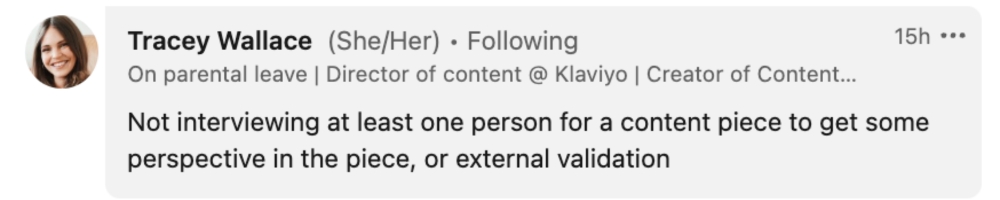
If you are producing an article about Google Ads blunders but have limited knowledge, it is advisable to consult subject-matter experts (SMEs).
In this situation, SMEs are those who have direct expertise managing Google Ads.
By neglecting to interview subject matter experts (SMEs), there is a possibility of providing erroneous, generic, or inefficient advice, which could potentially misguide your readers.
Tracey Wallace, the Content Director at Klaviyo, when asked about a common mistake she has observed among authors, responded with the following:
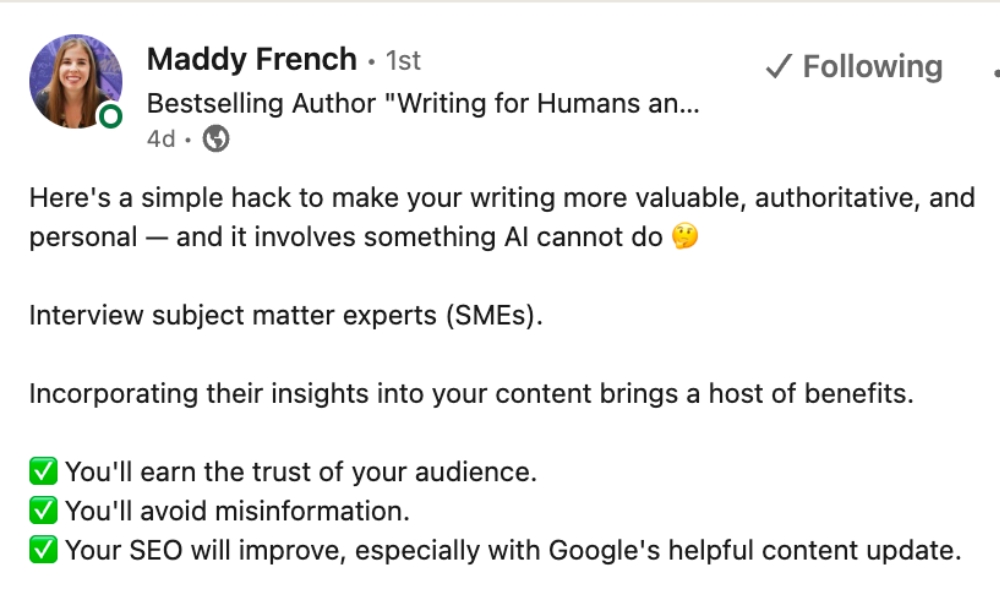
In addition to Tracey, many individuals in the content marketing industry emphasize the significance of conducting interviews with subject matter experts.
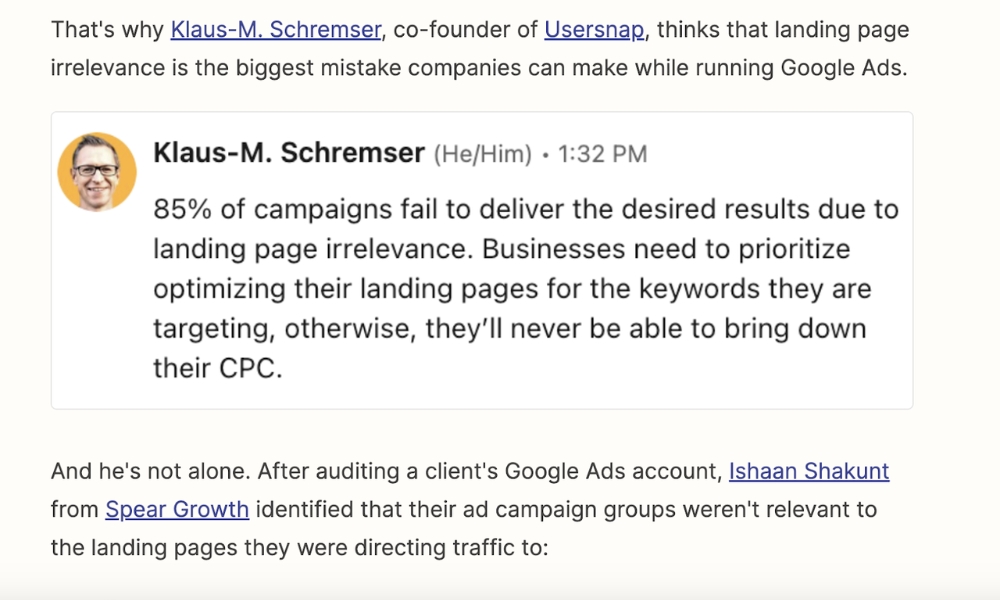
In the beginning of 2023, I penned my initial piece for Zapier, in which I discussed six typical errors made in Google Ads.
Because I lack extensive expertise with Google Ads, I conversed with numerous professionals in paid advertising who were eager to offer their knowledge and experiences.
Although it is not essential to interview subject matter experts for every piece of content you produce, it is advisable to do so for topics where you have limited understanding.
Keep in mind: it is not necessary to have a conversation with subject matter experts every time. Although they may want to offer their distinctive perspectives, it is probable that many of them will not have the capacity to participate in a phone conversation. Alternatively, you can create a basic Jotform or Google Form with a set of questions you would like them to respond to and email it to them.
3. Unquestioningly according to the instructions and plan
Avoid uncritically adhering to briefs and outlines.
Briefs and outlines are designed to provide guidance, rather than limit your creativity or your exploration of the issue.
Following them without considering or conducting your own evaluation can make your material seem mechanical, generic, and less valuable.
During the past 7.5 years, I have collaborated with numerous companies, and one consistent observation I've made is that each firm I've worked with has its own distinct method when it comes to developing briefs and outlines.
Some companies just give their authors themes and the corresponding H2 and H3 headers. While others provide comprehensive summaries and plans.
No matter what kind of plan or brief you are given, be sure to carefully analyze it before starting the writing process. This includes:
- Conducting comprehensive SERP research to comprehend the purpose and the content you should incorporate in your post. This will also assist you in comprehending the preferences of Google or other search engines for SERP elements.
- Evaluating the outline and brief for correctness. Frequently, content strategists or those who write briefs or outlines are quite busy, and although they may have done their own research, it's possible that they may have included false or unclear information. Therefore, as a writer, it is your duty to double-check everything, and if something appears incorrect, get explanation from them.
- Verifying if the given structure can assist you in composing an article that has a smooth progression.
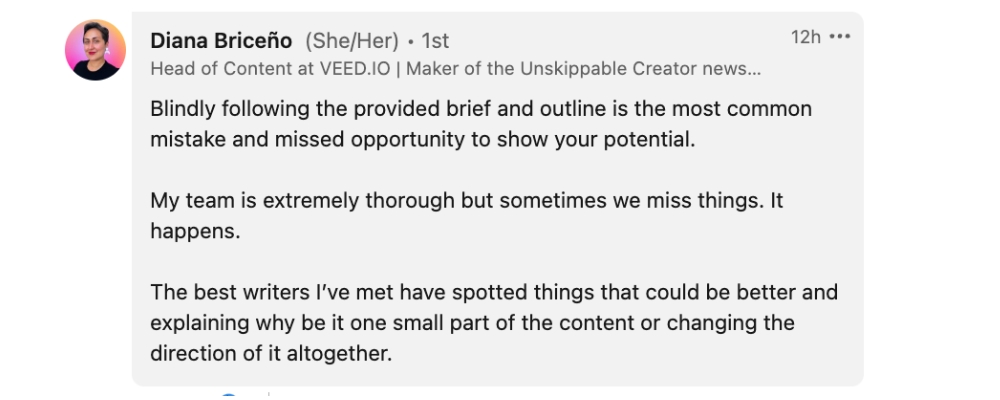
Diana Briceño, Content Manager of VEED, provides insight on the same:
Additionally, I suggest collaborating with companies that offer artistic independence.
Finally, ensure that you are seeking clarity or conveying the modifications you would like to make to the plan in advance. Otherwise, that will lead to numerous modifications and misunderstandings.
4. Lgnoring the Time-to-Value (TTV)
Ignoring the importance of time-to-value in your writing is a significant error that many writers commit. Time-to-value refers to the speed at which a reader or user can derive value from your content.
For instance, if you're creating a guide on how to establish an email marketing campaign, a significant number of your visitors are eager to put up their own email marketing campaign promptly.
If your introduction is very lengthy or if you're discussing issues (even for SEO purposes) such as the definition of an email marketing campaign or the advantages of establishing an email marketing campaign, then the time-to-value here is quite high. They need to invest a significant amount of time reviewing all of that information before they can obtain practical insights. This can be annoying for readers. Although include a table of contents section can be beneficial, it is not the definitive solution for addressing the time-to-value problem.
Ben Pines, the Content Director at Wordtune and AI21 Labs, strongly dislikes content that requires a significant amount of effort before it delivers value:
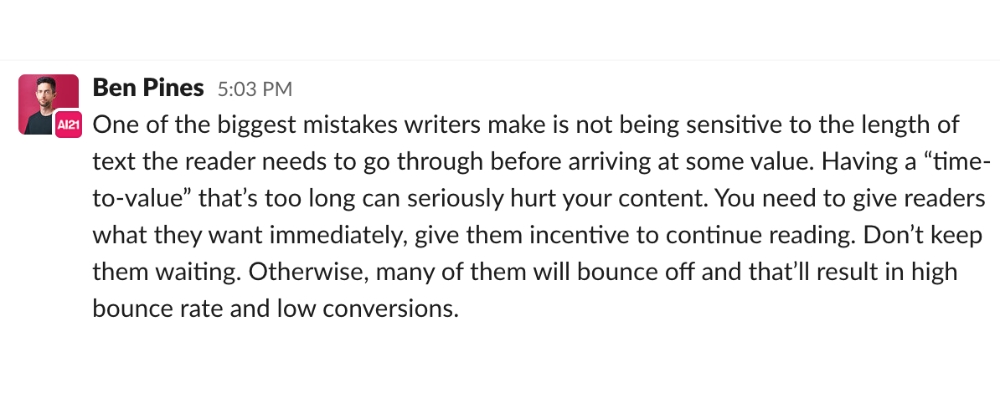
Provide readers with what they desire right away. To do that, you must comprehend the identity of your intended audience and their current position.
If someone is reading an article about starting up an email marketing campaign, demonstrate the process promptly.
The crucial aspect is to comprehend the desires of the readers and promptly present it to them.
5. Not prioritizing the coherence of the story
An often disregarded element of content writing is the need to keep a constant narrative flow.
Each sentence and paragraph you write should flow logically and smoothly from the prior information.
Consider your material like a narrative - it requires a distinct and logical introduction, body, and conclusion, regardless of the subject matter.
At times, we become so focused on including all the important aspects in an article that we overlook the way in which those points are related to one another.
The outcome is a composition that seems disconnected or perplexing, causing difficulty for the reader to comprehend or sustain engagement.
Donna Cavalier, the person in charge of editing at Automattic, provides her own perspectives on how writers should prevent making this error:
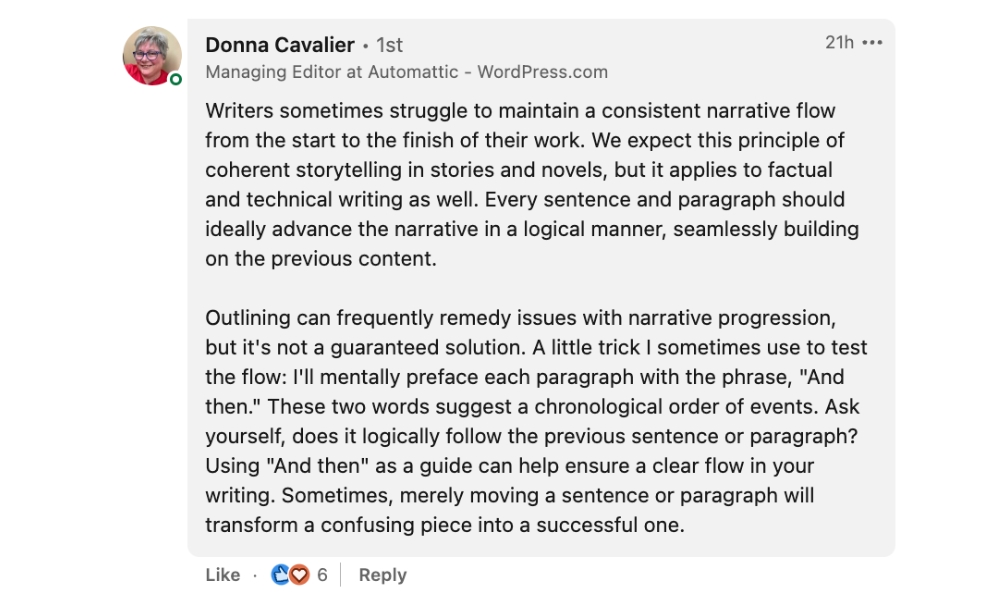
As Donna mentions, employing "And then" as a guideline might assist in maintaining a coherent flow in your writing. In addition to this, a couple of other suggestions for maintaining a smooth flow in your writing are:
- Utilize transitional words such as and, once more, and thereafter.
- Focus on one concept at a time.
- Utilize uncomplicated vocabulary.
- Avoid using passive voice.
- Prioritize clarity rather than ingenuity.
6. Failing to support text with appropriate examples
Merely presenting information, thoughts, or principles without supporting them with appropriate illustrations renders your content ambiguous and difficult to comprehend.
In addition, it could seem generic, providing no fresh or interesting content to readers.
For instance, if you are writing an article about email marketing methods and including one of the strategies as "customizing your email," ensure that you back it up with a strong example.
You can talk extensively about the definition and advantages of email personalization, but it is also important to provide a visual representation of a personalized email for your readers to fully understand its appearance.
When explaining the meaning of anything or providing instructions, it is important to demonstrate rather than simply state. And demonstrating involves including explicit, concrete illustrations that readers can readily imagine or connect with.
Precious Oboidhe, a skilled freelance SaaS writer, uncovers pertinent instances for each content item he creates.
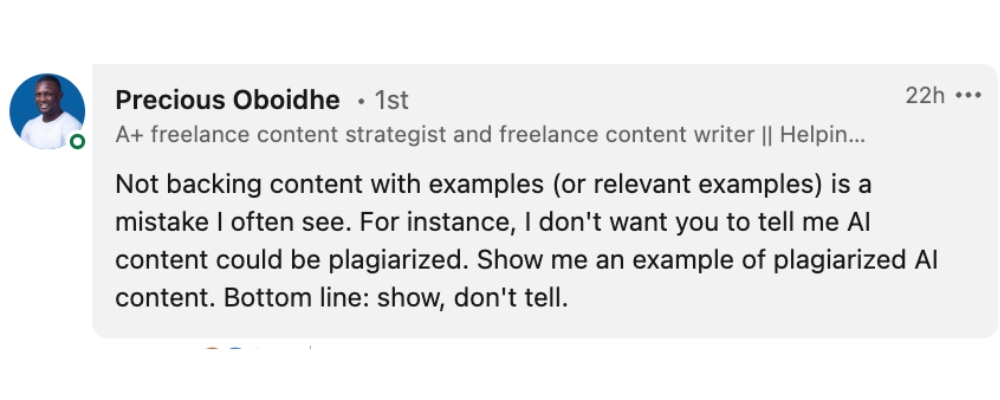
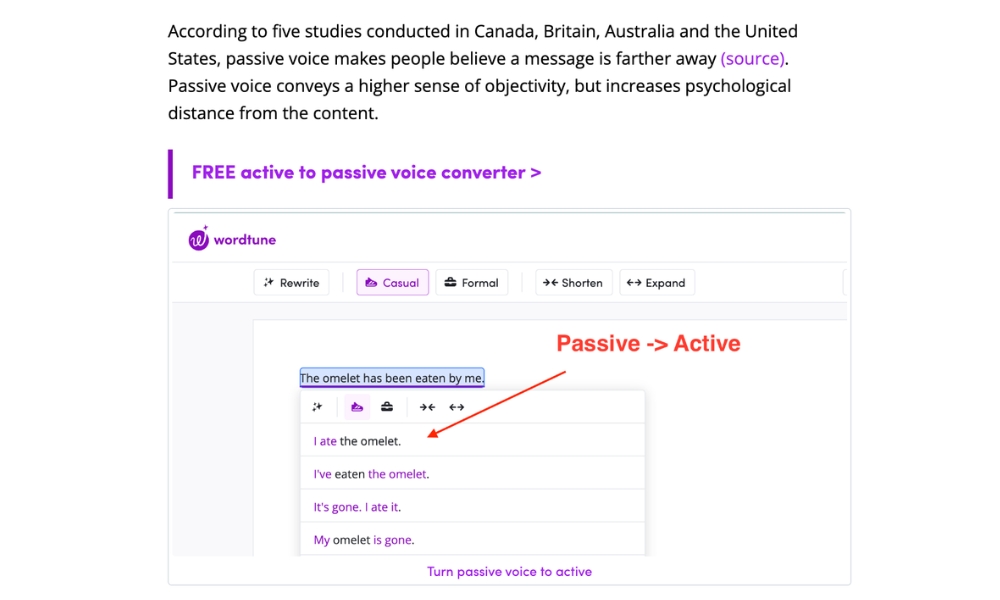
At Wordtune, we really like this technique. For example, in our blog post about converting passive voice to active voice using AI, we clearly emphasized how our AI platform accomplishes this with a before-and-after screenshot.
Now let's move on to our next suggestion.
7. Avoiding the active voice
Which sentence is concise, straightforward, and well-constructed?
John authored the report
or
John authored the report
I surveyed 125 content writers and marketers in my network, and the majority of them favored the initial statement, "John wrote the report."
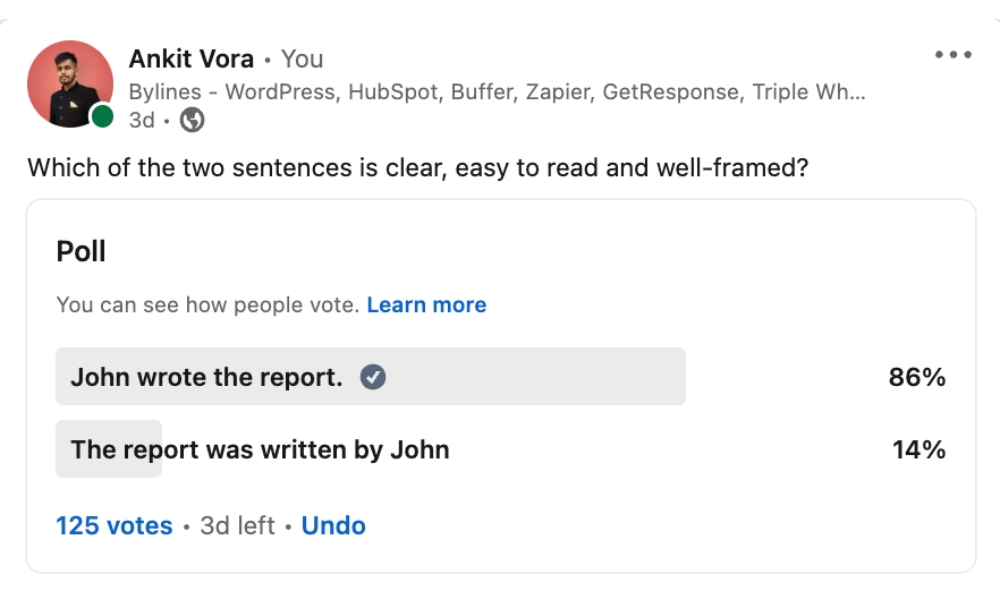
That's because the initial statement is in the active voice. Using the active voice is usually more direct and engaging, whereas the passive voice can be awkward and less clear.
I have observed numerous writers employing passive voice in their writing, which may be quite off-putting for the readers.
Although I'm not implying that you must constantly utilize active voice in your writing, strive to employ it predominantly to improve clarity and interest the reader.
In addition, based on five research, the use of passive voice might create the perception that the content is distant for your readers.
With Wordtune, you have the ability to convert passive voice to active with just one click.
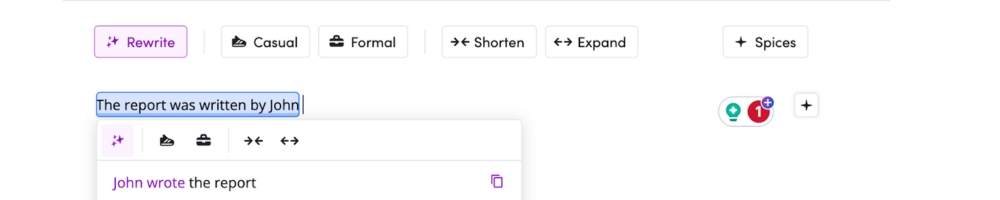
Regardless of the kind of writing, such as a blog post or a research paper, Wordtune can be utilized to refine your writing for better clarity and effectiveness.
8. Excluding practical lessons
Including appropriate illustrations in your material is crucial, but remember to also offer actionable insights.
This is a trap that many writers unintentionally stumble into. After illustrating and clarifying a topic or method, ensure that you are offering readers sufficient information or guidance for them to implement it in their own situation.
Carlos Silva, a Content Writer at Semrush, strongly supports providing practical takeaways.
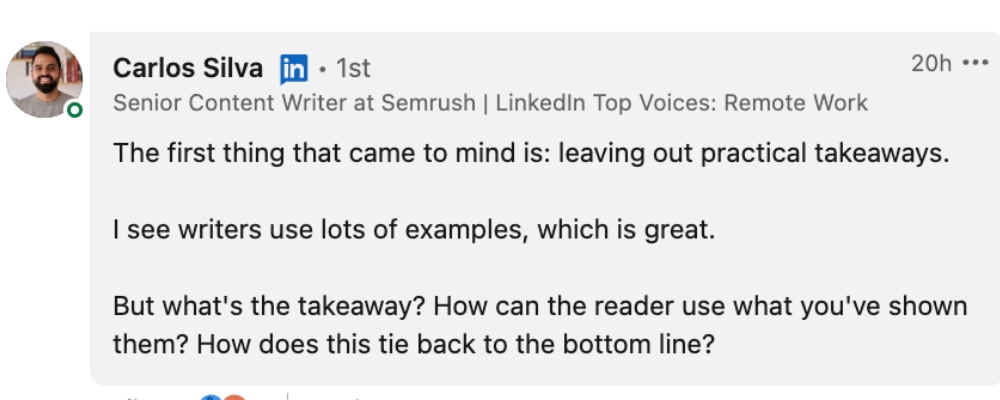
I really like how Semrush does this. In each of their publications, they include comprehensive step-by-step processes demonstrating how to do a task utilizing one of their products.
For instance, in their post on keyword difficulty, they demonstrate to readers how to assess keyword difficulty using their proprietary platform.
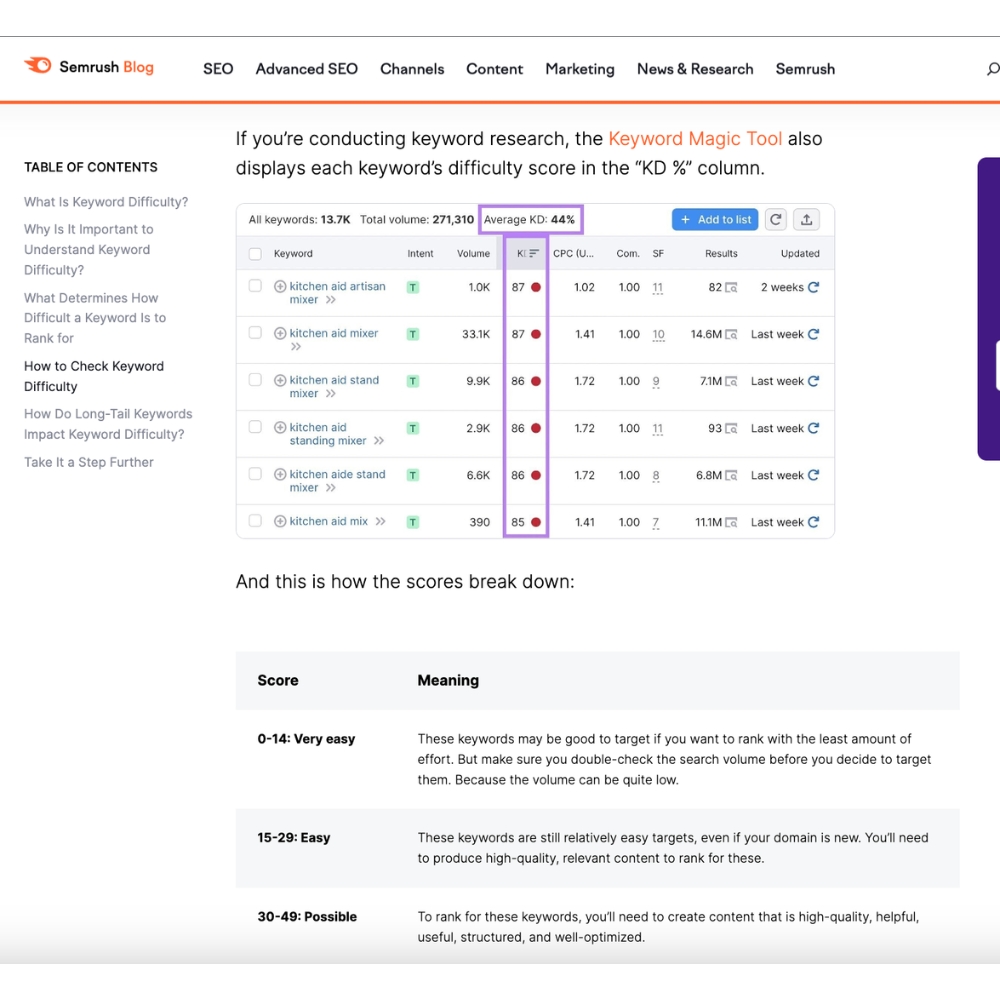
In the same article, they demonstrate how to utilize their knowledge of keyword difficulty in their keyword research and content planning process.
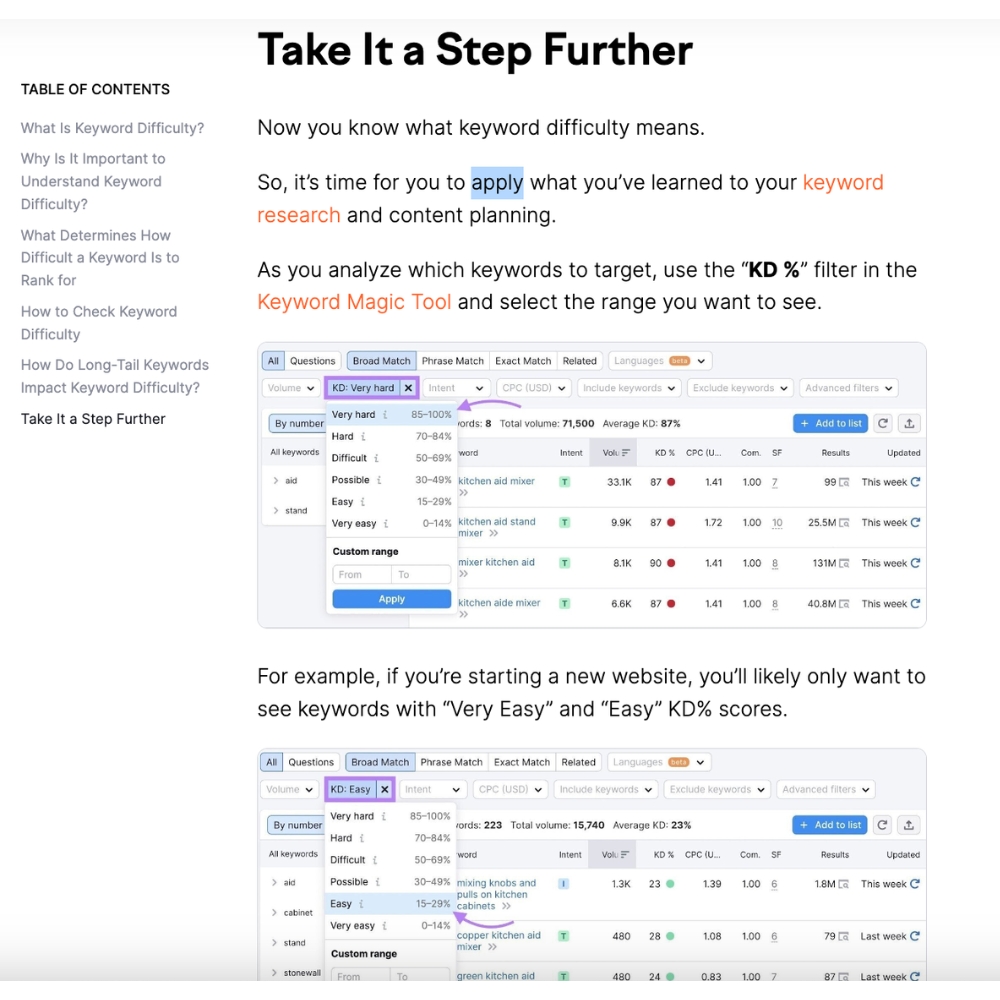
That is a useful lesson to learn from that.
9. Including statistics solely for the purpose of including them
Data analysis is influential.
When used properly, they can enhance the credibility and authority of your content.
However, I have personally witnessed numerous writers including them in their content articles only for the purpose of including them.
Avoid making this error.
For instance, while writing an article about effective video marketing techniques, readers may not be interested in a statistic that says, "The video marketing industry has a global value of $XX.YY billion and is expected to reach $AA.BB billion by 2030."
Lesson: Avoid include unnecessary statistics in your writing.
In addition, another error I have observed many authors do is that they overwhelm certain sections with an overwhelming amount of statistics.
For example, if you are writing an essay about how social media affects online buying behavior, try not to start your introduction like this:
"Based on a study, 80% of internet shoppers regularly utilize social media." In addition, 60% of consumers state that social media has an impact on their purchasing choices. In addition, 90% of internet customers consult social media prior to making a purchase.
Avoid making this error. Instead, support each statistic with background information and examination to offer unique insights to your viewers.
Here is the modified version of the previous example:
"A recent study conducted by a reputable marketing agency indicates that social media significantly influences online shopping." Approximately 80% of internet shoppers using social media on a regular basis.
In addition, the study found that 60% of customers acknowledged that social media influences their purchasing choices. This indicates that most internet customers are swayed by the content they encounter on social media when making purchasing decisions.
As you can observe, the modified version offers additional information and improved examination to back up the data.
You should do likewise.
Additionally, ensure that these statistics are presented in a clear and comprehensible manner.
Dana Nicole, a writer and consultant who collaborates with reputable publications such as Hotjar and Semrush, asserts that complex statistics can significantly impact the effectiveness of your work.

When it comes to statistics, writers often make many errors, with one major mistake being the failure to connect them to the original source.
10. Failing to connect statistics to the originating source
Many writers often fail to connect statistics with their original source.
If you're composing an article about influencer marketing and wish to include some data in the piece, you'll probably go to Google and search for a phrase such as "influencer marketing statistics".
After selecting search, you will get many articles from different sources that include statistics about influencer marketing.
Here's a report from Oberlo on statistics on influencer marketing:
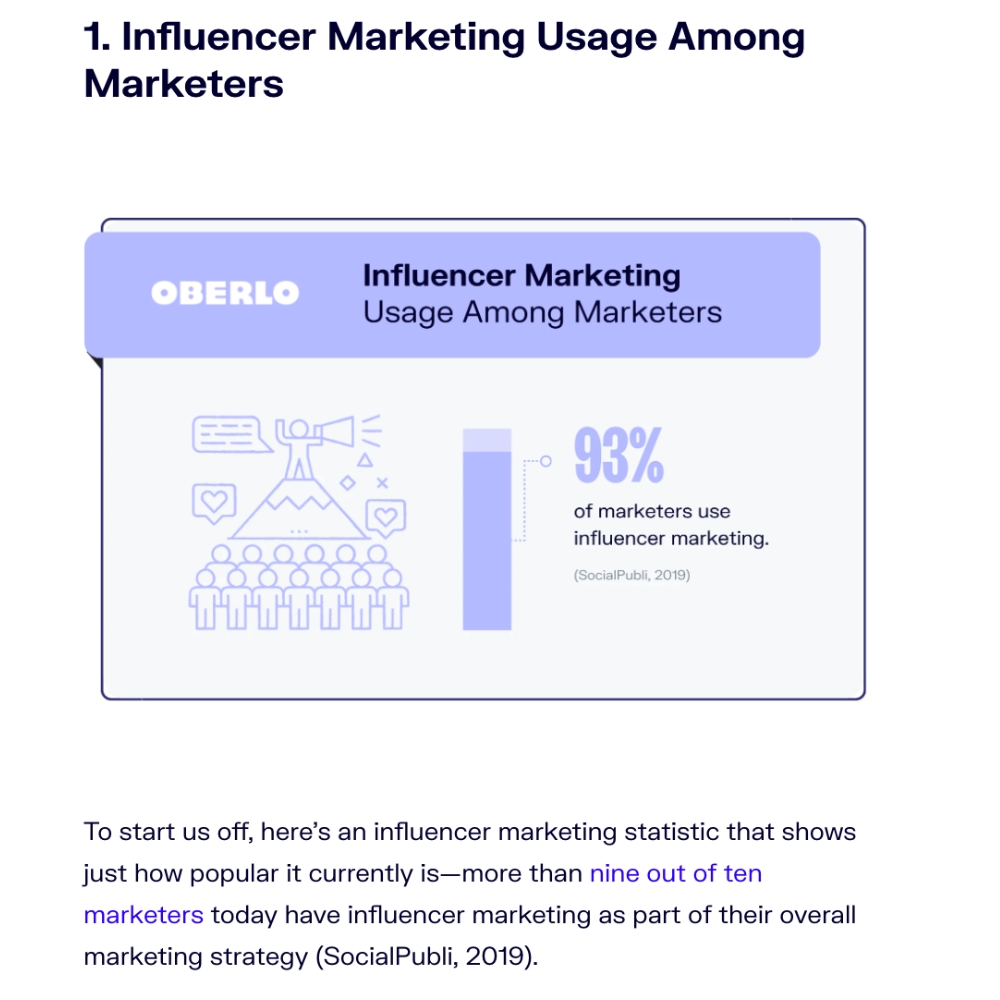
As you can observe, Oberlo has obtained this figure from SocialPubli's 2019 report - it doesn't truly pertain to Oberlo.
Therefore, if you include this data in your post, it is not logical to connect it to Oberlo's paper.
Instead, you should connect it to SocialPubli's report.
One major reason why many publications publish such items is because writers often make the error of linking to them instead of the actual source.
This is because writers unintentionally give more attention to secondary sources instead of acknowledging the primary research or report.
In addition, most articles like these on the internet are misleading (even from reputable sites).
The Oberlo post with the title "10 Influencer Marketing Statistics You Need to Know in 2023" includes statistics from before 2023.
To prevent this, we strongly suggest that you consult research papers and reports from reputable publications. For instance, if you are composing an article about influencer marketing in 2023, look up "influencer marketing report 2023" or a related keyword.
