
Paper Banana
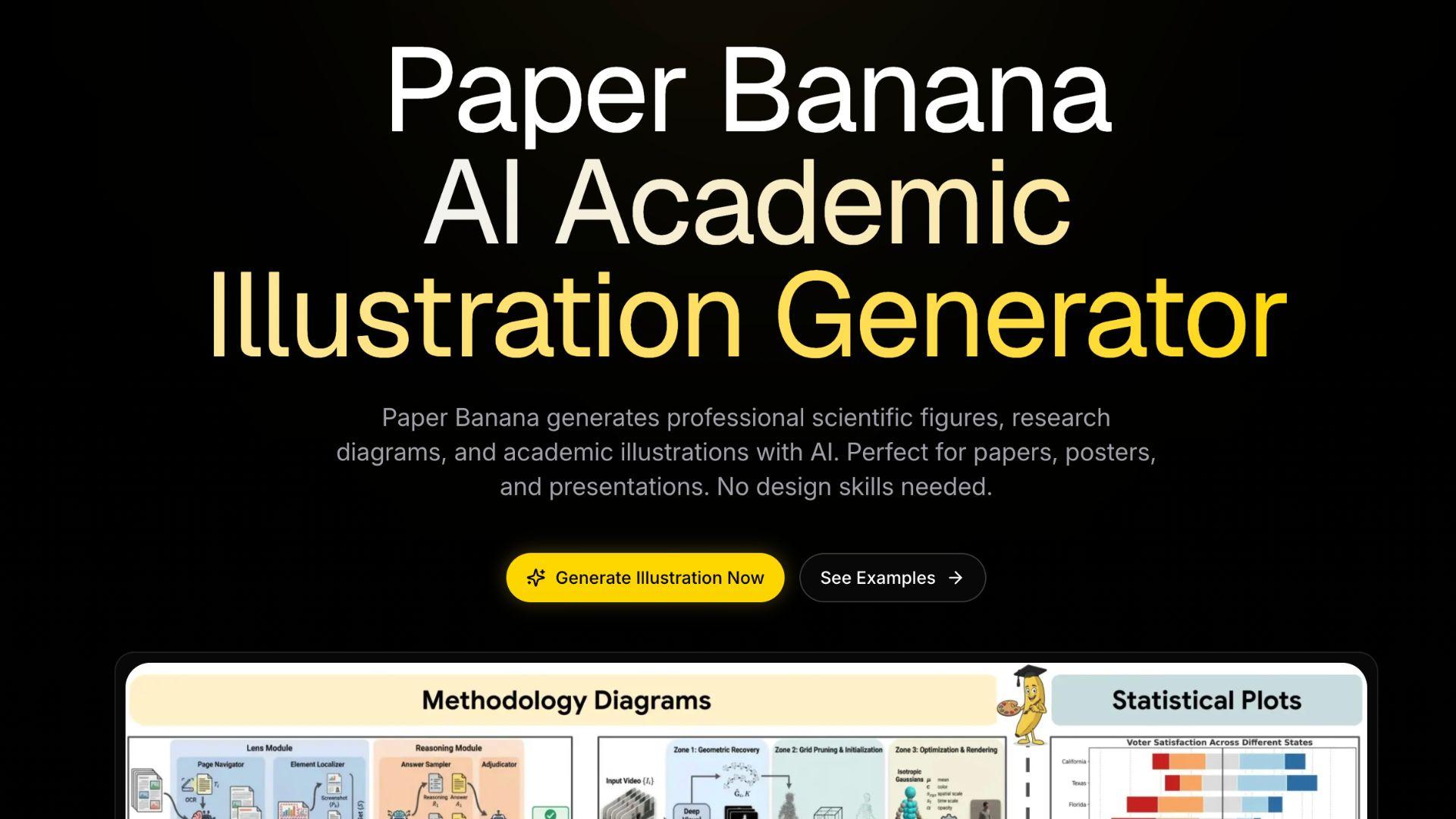

Creating scientific figures is one of the most time-consuming parts of academic work. Researchers often need to turn complex methods, workflows, architectures, experiments, or results into clear visuals for papers, posters, presentations, and grant proposals.
That is where Paper Banana comes in.
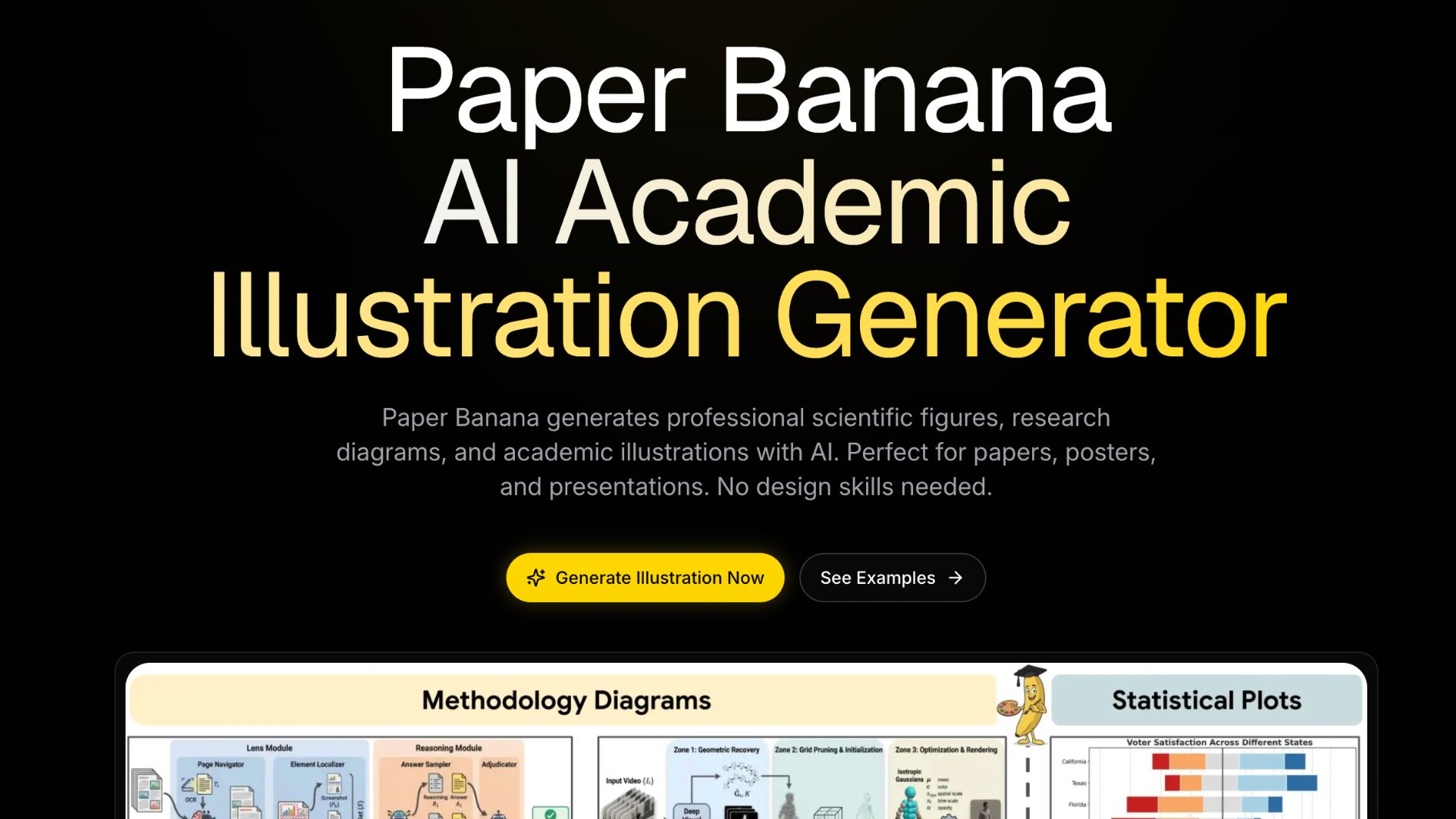
Paper Banana is an AI academic illustration generator designed to help researchers create scientific diagrams, methodology figures, graphical abstracts, posters, and editable scientific visuals from text prompts or research descriptions. Unlike general AI image generators, Paper Banana focuses specifically on academic communication, with support for diagrams, flowcharts, architecture figures, concept maps, schematics, high-resolution output, and editable SVG figures.
In this Paper Banana review, we’ll look at what it does, who it is for, its key features, pricing, pros and cons, alternatives, and whether it is worth using for research visuals.
Quick Verdict
Paper Banana is a useful AI tool for researchers, PhD students, educators, and lab teams who need to create scientific figures faster.
Its strongest value is not just image generation. The real advantage is that Paper Banana focuses on editable academic visuals, especially SVG-based figures that can be revised after generation. That matters because scientific figures usually need several rounds of edits before they are ready for a paper, poster, or presentation.
Paper Banana is best for:
- Research paper figures
- Methodology diagrams
- Scientific workflows
- Graphical abstracts
- Conference posters
- Lab presentations
- Teaching visuals
- Multi-panel academic figures
It is less suitable for users who only need general marketing images, social media graphics, or artistic AI images.
What Is Paper Banana?
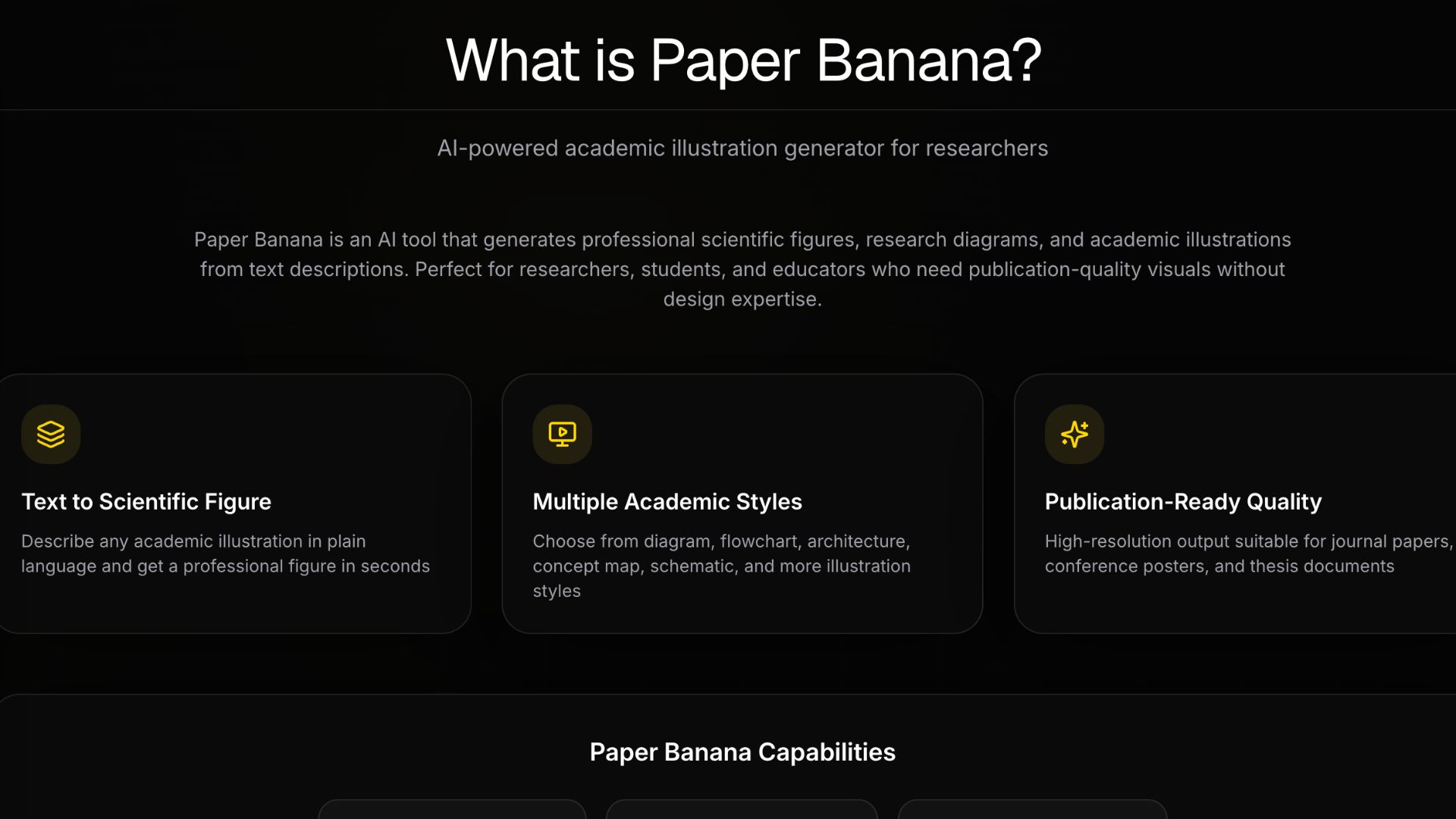
Paper Banana is an AI-powered scientific illustration and academic figure generator. It helps users turn research descriptions, methodology text, paper content, or visual ideas into structured scientific visuals.
The tool supports multiple academic visual formats, including diagrams, flowcharts, architecture figures, concept maps, and schematics. Its official website positions it as a tool for creating publication-ready academic illustrations and high-resolution visuals for journals, conferences, and presentations.
Instead of acting like another generic AI art generator, Paper Banana targets a very specific problem: helping researchers create clear and editable scientific visuals without spending hours in PowerPoint, Illustrator, BioRender, or other design tools.
Who Is Paper Banana Best For?
Paper Banana is best for people who work with research-heavy content and need to communicate complex ideas visually.
Researchers and PhD Students
Researchers can use Paper Banana to create first drafts of methodology diagrams, mechanism visuals, pathway diagrams, architecture figures, and graphical abstracts.
For PhD students, it can be especially useful when preparing thesis chapters, defense slides, journal submissions, or conference posters.
Educators and Academic Presenters
Teachers, lecturers, and academic speakers can use Paper Banana to create visuals that explain scientific processes more clearly.
Instead of building diagrams manually from scratch, they can generate a structured visual draft and then edit it for clarity.
Lab Teams
Lab teams can use the tool to create more consistent figure styles across posters, presentations, and paper drafts. Paper Banana also provides a scientific figure editor for tasks such as editing labels, layers, panels, annotations, charts, and SVG elements.
AI, Biology, Medicine, and Engineering Users
The tool appears especially relevant for fields that rely heavily on diagrams, such as:
- Biology
- Medicine
- Computer science
- Machine learning
- Chemistry
- Engineering
- Neuroscience
- Environmental science
- Data science
Key Features of Paper Banana
1. AI Scientific Illustration Generator
The core feature of Paper Banana is its AI scientific illustration generator.
Users can describe the figure they need in plain text. Paper Banana then generates a scientific visual based on that input. Its official scientific illustration page highlights use cases such as professional research figures, editable SVG output, and reference-based style transfer.
This is useful because many researchers know what they want to explain, but do not always know how to design the visual structure from scratch.
For example, a researcher could use Paper Banana to generate:
- A machine learning model architecture
- A research workflow
- A biological mechanism
- A lab protocol diagram
- A graphical abstract
- A system pipeline
- A concept map
The output may still need editing, but it can help users move much faster from idea to visual draft.
2. Editable SVG Output
One of Paper Banana’s most important features is editable SVG figure generation.
This matters a lot for academic work. A normal AI-generated image may look good at first, but it becomes difficult to use if the labels are wrong, the arrows need adjustment, or the layout needs to match a journal style.
Paper Banana emphasizes structured, editable SVG output. Its scientific illustration page describes a five-step pipeline: Generator, Segmenter, Extractor, Assembler, and Optimizer. The goal is to create SVG figures where elements can be edited after generation.
For academic users, this is a major advantage over standard text-to-image tools.
3. Scientific Diagram Maker
Paper Banana also includes a scientific diagram maker for creating structured research diagrams.
Its diagram maker page connects the workflow across AI figure generation, editable diagrams, and conference posters. This suggests that Paper Banana is not only trying to generate one-off images, but also support a broader research visual workflow.
This feature is useful for researchers who need quick diagrams for:
- Methods sections
- Research workflows
- Lab protocols
- Model architecture
- Experimental design
- Literature review frameworks
- Technical documentation
4. Scientific Figure Editor
Paper Banana includes a scientific figure editor for revising and polishing research visuals.
The editor is designed for creating, editing, annotating, vectorizing, and exporting scientific figures. The official page mentions tasks such as editing labels, layers, panels, microscopy images, chart annotations, and SVG elements. (PaperBanana)
This is important because scientific visuals are rarely finished after one generation. Researchers often need to revise figures after comments from a PI, collaborator, reviewer, or conference organizer.
5. AI Scientific Poster Maker
Paper Banana also offers a scientific poster maker.
This can be useful for PhD students, medical researchers, lab teams, and conference presenters who need to prepare posters quickly. Instead of manually building a poster layout from scratch, users can use AI to create a more structured starting point.
This makes Paper Banana more useful as a research communication tool, not just a figure generator.
6. Academic Visual Styles
Paper Banana supports several types of academic visuals, including diagrams, flowcharts, architecture figures, concept maps, and schematics.
That range matters because research visuals are not all the same.
A machine learning researcher may need a model architecture diagram. A biologist may need a pathway or mechanism illustration. An educator may need a concept map. A PhD student may need a poster figure.
Paper Banana’s academic focus makes it more relevant for these use cases than a general AI image generator.
How Paper Banana Works
Paper Banana works by turning research input into structured scientific visuals.
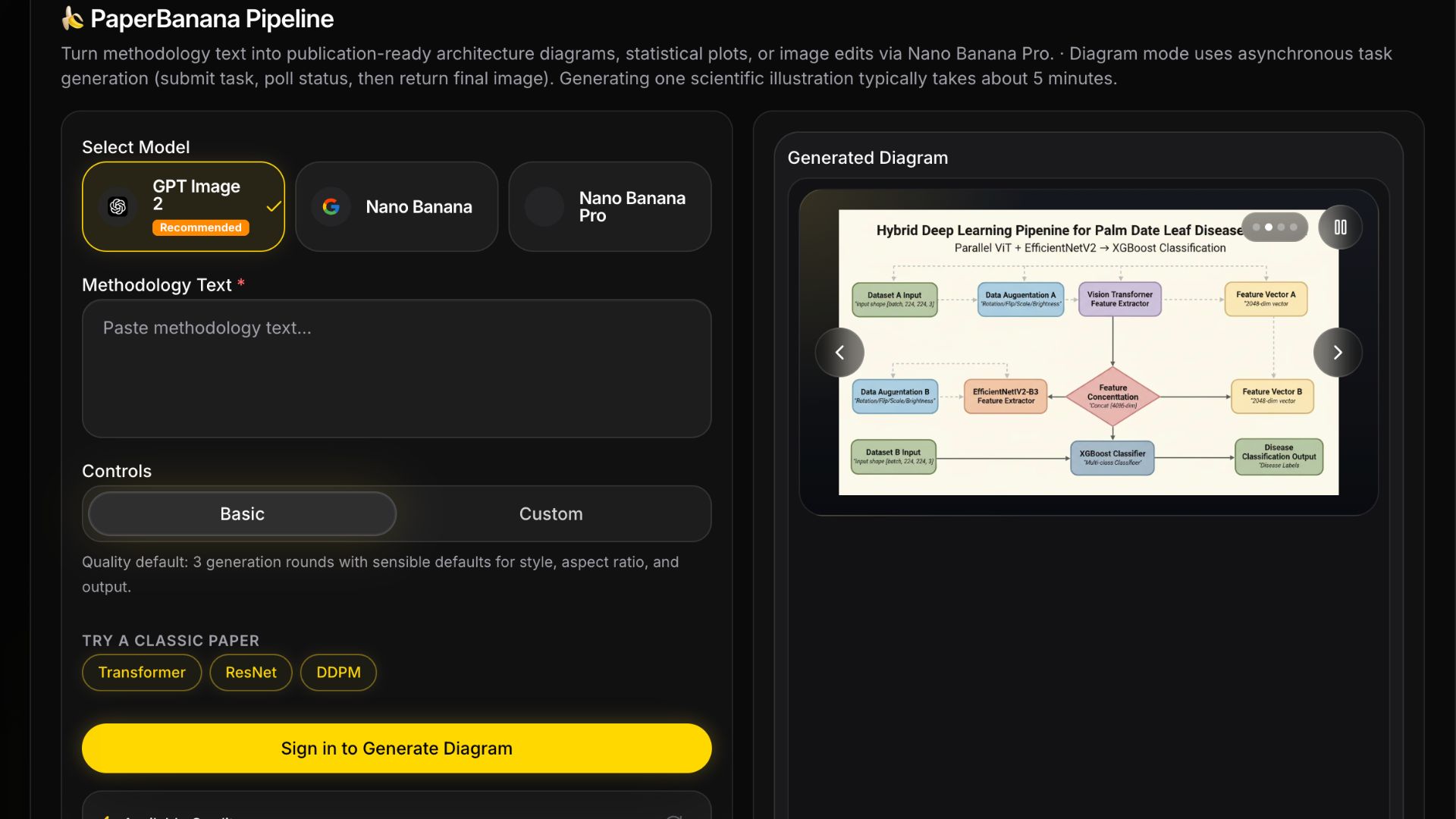
The general workflow looks like this:
- Describe the scientific figure, workflow, or research concept.
- Let the AI generate a visual draft.
- Edit labels, layout, arrows, panels, or colors.
- Export the figure in a usable format.
The broader research project behind PaperBanana describes it as an agentic framework that uses specialized agents to retrieve references, plan content and style, render images, and refine the result through critique. The accompanying paper also introduces PaperBananaBench, a benchmark of 292 methodology diagram test cases curated from NeurIPS 2025 publications.
This research background helps explain why Paper Banana focuses so heavily on academic figures rather than general image generation.
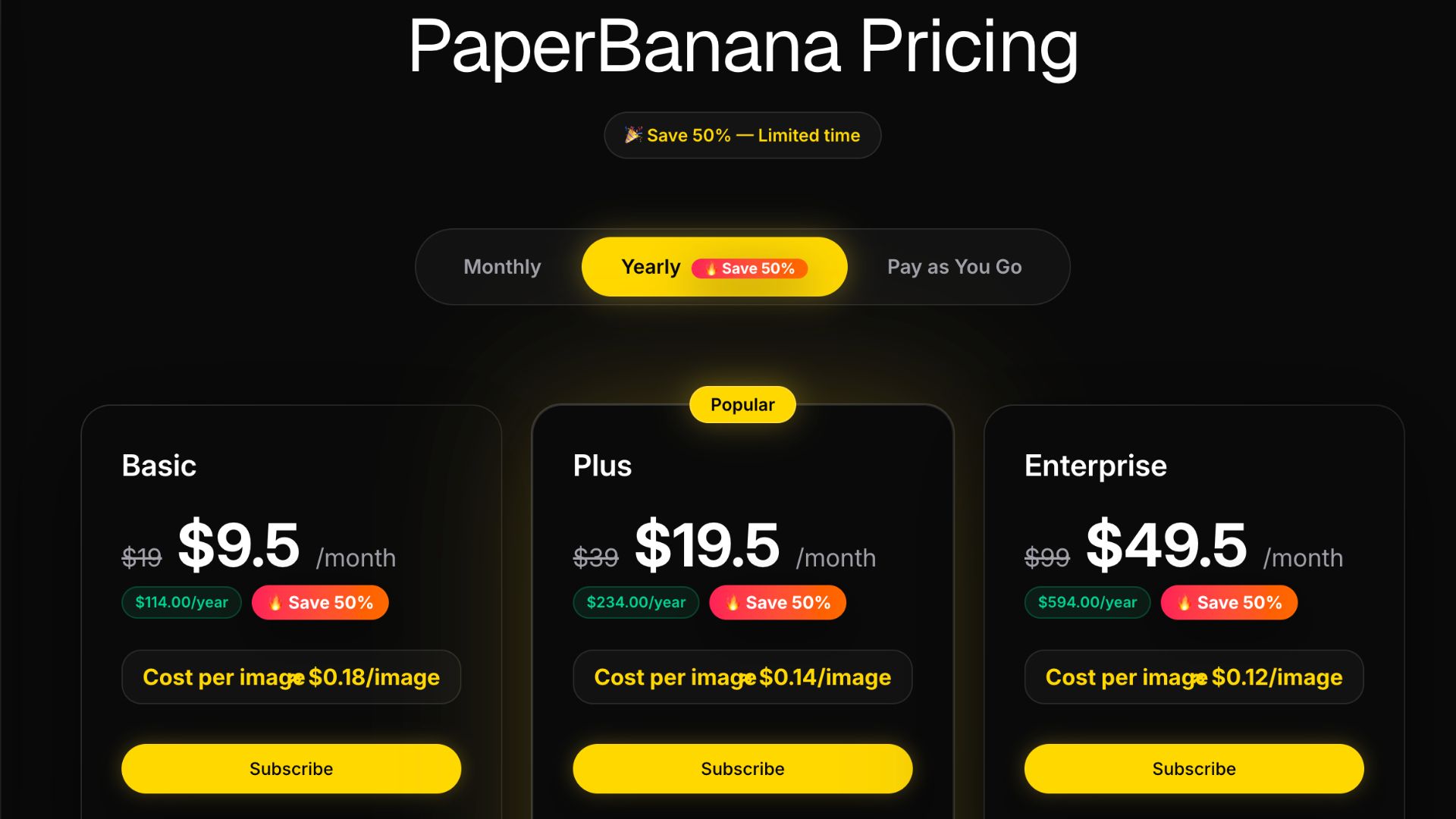
Paper Banana Pricing
Paper Banana’s official website currently says plans start from $19/month for researchers and students who need professional scientific figures.
Because AI tool pricing can change frequently, users should check the official Paper Banana pricing page before subscribing.
In general, Paper Banana is likely most worth considering if you create scientific visuals often enough to justify a paid tool. If you only need one simple diagram, a free design tool may be enough. But if you regularly make paper figures, conference posters, research diagrams, or academic presentations, Paper Banana may save meaningful time.
What Makes Paper Banana Different?
The biggest difference is its academic focus.
Most AI image generators are built for general visuals, art, product images, social content, or marketing assets. Paper Banana is designed around research communication.
That means it focuses on things academic users actually care about:
- Clear labels
- Editable figures
- Diagram structure
- Export quality
- Poster workflows
- Multi-panel figures
- Scientific readability
- Revision after feedback
This makes Paper Banana more practical for researchers than a general AI image generator that only produces a flat final image.
Paper Banana Pros and Cons
Pros
Strong Academic Focus
Paper Banana has a clear niche. It is built for scientific and academic visuals rather than generic image generation.
That makes the product easier to understand and more relevant for researchers, students, educators, and lab teams.
Editable SVG Figures
Editable SVG output is one of its strongest features.
Scientific figures often need revisions. Labels may need to change. Arrows may need to move. A figure may need to match a journal’s style. Editable SVG makes the workflow more practical than using a flat AI-generated image.
Useful for Paper and Poster Workflows
Paper Banana supports research diagrams, scientific illustrations, figure editing, and poster creation.
This gives it more workflow value than a simple image generator.
Good for First Drafts
Paper Banana can help users move from a rough idea to a visual draft quickly.
Even if the output needs editing, it can save time compared with starting from a blank slide.
Built for Researchers
Paper Banana’s positioning is very clear. It is not trying to be Canva, Midjourney, or DALL·E. It is trying to help academic users create research visuals faster.
That specific focus is one of the tool’s biggest advantages.
Cons
Scientific Accuracy Still Needs Human Review
AI-generated scientific visuals can still misrepresent relationships, labels, mechanisms, or methods.
This is not a small issue. Scientific figures must be accurate. Researchers should always check every figure carefully before using it in a paper, poster, or presentation.
Recent research on scientific illustration generation also shows that even advanced text-to-image systems can struggle with text rendering, semantic precision, reasoning enrichment, and balancing richness with accuracy.
Not a Full Replacement for Expert Design
Paper Banana can help generate and edit visuals, but complex journal figures may still require manual polishing in tools like Illustrator, Inkscape, PowerPoint, or BioRender.
It is best used as a visual assistant, not a complete replacement for design judgment.
Output Quality May Vary by Field
A simple workflow diagram may be easier to generate than a complex molecular pathway, medical mechanism, or multi-panel experimental figure.
Users should test it with their own field-specific content before relying on it for important submissions.
Academic Publishing Policies Still Matter
Researchers should also consider publication rules before using AI-generated visuals. A recent paper on AI-generated figures in academic publishing notes that publisher policies can vary and that concerns include reproducibility, attribution, and visual misinformation.
In practice, this means users should disclose AI assistance when required and carefully verify all scientific content.
Paper Banana Alternatives
Paper Banana competes with several types of tools, depending on the user’s goal.
BioRender
BioRender is one of the most popular tools for creating biology and medical illustrations. It has a large icon library and is widely used in life sciences.
Paper Banana may be more useful for users who want AI-generated first drafts from text, while BioRender may still be stronger for highly controlled biology-specific visuals.
Canva
Canva is useful for posters, slides, and simple diagrams. However, it is not built specifically for scientific figure generation or editable academic SVG workflows.
Canva may be better for general presentation design. Paper Banana is more focused on scientific figures.
PowerPoint
Many researchers still create figures in PowerPoint because it is familiar and flexible.
Paper Banana can speed up the first draft, but PowerPoint may still be useful for final manual adjustments.
Adobe Illustrator
Illustrator gives maximum control over professional vector figures, but it has a steeper learning curve.
Paper Banana is easier for users who want AI assistance and do not want to design everything manually.
General AI Image Generators
Tools like Midjourney, DALL·E, or Stable Diffusion can generate impressive visuals, but they are not optimized for scientific accuracy, editable labels, academic diagrams, or publication workflows.
For artistic visuals, they may be stronger. For research diagrams, Paper Banana is more purpose-built.
Is Paper Banana Worth It?
Paper Banana is worth trying if you regularly create scientific figures, research diagrams, academic posters, or presentation visuals.
It is especially useful if you often struggle with the first step: turning a complex research idea into a clear visual structure. The tool can help create a starting point, then let you edit and refine the result.
However, it should not be treated as a fully automatic publication tool. Researchers still need to check accuracy, revise labels, simplify layouts, and confirm that the figure matches the actual science.
For academic users, Paper Banana is best seen as a research visual assistant, not a replacement for scientific judgment.
Final Verdict
Paper Banana is a promising AI tool for academic visual creation. Its focus on scientific illustrations, editable SVG figures, research diagrams, and poster workflows makes it more useful for researchers than general AI image generators.
The biggest strength is editability. Scientific figures need revision, and Paper Banana’s SVG and figure-editing workflow addresses that problem directly.
If you are a researcher, PhD student, educator, or lab member who often creates diagrams and posters, Paper Banana can save time and help you produce cleaner first drafts.
Overall rating: 8/10
Paper Banana is not perfect, and users still need to verify scientific accuracy. But for creating editable academic visuals faster, it is a strong tool worth testing.
Paper Banana Launch embeds
Use website badges to drive support from your community for your AI Journey Launch. They're easy to embed on your homepage or footer.


GALLERY
Featured image represents the contents
Empowering You With AI JOURNEY Discover, Learn, Master!
Get the latest on AI!
Subscribe for helpful tips, updates, and exciting news delivered straight to your inbox. Stay in the loop and level up your skills. Join us today!
Categories
Resources
Copyright © 2024 AI Journey LLC. All rights reserved.