
HiAPI
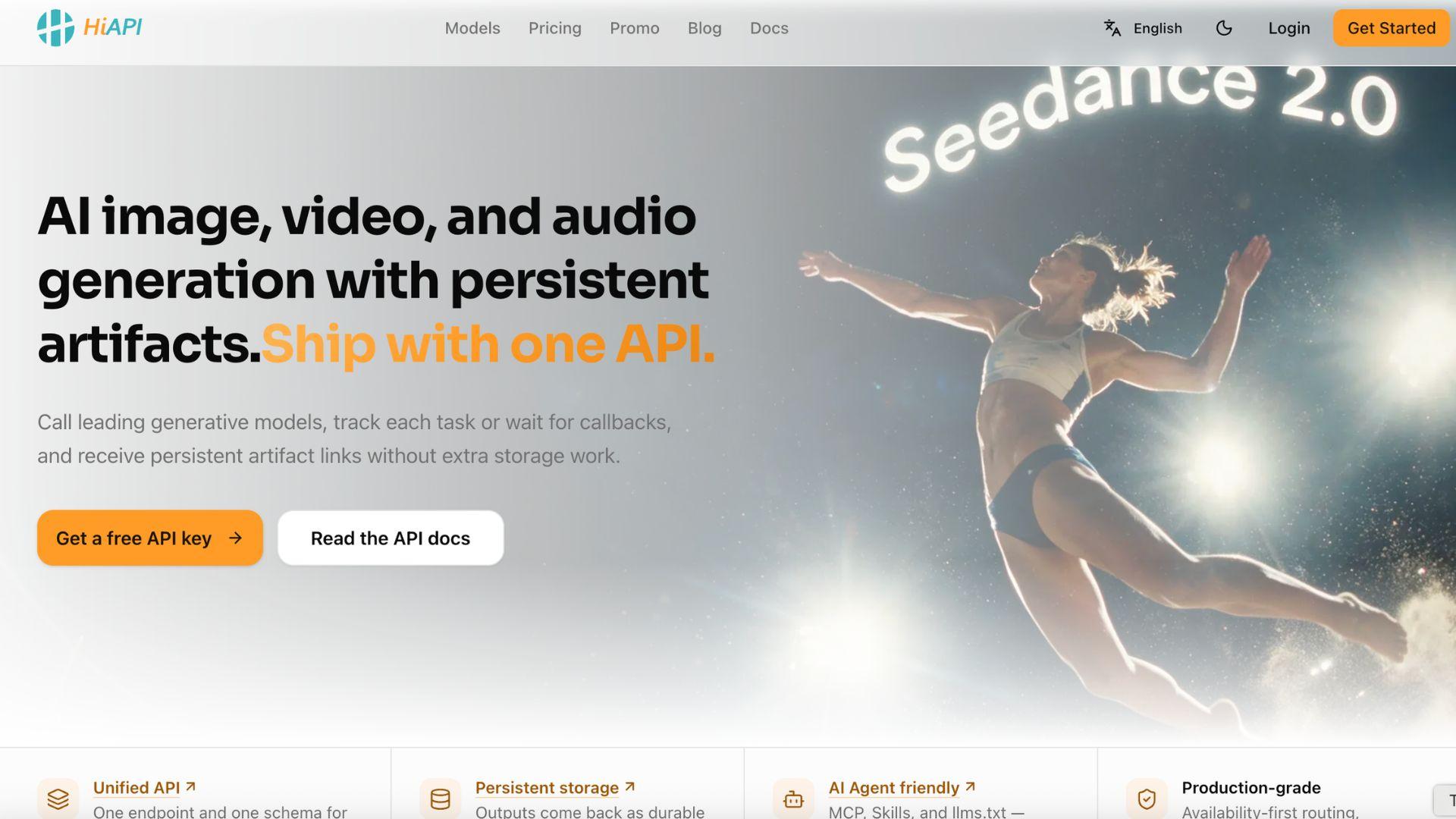

HiAPI Review: One API for AI Image, Video, and Audio Generation
HiAPI is a unified generative media API that gives developers access to multiple AI image, video, and audio models through one account. Instead of integrating separately with each provider, teams can submit generation jobs through a shared task-based interface.
The platform targets developers building creative tools, SaaS products, media automation systems, and AI agent workflows. Its main benefits include consolidated billing, asynchronous task management, callbacks, and persistent output links.
Editor’s note: This review is based on HiAPI’s public website, documentation, pricing information, and privacy policy. It is not based on a production-scale test.
What Is HiAPI?
HiAPI is an API gateway for generative media. It supports workflows such as text-to-image, image-to-image, text-to-video, image-to-video, music generation, and other audio tasks.
As of July 2026, featured models include GPT Image 2, Nano Banana 2, FLUX 1.1 Pro, Seedream 5.0 Pro, Seedance 2.0, and MiniMax Music 2.6. Availability may change, so developers should check the live catalog before building around a particular model.
HiAPI does not develop the underlying models. It provides an intermediary layer for model access, routing, billing, task tracking, and generated outputs.
Key Features
Unified generation API
Image, video, and audio jobs are submitted through the same asynchronous endpoint:
Developers select a model, provide the required inputs, and receive a task that can be monitored until completion. This reduces the need to maintain separate authentication systems, SDKs, and billing accounts.
However, a unified endpoint does not mean identical model parameters. Inputs can still vary by model, resolution, aspect ratio, reference media, and generation mode. Applications supporting several models may need their own adapter layer.
Callbacks and task tracking
Media generation can take longer than a standard text request. HiAPI supports task tracking and callbacks, allowing an application to receive a notification when a job reaches its final state. This is especially useful for video, music, and other long-running tasks.
Persistent artifact links
HiAPI can return generated media through what the company describes as persistent artifact links. This may help developers move assets between applications without immediately building a separate storage pipeline.
Before using the feature in production, teams should confirm retention periods, storage charges, access controls, and deletion procedures. “Persistent” should not automatically be interpreted as permanent storage.
Playground and agent resources
HiAPI provides Playground access on supported model pages, allowing users to test parameters and review estimated costs before integrating. It also publishes code examples, model guides, an llms.txt documentation index, agent skills, and MCP integration options.
HiAPI Pricing
HiAPI uses pay-as-you-go billing. Users purchase USD-denominated credit, which the company says does not expire.
As of July 2026, the English pricing page lists $5, $10, $50, and $100 top-up options. New users are advertised as receiving $1 in trial credit, potentially enough for up to 50 images. The actual output depends on the selected model and settings.
Image models are generally charged per generated image, while video models are often billed per second. Audio pricing may depend on characters, duration, or another model-specific unit. Prices vary substantially across models, routes, resolutions, and quality levels.
Users should therefore treat estimates such as “250 images for $5” as examples rather than guarantees. Check the live pricing page before launching a production workload.
Privacy and Data Handling
According to HiAPI’s privacy policy, the service collects account information, technical data, model usage, API call logs, and request logs. API logs are retained for 90 days by default.
However, the policy does not clearly define whether request logs include full prompts, uploaded reference media, or generated outputs. It also provides limited public detail about upstream model processing, data residency, zero-retention options, security certifications, or service-level commitments.
Organizations handling confidential, regulated, or customer-owned content should request further documentation before uploading sensitive material.
Pros and Cons
Pros
- One API key for multiple media models
- Unified asynchronous task workflow
- Pay-as-you-go billing
- Free trial credit
- Callbacks for long-running tasks
- Optional persistent output links
- Playgrounds and agent-oriented resources
Cons
- Model inputs are not completely standardized
- Pricing and model availability can change
- Limited independent user feedback
- Public company and infrastructure information is limited
- Unclear handling of prompts and media within request logs
- No enterprise security certifications identified in the reviewed materials
- Commercial rights may depend on the underlying model provider
Final Verdict
Based on its published features, HiAPI appears useful for prototyping and multi-model media workflows. Its unified endpoint, callbacks, flexible credit system, and persistent links can reduce the engineering work required to test several generative models.
The trade-off is that HiAPI becomes another layer between an application and the underlying providers. Teams should verify reliability, pricing, data handling, and model-specific usage rights before using it for production or sensitive workloads.
HiAPI Launch embeds
Use website badges to drive support from your community for your AI Journey Launch. They're easy to embed on your homepage or footer.


Empowering You With AI JOURNEY Discover, Learn, Master!
Get the latest on AI!
Subscribe for helpful tips, updates, and exciting news delivered straight to your inbox. Stay in the loop and level up your skills. Join us today!
Categories
Resources
Copyright © 2024 AI Journey LLC. All rights reserved.