





Are you enhancing your scholarly study with the use of AI tools? This indicates that you are making progress toward customizing your educational experience. These days, AI has streamlined learning and research procedures, simplifying the educational process for academics and students. Let's look at some incredible AI resources to support your studies.
Today's scholars and students are able to obtain greater information because of all the AI tools available. These days, there are a lot of articles available online, but choosing one can be difficult. AI tools can make students' work easier as they dedicate endless hours to improving their academic study.
Therefore, automating some of their boring duties is crucial to leveraging and gaining greater expertise for writing.
The top 12 AI tools that can support your superior academic research are covered in this article.
These artificial intelligence technologies will assist you in both information gathering and utilizing your subject-matter expertise.
Let's delve further into the subject.
1. The Google Scholar

Google Scholar should be at the top of the list for students and academics looking for better information about academic research. You may quickly stay current on the most recent research papers, articles, conference papers, theses, and scholarly literature with this application. It also makes it simple for academics to locate pertinent papers and citations.
Most significantly, it is an excellent tool and a vital resource due to its straightforward, user-friendly interface.
2. Scite
Scite is one of the most widely used AI-powered research tools for academics, capable of instantly improving any kind of academic work. Users can conduct more thorough research on academic articles and examine citations with the use of its own machine learning and natural language processing.
Additionally, Scite enables scholars such as yourself to evaluate the reliability in any specific reference environment. It aids in assessing the caliber and significance of the study. Additionally, it offers improved metrics and visuals to help comprehend the citation landscape of a certain publication or subject. Try this tool out now if you haven't used it before.
3. Trinka
Because it assists with grammar and language correction for academic and technical writing, it is one of the most widely utilized AI tools for academics and students. With its more than 3,000 grammatical checks, tone, and style modifications, it aids academic writers in producing error-free theses and projects.
With Trinka, you may easily record scientific discoveries and write in a more technical tone and manner. Trinka is therefore the most promising instrument for academic research since it facilitates improved documentation of research papers and white papers.
4. Elicit
One of the simplest AI technologies available on the market for processing knowledge is Elicit. This tool allows you to plan and carry out qualitative research. A researcher can utilize this technology to automate tasks such as textual data analysis and the identification of important themes, attitudes, and patterns.
To effectively interpret data, Elicit can also be used to infer summaries and visuals. Elicit is a valuable resource for researchers as it facilitates deeper insights and well-informed decision-making.
5. Scholarcy
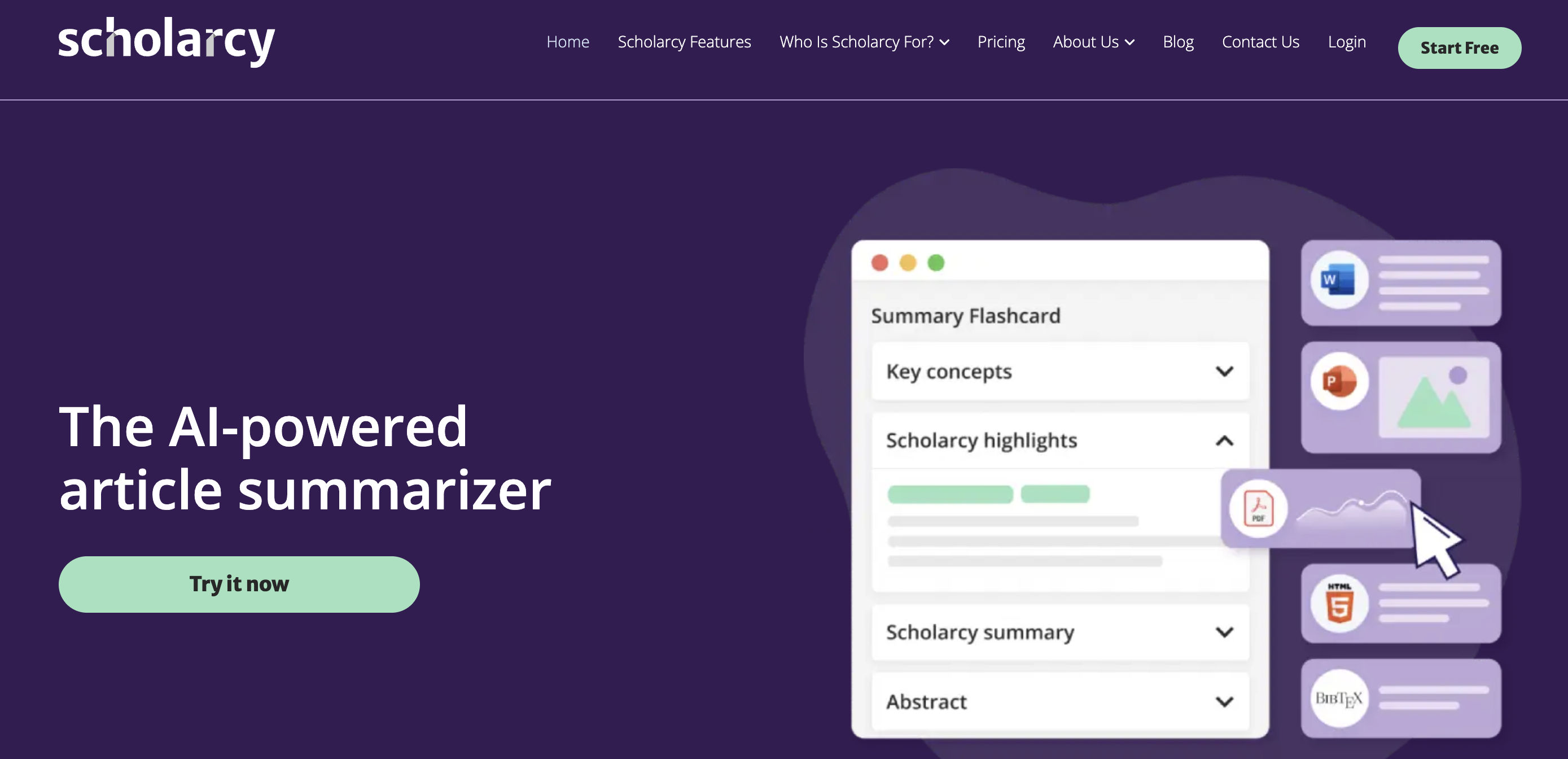
With the use of artificial intelligence (AI), Scholarly enhances scholarly research by automating the reading, summarizing, and information extraction processes. It can assist you in understanding the key ideas and in identifying the figures, tables, and references from the articles.
Furthermore, this application has citation extraction capabilities that let users arrange and reference the study sources. Additionally, it offers the literature review procedure, which helps you to save a significant amount of time and energy.
6. Knewton
Users can receive individualized instructional information from Knewton thanks to its usage of artificial intelligence and machine learning technologies. The tool's instructional content can be customized to meet the demands and learning preferences of each user. This is a convenient one-stop shop for academic learning resources.
Users of Knewton can also examine data on student performance, progress, and areas of strength and weakness. Knewton aims to increase engagement by utilizing the advantages of AI, making it one of the top online learning systems.
7. IBM Watson
For scholarly study, IBM Watson offers a range of AI-powered resources. Watson Natural Language Understanding and Watson Discovery are features exclusive to this tool. This program has built-in functions that facilitate the research process, such as sentiment analysis, data extraction, and language processing. This tool can assist you in extracting insights from unstructured data in this manner.
8. Tableau
Tableau is an effective program that facilitates data analysis for users. Tableau's drag-and-drop interface makes it simple for users to explore, comprehend, and recognize data, patterns, trends, and outliers. It can handle sophisticated maps, treemaps, heat maps, and all kinds of graphs and charts.
Because of its comprehensive data visualization features and user-friendly interface, it is a popular choice among enterprises, researchers, and data analysts in several industries.
9. Semantic Scholar
An AI academic search engine called Semantic Scholar only returns pertinent research articles. It is applied in the biomedical sciences, neuroscience, and computer science. Additionally, its machine learning and natural language processing methods aid in the content analysis.
This application can assist researchers with tracking scientific publications, finding and navigating pertinent material, and visualizing citations. It is highly suggested to utilize its extensive search capabilities and citation analysis functions. Its AI-driven methodology makes it possible to produce and distribute excellent scientific content quickly.
10. Consensus
One of the best AI methods for detecting real scientific findings is consensus. You can never go wrong with research information when using this AI tool because they only obtain their data from published sources. This makes the process of comprehending the topic and properly documenting it quite dependable and simple.
Additionally, this AI technology meticulously examines every issue (using peer-reviewed research) in order to deliver a real, well-researched article that will ease your stress. You have to give it a try today if you haven't already.
11. Mendeley

Mendeley is an easy-to-use AI application that lets you correctly arrange, share, and cite all of your research articles in one location. It facilitates easier document annotation, improved bibliography creation, and PDF organization.
Researchers can also work together on projects with this tool and find publications that are relevant to their interests. Mendeley is a useful tool because of its robust capabilities and ability to be integrated into academic procedures. It facilitates the optimization of your administration and improves cooperation among academics.
12. Zotero
Zotero is a personal research assistant and management tool driven by artificial intelligence. It is specifically made to make collecting, organizing, annotating, citing, and sharing research documents easier for academics and researchers. With the aid of this program, you may automatically extract metadata from sources and configure each and every collection.
With Zotero, you can structure your work and align your style with a publication thanks to its 10,000 citation styles. Additionally, references and bibliographies are necessary to update text and provide you with accurate information in your Word or Google Doc project.
Conclusion
Instead of viewing AI tools and apps as a danger, consider how they might improve your learning process when it comes to creativity. AI is revolutionizing every industry today since it can provide you with vast amounts of information quickly. Thus, as a scholar or researcher in academia, make use of them to expedite your work and relieve yourself of needless tension. As such, you can enhance your expertise to generate superior theses or projects.
